In dealing with socio-economic issues of development, what kind of collaboration between government, NGOs and private sector would be most productive?
In dealing with socio-economic issues of development, what kind of collaboration between government, NGOs and private sector would be most productive?
Subject: Indian Society
Economic liberalization and globalization have necessitated a collaborative approach between government, NGOs, and private sector to address complex socio-economic challenges.
The success of initiatives like Swachh Bharat Mission demonstrates the power of multi-stakeholder partnerships in achieving developmental goals.
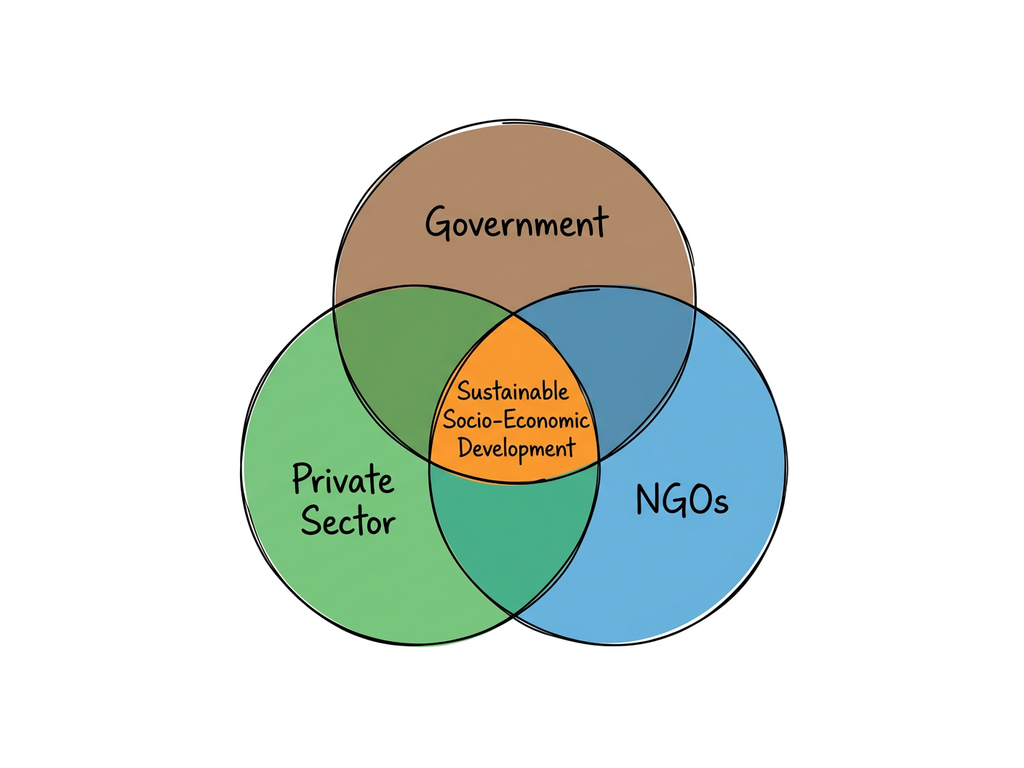
Sustainable Socio-Economic Development
Models of Productive Collaboration
-
Public-Private Partnerships (PPPs): These leverage private sector investment and expertise for public infrastructure and services, with the government providing regulatory support. Examples include the National Skill Development Corporation and Swachh Bharat Abhiyan, where businesses fund projects and NGOs handle community engagement.
-
Co-funding and Joint Programming: Pooling resources and expertise, all three actors can co-design and co-implement projects. For instance, in sanitation and health, the government sets targets, companies provide funding, and NGOs conduct awareness and implementation.
-
Capacity Building Initiatives: Private sector and NGOs work together to train communities or enhance NGO capabilities, ensuring sustainability and empowerment.
-
Collective Impact Platforms:
Forums like NITI Aayog’s Development Dialogues bring together all stakeholders to share best practices, align strategies, and scale up successful models.
Rationale for Multi-Stakeholder Collaboration
-
Resource Optimization: Combines government scale, private sector funding, and NGO grassroots reach for efficient resource use.
-
Inclusive Development: Ensures marginalized voices are heard and benefits reach the last mile.
-
Innovation and Sustainability: Private sector drives innovation; NGOs ensure community ownership and long-term impact.
-
Holistic Solutions: Tackles interconnected issues—poverty, health, education—through coordinated action.
The most effective approach to socio-economic development is a multi-stakeholder partnership where government, NGOs, and private sector collaborate through PPPs, joint programming, and integrated models. This ensures scale, inclusivity, innovation, and sustainable impact in addressing India’s developmental challenges.
Answer Length
Model answers may exceed the word limit for better clarity and depth. Use them as a guide, but always frame your final answer within the exam’s prescribed limit.
Evaluate this PYQ now
Write your answer & evaluate in just 60 seconds




500+ students evaluated
Model Answers from
- 2024Indian Society15 MarksView Answer
Critically analyze the proposition that there is a high correlation between India's cultural diversities and socio-economic marginalities.
- 2024Indian Society15 MarksView Answer
Globalization has increased the urban migration by skilled, young, unmarried women from various classes. How has this trend impacted upon their personal freedom and relationship with family?
- 2024Indian Society15 MarksView Answer
Despite comprehensive policies for equity and social justice, underprivileged sections are not yet getting the full benefits of the affirmative actions envisaged by the constitutions. Comment
- 2024Indian Society15 MarksView Answer
What is regional disparity? How does it differ from diversity? How serious is the issue of regional disparity in India?
- 2024Indian Society10 MarksView Answer
Intercaste marriages between castes which have socio-economic parity have increased, to some extent, but this is less true of interreligious marriages. Discuss.
- 2024Indian Society10 MarksView Answer
Distinguish between gender equality, gender equity and women's empowerment. Why is it important to take gender concerns into account in programme design and implementation?
Model Answers by Subject


Crack UPSC with your
Personal AI Mentor
An AI-powered ecosystem to learn, practice, and evaluate with discipline