Discuss about the vulnerability of India to earthquake related hazards. Give examples including the salient features of major disasters caused by earthquakes in different parts of India during the last three decades.
Discuss about the vulnerability of India to earthquake related hazards. Give examples including the salient features of major disasters caused by earthquakes in different parts of India during the last three decades.
India faces significant earthquake vulnerability due to its location at the convergence of major tectonic plates. According to the Bureau of Indian Standards (BIS), approximately 59% of India's landmass lies in moderate to high seismic risk zones.
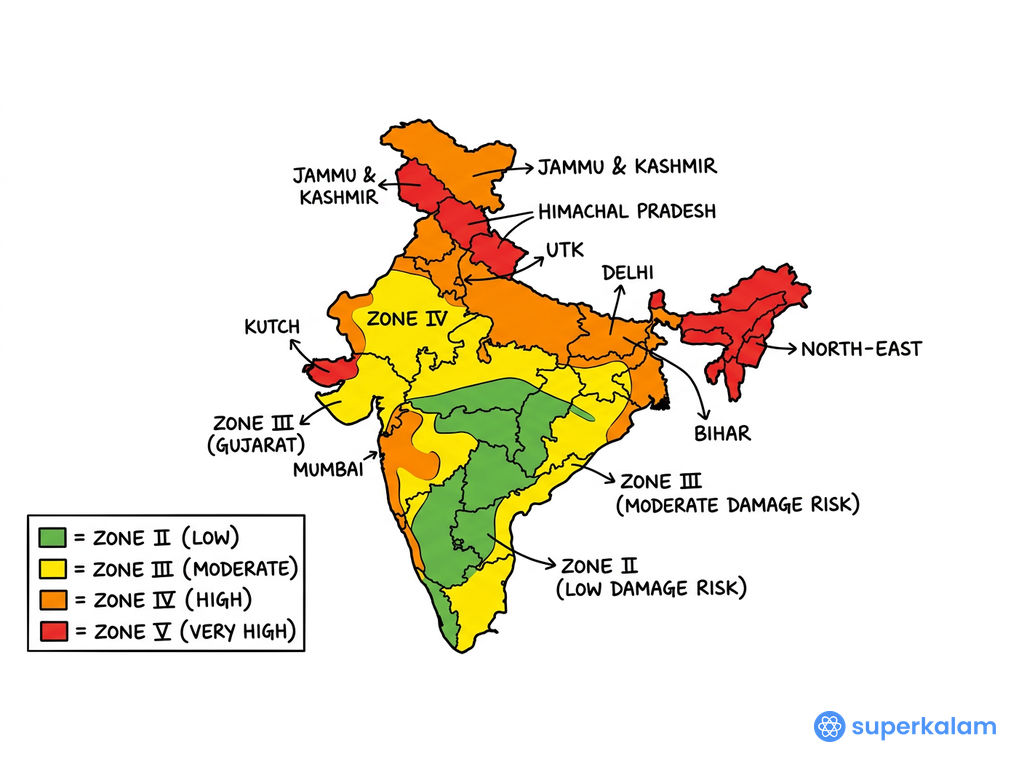
India Seismic Zones Map Based on BIS
Geological and Tectonic Vulnerability of India
- Plate Tectonics: India's position at the Indo-Australian and Eurasian plate boundary creates continuous seismic stress, particularly along the Himalayan belt
- Seismic Zonation: Country divided into four seismic zones (Zone II-V), with Zone V covering northeastern states, parts of Kashmir, and Kutch region experiencing highest risk
- Fault Systems: Active fault lines like Main Boundary Thrust (MBT), Main Central Thrust (MCT), and Himalayan Frontal Thrust increase earthquake frequency
- Geological Diversity: Varying rock formations from ancient Deccan Plateau to recent Himalayan formations create differential seismic responses
- Population Density: Over 40 crore people live in earthquake-prone areas, amplifying vulnerability risks
Major Earthquake Disasters and Their Salient Features (1993-2023)
| Earthquake | Year | Magnitude | Deaths | Key Features |
|---|---|---|---|---|
| Latur, Maharashtra | 1993 | 6.2 | 9,748 | First major intraplate earthquake; revealed rural housing vulnerability |
| Bhuj, Gujarat | 2001 | 7.7 | 20,023 | Costliest earthquake; led to building code reforms |
| Kashmir | 2005 | 7.6 | 1,350+ | Cross-border disaster; international cooperation required |
| Sikkim | 2011 | 6.9 | 111 | Affected Nepal-India border; landslide triggers |
Specific Disaster Analysis
Bhuj Earthquake (2001): Destroyed over 1 million structures, caused ₹20,000 crore economic loss. Led to establishment of Gujarat State Disaster Management Authority (GSDMA) and mandatory seismic-resistant construction.
Latur Earthquake (1993): Exposed vulnerability of traditional stone-slab construction in Deccan region. Prompted National Building Code revisions for earthquake-resistant rural housing.
Kashmir Earthquake (2005): Demonstrated cross-border disaster management challenges and importance of international cooperation in Himalayan region.
Way Forward
India must strengthen early warning systems through initiatives like National Centre for Seismology expansion and implement stricter building codes under the Disaster Management Act 2005 to reduce future earthquake vulnerabilities effectively.
Answer Length
Model answers may exceed the word limit for better clarity and depth. Use them as a guide, but always frame your final answer within the exam’s prescribed limit.
Evaluate this PYQ now
Write your answer & evaluate in just 60 seconds




500+ students evaluated
Model Answers by Subject


Crack UPSC with your
Personal AI Mentor
An AI-powered ecosystem to learn, practice, and evaluate with discipline



