“The USA is facing an existential threat in the form of China, that is much more challenging than the erstwhile Soviet Union.” Explain.
“The USA is facing an existential threat in the form of China, that is much more challenging than the erstwhile Soviet Union.” Explain.
Recent US intelligence assessments and strategic documents identify China as a "strategic competitor" requiring comprehensive policy responses. China's multifaceted challenge differs fundamentally from the Soviet Union's primarily ideological and military confrontation.
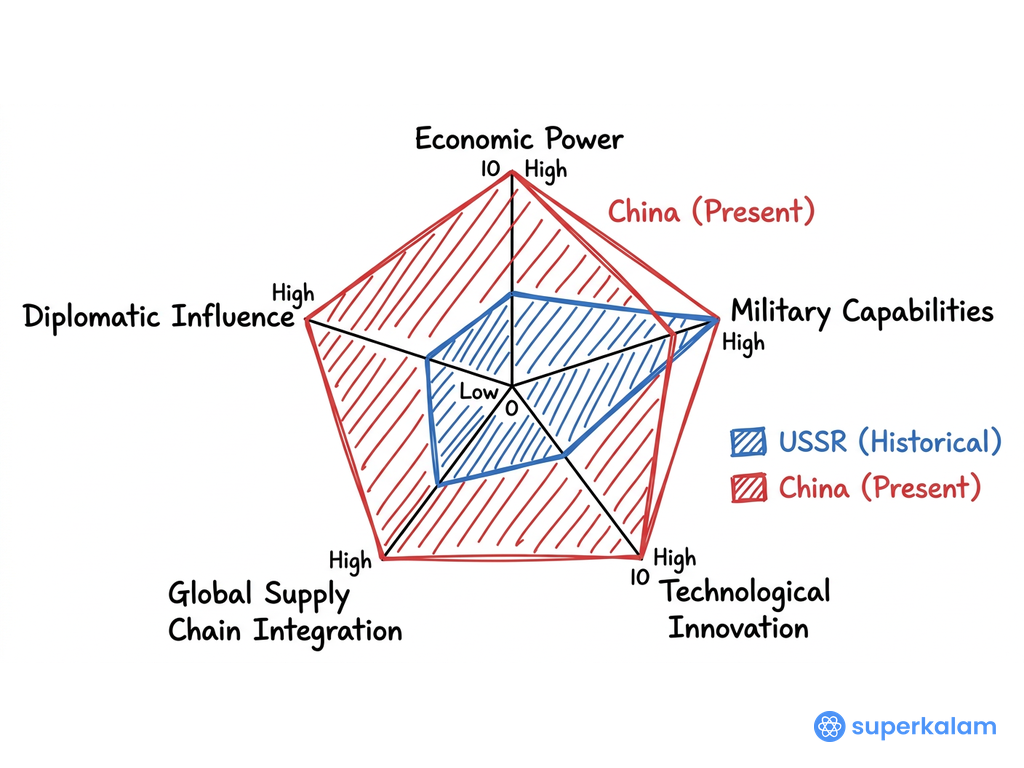
2021 Radar Chart of National Power
Economic Integration vs. Economic Isolation
| Aspect | Soviet Union | China |
|---|---|---|
| Global Integration | Isolated, separate economic bloc | Deeply integrated into global supply chains |
| Trade Volume with US | Minimal bilateral trade | $690 billion in 2022 trade volume |
| Economic Model | Command economy, limited global appeal | Market socialism attracting developing nations |
| GDP Growth | Stagnant in final decades | Consistent 5-6% annual growth |
| Global Influence | Military aid and ideology | Economic partnerships and investments |
Technological Competition Landscape
- China's technological advancement in artificial intelligence, quantum computing, and semiconductors poses direct challenges to US innovation leadership, unlike Soviet focus on military technologies.
- Beijing's Made in China 2025 initiative targets ten key sectors including robotics and aerospace, threatening US technological supremacy.
- The technology transfer requirements and alleged intellectual property theft create sustained competitive pressure.
- China's 5G infrastructure development offers alternative technological ecosystems globally.
- Cyber warfare capabilities enable persistent, low-level conflicts without direct military confrontation.
Strategic Patience vs. Confrontational Approach
- China employs long-term strategic planning through initiatives like Belt and Road Initiative, creating sustainable influence networks across 65+ countries.
- Unlike Soviet military expansionism, China uses economic statecraft and infrastructure investments to build dependencies.
- Beijing's debt-trap diplomacy in Sri Lanka and Pakistan demonstrates alternative influence mechanisms.
- China's approach to Taiwan reflects calculated escalation rather than direct confrontation.
- The establishment of Asian Infrastructure Investment Bank and expansion of BRICS+ challenges US-led financial institutions.
Military Modernization Complexity
- China's anti-access/area-denial strategy in South China Sea poses asymmetric challenges to US naval dominance.
- Rapid expansion from 200 to 500+ nuclear warheads by 2030 threatens strategic balance.
- Space warfare capabilities and anti-satellite weapons create new domains of competition.
China's comprehensive challenge across economic, technological, and strategic dimensions requires nuanced responses through QUAD partnerships, CHIPS Act, and Indo-Pacific Strategy, making it more complex than Cold War containment strategies.
Answer Length
Model answers may exceed the word limit for better clarity and depth. Use them as a guide, but always frame your final answer within the exam’s prescribed limit.
Evaluate this PYQ now
Write your answer & evaluate in just 60 seconds




500+ students evaluated
Model Answers from
- 2021International Relations15 MarksView Answer
The newly tri-nation partnership AUKUS is aimed at countering China’s ambitions in the Indo-Pacific region. Is it going to supersede the existing partnerships in the region? Discuss the strength and impact of AUKUS in the present scenario.
- 2021International Relations15 MarksView Answer
Critically examine the aims and objectives of SCO. What importance does it hold for India?
- 2021International Relations15 MarksView Answer
Analyze the distinguishing features of the notion of Equality in the Constitutions of the USA and India.
- 2021International Relations10 MarksView Answer
“If the last few decades were Asia's growth story, the next few are expected to be Africa's.” In the light of this statement, examine India’s influence in Africa in recent years.
Model Answers by Subject


Crack UPSC with your
Personal AI Mentor
An AI-powered ecosystem to learn, practice, and evaluate with discipline



