Why is India taking a keen interest in the Arctic region?
Why is India taking a keen interest in the Arctic region?
India's growing Arctic engagement represents a strategic shift from passive observation to active participation, driven by climate science, economic opportunities, and geopolitical positioning.
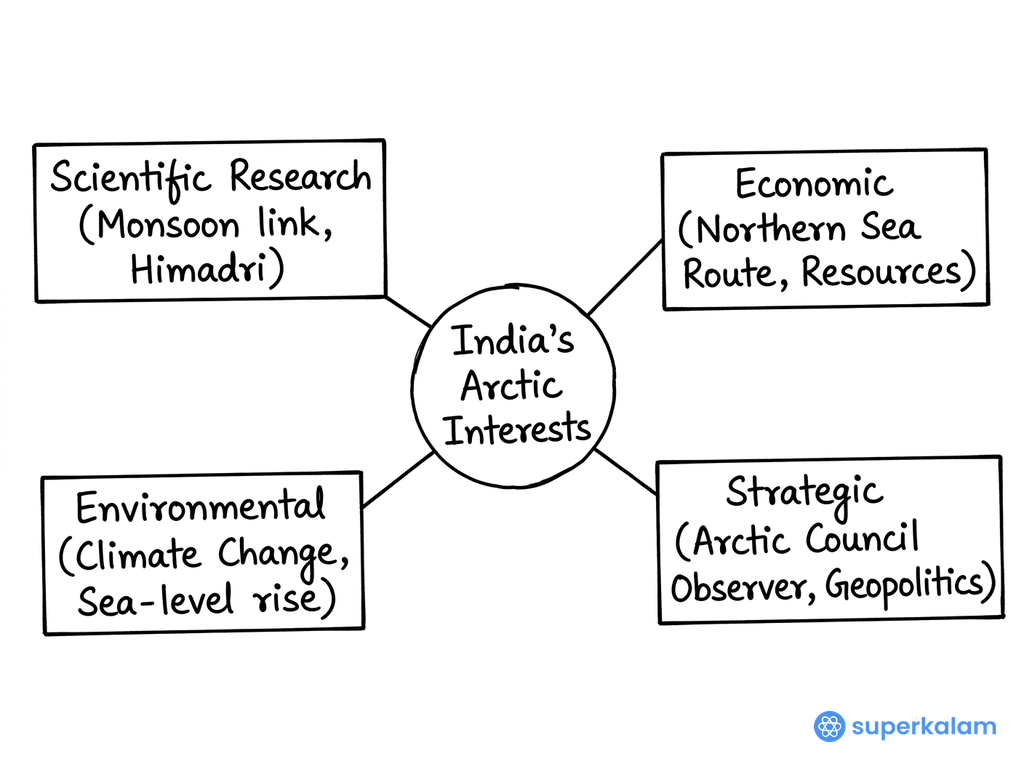
India's Arctic Interests Hub and Spoke
Scientific Research and Climate Monitoring
- Arctic Research Station: "Himadri" at Svalbard, Norway conducts critical polar research on ice sheet dynamics and atmospheric studies
- International Collaborations: Partnerships with Norwegian Polar Institute and Alfred Wegener Institute for marine ecosystem research
- Climate Connection: Arctic warming directly affects Indian monsoon patterns, impacting agriculture and water security across the subcontinent
- Permafrost Studies: Research on methane emissions and carbon release affecting global climate models
- Ocean-Atmosphere Interaction: Understanding Arctic influence on Indian Ocean Dipole and El Niño patterns
Economic and Strategic Opportunities
| Sector | Opportunity | Impact |
|---|---|---|
| Shipping | Northern Sea Route (NSR) | 40% reduction in Asia-Europe transit time |
| Energy | Hydrocarbon reserves | 13% of global oil, 30% natural gas |
| Minerals | Rare earth elements | Critical for renewable energy technology |
| Fisheries | Marine resources | New fishing grounds as ice retreats |
- Maritime Trade: NSR offers alternative to Suez Canal, reducing shipping costs and dependency
- Resource Access: Potential partnerships in sustainable Arctic resource extraction
Geopolitical and Diplomatic Engagement
- Arctic Policy 2022: Comprehensive framework emphasizing "science, research, and sustainable development"
- Arctic Council Observer: Active participation since 2013 in regional governance and environmental protection
- International Treaties: Signatory to Central Arctic Ocean Fisheries Agreement (2018)
- Bilateral Partnerships: Enhanced cooperation with Arctic nations like Norway, Russia, and Canada
- Strategic Positioning: Balancing great power competition while maintaining independent approach
Environmental and Security Implications
- Sea Level Rise: Arctic ice melt threatens India's 7,500 km coastline and 250 million coastal population
- Food Security: Changes in Arctic circulation patterns affect monsoon reliability
- Disaster Preparedness: Arctic research improves cyclone and extreme weather prediction models
- Marine Ecosystem: Understanding Arctic changes helps protect Indian Ocean biodiversity
India's Arctic engagement reflects its "Vasudhaiva Kutumbakam" philosophy, combining scientific diplomacy with strategic foresight under the National Mission for Sustaining Himalayan Ecosystem, positioning India as a responsible Arctic stakeholder.
Answer Length
Model answers may exceed the word limit for better clarity and depth. Use them as a guide, but always frame your final answer within the exam’s prescribed limit.
Evaluate this PYQ now
Write your answer & evaluate in just 60 seconds




500+ students evaluated
Model Answers by Subject


Crack UPSC with your
Personal AI Mentor
An AI-powered ecosystem to learn, practice, and evaluate with discipline



