Define mantle plume and explain its role in plate tectonics.
Define mantle plume and explain its role in plate tectonics.
A mantle plume is a column of hot, buoyant rock rising from Earth's deep mantle, creating hotspot volcanism and significantly influencing plate tectonic processes.
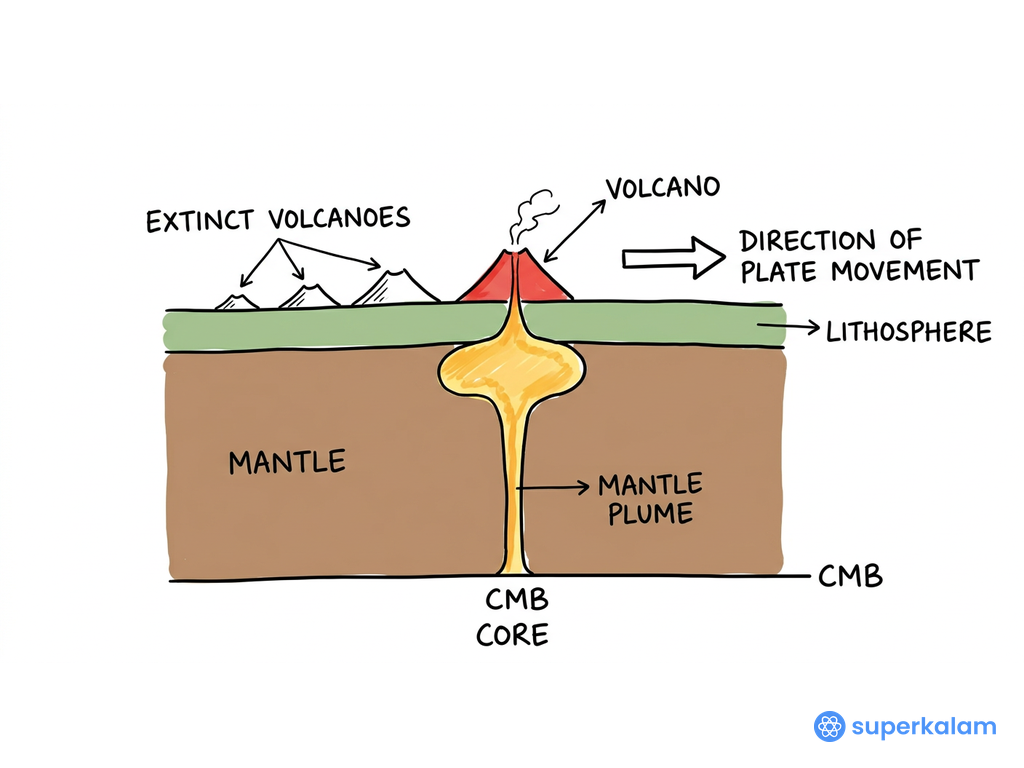
2018 Mantle plume geological cross section
Definition and Structure of Mantle Plumes
- Mushroom-shaped structure consisting of a large bulbous head (1000-2000 km diameter) and narrow tail (100-200 km wide)
- Originate from the core-mantle boundary at 2,900 km depth in the D" layer
- Composed of material 100-200°C hotter than surrounding mantle, making it less dense and buoyant
- Rise through thermal convection at rates of 5-10 cm/year
- Remain relatively stationary while tectonic plates move over them
Formation Mechanism
- Temperature differences at core-mantle boundary create thermal instabilities
- Hot material accumulates and eventually breaks free as ascending plumes
- Decompression melting occurs as plumes approach surface, generating magma
- Recent studies suggest some plumes may originate from transition zone at 410-660 km depth
- Chemical composition often differs from mid-ocean ridge basalts, indicating deep mantle source
Role in Plate Tectonics
Plate Boundary Formation
- Continental breakup: Karoo-Ferrar plume contributed to Gondwana fragmentation 180 million years ago
- Rift initiation: Ethiopian plume system creating East African Rift System
- Triple junction formation: Afar plume creating Red Sea-Gulf of Aden junction
Hotspot Volcanism
- Hawaiian-Emperor chain: Pacific plate movement over Hawaiian plume for 80 million years
- Yellowstone track: North American plate motion over Yellowstone hotspot
- Iceland: North Atlantic plume creating unique on-ridge hotspot
Large Igneous Provinces (LIPs)
- Deccan Traps (66 Ma): Réunion plume creating massive flood basalts during India's northward journey
- Siberian Traps (252 Ma): Associated with Permian-Triassic mass extinction
- Columbia River Basalts (16 Ma): Yellowstone plume activity
Mantle plumes serve as deep Earth's thermal engines, driving plate reorganization and creating some of Earth's most spectacular volcanic features while providing insights into mantle dynamics.
Answer Length
Model answers may exceed the word limit for better clarity and depth. Use them as a guide, but always frame your final answer within the exam’s prescribed limit.
Evaluate this PYQ now
Write your answer & evaluate in just 60 seconds




500+ students evaluated
Model Answers from
- 2018Modern History15 MarksView Answer
Why indentured labour was taken by the British from India to their colonies? Have they been able to preserve their cultural identity over there?
- 2018Modern History10 MarksView Answer
Throw light on the significance of the thoughts of Mahatma Gandhi in the present times.
Model Answers by Subject


Crack UPSC with your
Personal AI Mentor
An AI-powered ecosystem to learn, practice, and evaluate with discipline



