“Access to affordable, reliable, sustainable and modern energy is the sine qua non to achieve Sustainable Development Goals (SDGs)”.Comment on the progress made in India in this regard.
“Access to affordable, reliable, sustainable and modern energy is the sine qua non to achieve Sustainable Development Goals (SDGs)”.Comment on the progress made in India in this regard.
Energy access is fundamental to achieving SDG 7 and broader sustainable development. India has demonstrated remarkable progress in expanding energy access while transitioning toward renewable sources, though regional disparities and reliability challenges remain.
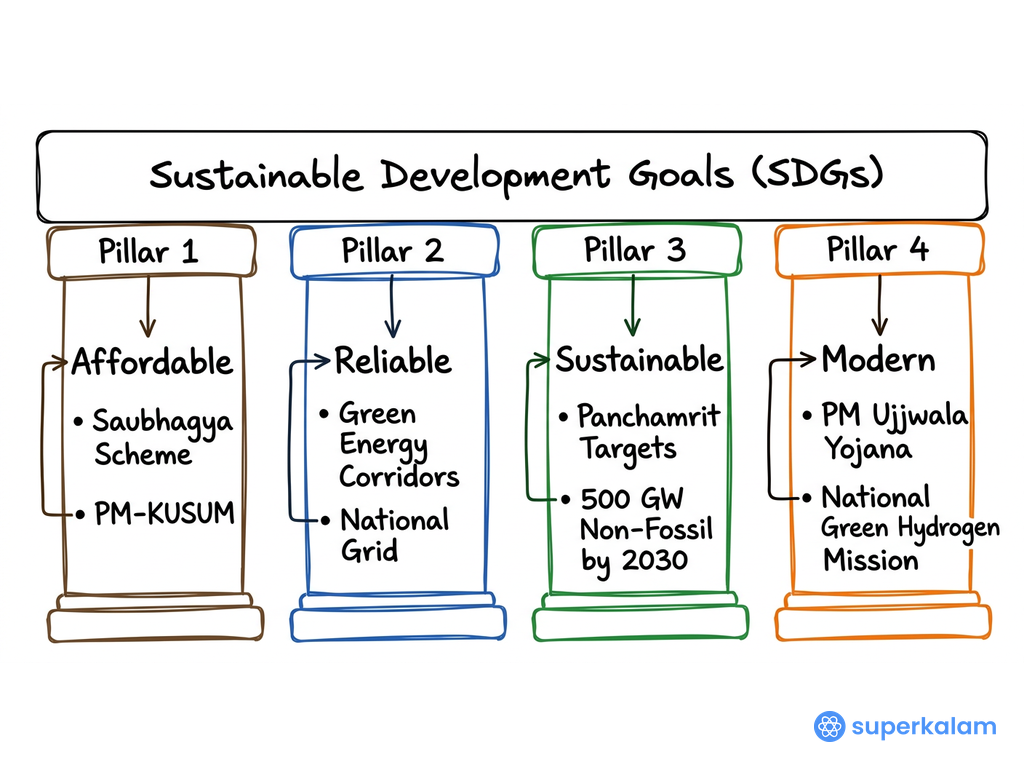
India's Progress on Sustainable Development Goal 7
Energy Access and Electrification Progress
- Universal Coverage Achievement: India achieved 99.9% household electrification by 2022 through the Saubhagya Scheme, connecting over 28 million households.
- Rural Electrification: 100% village electrification completed under Deen Dayal Upadhyaya Gram Jyoti Yojana (DDUGJY).
- LPG Access: Pradhan Mantri Ujjwala Yojana provided clean cooking fuel to 95 million BPL households, achieving 99.8% LPG coverage.
- Energy Security: Reduced dependence on energy imports through domestic production enhancement and renewable capacity addition.
- Affordability Measures: PM-KUSUM scheme provides solar pumps to farmers, reducing electricity costs and improving irrigation access.
Renewable Energy Transformation
- Capacity Addition: India added 15.27 GW renewable capacity in 2023-24, with total renewable installed capacity reaching 185 GW by December 2024.
- Solar Leadership: Fourth largest solar capacity globally with 75 GW installed capacity, supported by International Solar Alliance (ISA) initiatives.
- Green Hydrogen Mission: National Green Hydrogen Mission launched with ₹19,700 crore allocation for 2030 production targets.
- Energy Transition Goals: Committed to 500 GW non-fossil fuel capacity by 2030 and net-zero emissions by 2070.
- Decentralized Solutions: Mini-grids and off-grid systems serving remote areas, with over 1,000 mini-grids operational.
| Parameter | Achievement | Target (2030) |
|---|---|---|
| Renewable Capacity | 185 GW | 500 GW |
| Household Electrification | 99.9% | 100% |
| Emissions Intensity Reduction | 33% (2005-2019) | 45% |
Remaining Challenges
- Supply Reliability: Power outages affect 18% rural households despite connectivity, indicating grid stability issues.
- Regional Disparities: States like Bihar and Odisha lag in per capita energy consumption compared to Gujarat and Maharashtra.
- Grid Integration: Renewable energy intermittency challenges requiring advanced battery storage systems and smart grid infrastructure.
- Energy Poverty: 25% rural households still rely on traditional biomass for cooking despite LPG access.
India's energy transformation supports Paris Agreement commitments while addressing development needs. Strengthening National Solar Mission implementation and expanding Green Energy Corridors will ensure sustainable and inclusive energy access for all citizens.
Answer Length
Model answers may exceed the word limit for better clarity and depth. Use them as a guide, but always frame your final answer within the exam’s prescribed limit.
Evaluate this PYQ now
Write your answer & evaluate in just 60 seconds




500+ students evaluated
Model Answers from
- 2018Economy15 MarksView Answer
With growing energy needs should India keep on expanding its nuclear energy programme? Discuss the facts and fears associated with nuclear energy.
- 2018Economy15 MarksView Answer
How has the emphasis on certain crops brought about changes in cropping patterns in the recent past? Elaborate the emphasis on millet production and consumption.
- 2018Economy15 MarksView Answer
Assess the role of the National Horticulture Mission (NHM) in boosting the production, productivity and income of horticulture farms. How far has it succeeded in increasing the income of farmers?
- 2018Economy15 MarksView Answer
How would the recent phenomena of protectionism and currency manipulations in world trade affect the macroeconomic stability of India?
- 2018Economy15 MarksView Answer
How are the principles followed by NITI Aayog different from those followed by the erstwhile planning commission in India?
- 2018Economy10 MarksView Answer
Sikkim is the first ‘Organic State’ in India. What are the ecological and economic benefits of an Organic State?
Model Answers by Subject


Crack UPSC with your
Personal AI Mentor
An AI-powered ecosystem to learn, practice, and evaluate with discipline



