Evaluate the economic and strategic
dimensions of India’s Look East Policy
in the context of the post-Cold War
international scenario.
Evaluate the economic and strategic
dimensions of India’s Look East Policy
in the context of the post-Cold War
international scenario.
India's Look East Policy, launched in 1991 and upgraded to Act East Policy in 2014, represents a strategic pivot towards Southeast and East Asia in response to post-Cold War multipolarity and economic liberalization.
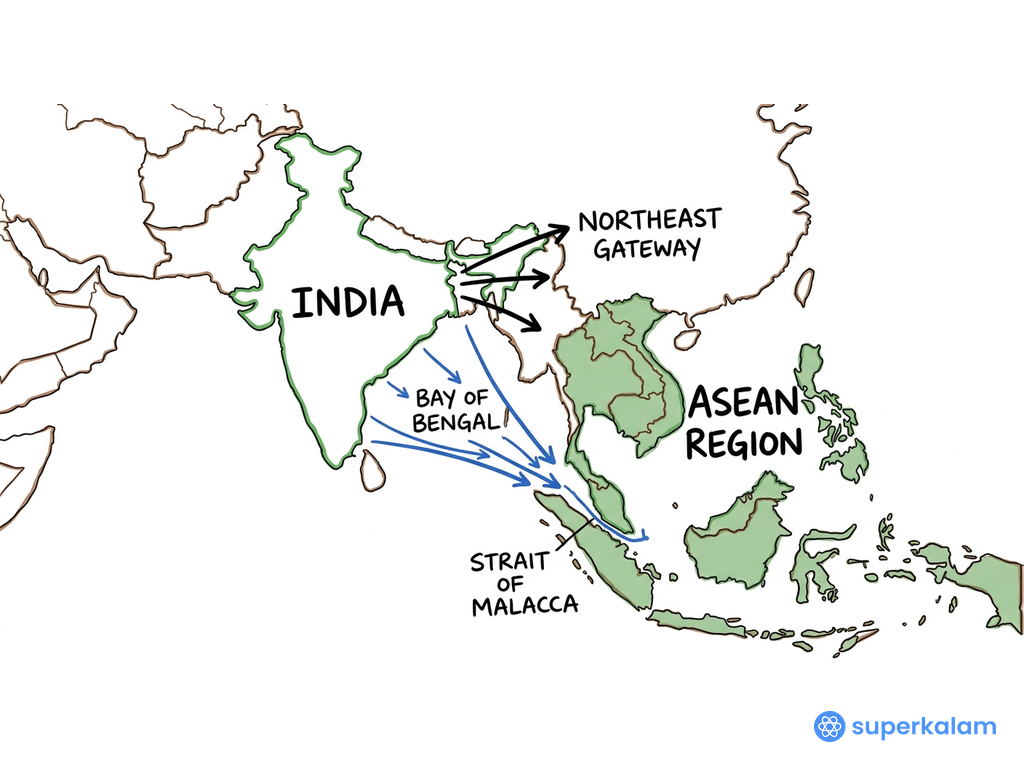
Geopolitical Map of India and ASEAN
Economic Dimensions of Look East Policy
Trade and Investment Growth:
- India-ASEAN trade reached $131.5 billion in 2023-24, with ASEAN becoming India's fourth-largest trading partner
- Singapore emerged as largest FDI source with investments worth $17.2 billion in 2023-24
- India-Japan Comprehensive Economic Partnership Agreement facilitated $18.8 billion bilateral trade in 2024
Regional Economic Integration:
- RCEP negotiations (though India withdrew) demonstrated commitment to regional economic frameworks
- Indo-Pacific Economic Framework participation since 2022 for supply chain resilience
- BIMSTEC Free Trade Area negotiations advancing economic cooperation with Myanmar, Thailand, Sri Lanka
Infrastructure Connectivity:
- India-Myanmar-Thailand Trilateral Highway enhancing trade corridors
- Kaladan Multi-Modal Transit Transport Project connecting northeast India via Myanmar
- Chennai-Vladivostok Maritime Corridor boosting Far East trade
Strategic Dimensions of Look East Policy
Security Partnerships:
- QUAD framework with US, Japan, Australia for Indo-Pacific security architecture
- Malabar Naval Exercises 2024 demonstrating maritime cooperation capabilities
- 2+2 Dialogues with Japan strengthening defense technology cooperation
Geopolitical Balancing:
- String of Pearls counter-strategy through partnerships with Vietnam, Philippines, Indonesia
- Andaman and Nicobar Command serving as strategic gateway to Southeast Asia
- Act East Policy's military dimension includes joint exercises like Yudh Abhyas (US), Dharma Guardian (Japan)
Multilateral Engagement:
- East Asia Summit participation since 2011 for regional security dialogue
- ASEAN Regional Forum membership advancing conflict prevention mechanisms
- ADMM-Plus framework for maritime domain awareness and humanitarian assistance
The policy successfully transformed India from a peripheral to central player in Asian economic and security architecture, leveraging post-Cold War opportunities while addressing China's rise through strategic partnerships and economic integration.
Answer Length
Model answers may exceed the word limit for better clarity and depth. Use them as a guide, but always frame your final answer within the exam’s prescribed limit.
Evaluate this PYQ now
Write your answer & evaluate in just 60 seconds




500+ students evaluated
Model Answers from
- 2016International Relations12.5 MarksView Answer
What are the aims and objectives of the
McBride Commission of UNESCO?
What is India’s position on these? - 2016International Relations12.5 MarksView Answer
Increasing cross-border terrorist attacks in India and growing interference in the internal affairs of member-states by Pakistan are not conducive for the future of SAARC (South Asian Association for Regional Cooperation).” Explain with suitable examples
- 2016International Relations12.5 MarksView Answer
The broader aims and objectives of
WTO are to manage and promote
international trade in the era of
globalization. But the Doha round of
negotiations seems doomed due to
differences between the developed
and the developing countries.” Discuss
from the Indian perspective.
Model Answers by Subject


Crack UPSC with your
Personal AI Mentor
An AI-powered ecosystem to learn, practice, and evaluate with discipline