With respect to the South China sea, maritime territorial disputes and rising tension affirm the need for safeguarding maritime security to ensure freedom of navigation and ever flight throughout the region. In this context, discuss the bilateral issues between India and China.
With respect to the South China sea, maritime territorial disputes and rising tension affirm the need for safeguarding maritime security to ensure freedom of navigation and ever flight throughout the region. In this context, discuss the bilateral issues between India and China.
Recent South China Sea tensions and China's growing assertiveness have significantly impacted India-China bilateral relations, creating new challenges for maritime security and regional stability.
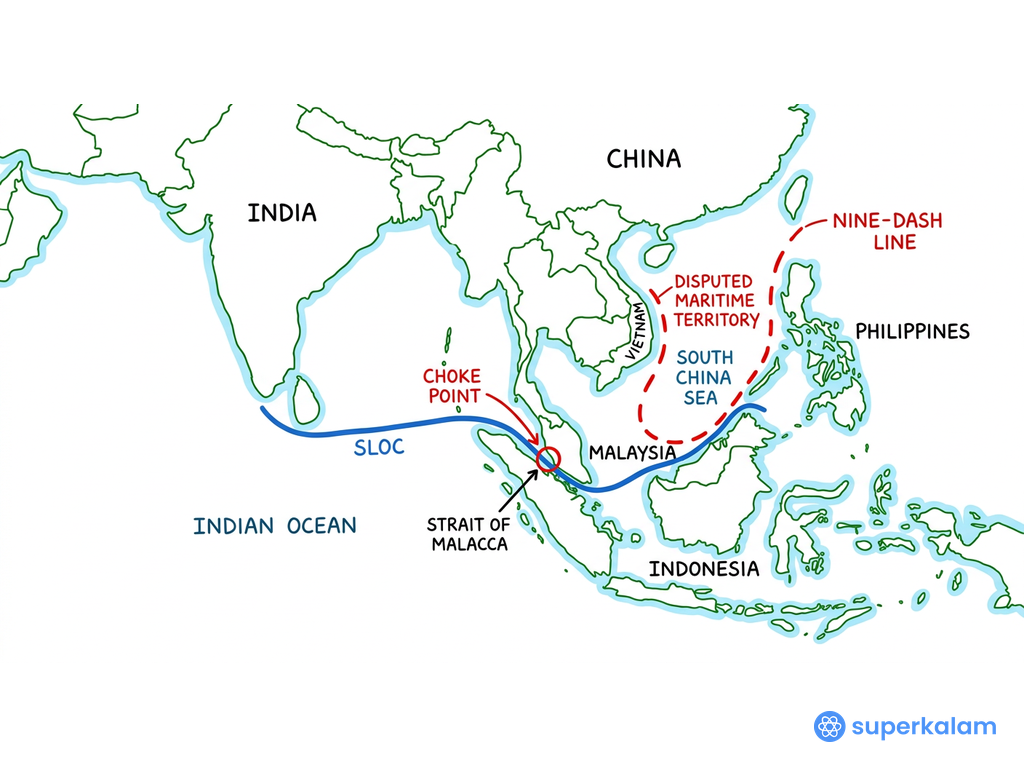
Indo Pacific Region Map and Straits
Maritime Security Concerns in Bilateral Relations
-
String of Pearls Strategy
- China's naval base establishment across Indian Ocean Region (IOR) from Gwadar to Djibouti
- Hambantota Port in Sri Lanka and infrastructure projects in Myanmar threatening India's maritime interests
- Intelligence gathering capabilities through dual-use facilities in neighboring countries
- Economic leverage through debt-trap diplomacy converting commercial ports to military assets
- Strategic encirclement of India through maritime chokepoints control
-
Naval Competition and Presence
- China's Type 055 destroyers and nuclear submarines increasing presence in Indian Ocean
- India's counter-deployment through Mission-Based Deployments since 2017
- Competition for influence in Maldives, Mauritius, and Seychelles
- Both nations expanding anti-piracy operations as strategic cover
- Growing submarine activities creating underwater domain challenges
Border Disputes Affecting Maritime Relations
- Land-Sea Linkage Impact
- Galwan Valley clash (2020) affecting maritime cooperation agreements
- Suspension of joint naval exercises and military-to-military exchanges
- Border tensions influencing maritime boundary discussions in contested areas
- Doklam standoff precedent affecting trust in maritime domain
- Trade route security concerns due to land border instability
| Issue | India's Position | China's Position |
|---|---|---|
| Freedom of Navigation | Supports UNCLOS, free navigation | Claims historic rights over SCS |
| Regional Partnerships | QUAD, bilateral naval exercises | Belt and Road Initiative |
| Maritime Laws | International law adherence | Nine-dash line claims |
Strategic Responses and Initiatives
-
India's Maritime Strategy
- Act East Policy strengthening ASEAN naval partnerships
- Quad naval exercises (Malabar 2024) with US, Japan, Australia
- Indo-Pacific Vision promoting rule-based maritime order
- Information Fusion Centre in Gurugram for maritime domain awareness
- Mission SAGAR providing humanitarian assistance to Indian Ocean nations
-
Diplomatic Engagement Mechanisms
- Border Personnel Meeting Points extending to maritime confidence-building
- Military Commander-level talks including naval representatives since 2020
- Special Representatives dialogue addressing maritime security concerns
- BRICS naval cooperation maintaining limited engagement channels
- Shanghai Cooperation Organization maritime security discussions
The India-China bilateral maritime relationship reflects broader geopolitical competition in the Indo-Pacific. India's emphasis on UNCLOS-based order and multilateral partnerships through QUAD represents a strategic response to China's assertive maritime posture, requiring careful balance between competition and cooperation.
Answer Length
Model answers may exceed the word limit for better clarity and depth. Use them as a guide, but always frame your final answer within the exam’s prescribed limit.
Evaluate this PYQ now
Write your answer & evaluate in just 60 seconds




500+ students evaluated
Model Answers from
- 2014International Relations12.5 MarksView Answer
WTO is an important international institution where decisions taken affect countries in a profound manner. What is the mandate of WTO and how binding are their decisions? Critically analyse India’s stand on the latest round of talks on Food security.
- 2014International Relations12.5 MarksView Answer
India has recently signed to become a founding member of New Development Bank (NDB) and also the Asian Infrastructure Investment Bank (AIIB). How will the role of the two Banks be different? Discuss the strategic significance of these two Banks for India.
- 2014International Relations12.5 MarksView Answer
Some of the International funding agencies have special terms for economic participation stipulating a substantial component of the aid used for sourcing equipment from the leading countries. Discuss the merits of such terms and there exists a strong case not to accept such conditions in the Indian context.
- 2014International Relations12.5 MarksView Answer
The aim of Information Technology Agreements (ITAs) is to lower all taxes and tariffs on Information technology products by signatories to zero. What impact would such agreements have on India’s interests?
Model Answers by Subject


Crack UPSC with your
Personal AI Mentor
An AI-powered ecosystem to learn, practice, and evaluate with discipline



