Bring out the causes for the formation of heat islands in the urban habitat of the world
Bring out the causes for the formation of heat islands in the urban habitat of the world
Urban heat islands have emerged as a critical environmental challenge, with cities experiencing temperatures 2-5°C higher than surrounding areas. This phenomenon results from multiple interconnected factors transforming urban microclimates.
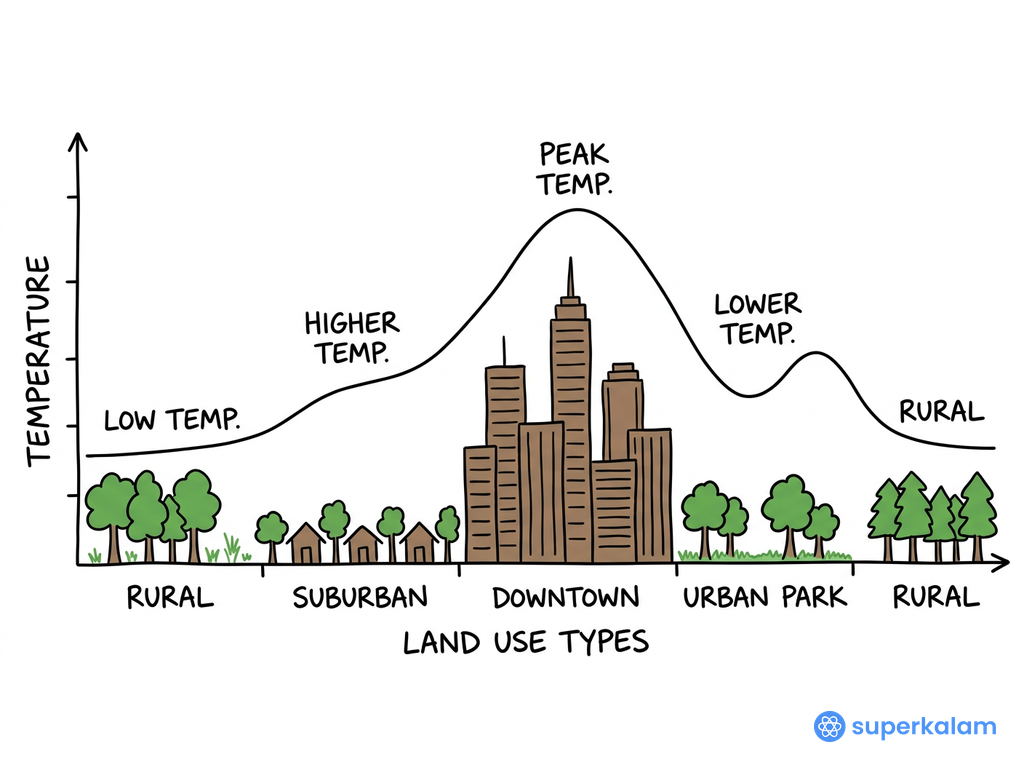
Urban Heat Island Cross Section Diagram
Physical and Infrastructural Causes
- Concrete, asphalt, and steel surfaces have low albedo (0.05-0.20) compared to vegetation (0.25-0.30), absorbing more solar radiation
- High thermal mass materials store heat during day and release at night, maintaining elevated temperatures
- Dark-colored surfaces can reach temperatures 27-50°C higher than air temperature
- Reduced evapotranspiration from impervious surfaces eliminates natural cooling mechanisms
- Urban canyon effect traps long-wave radiation between buildings, creating heat pockets
| Surface Type | Albedo | Peak Temperature |
|---|---|---|
| Fresh Asphalt | 0.05-0.10 | 48-67°C |
| Concrete | 0.10-0.35 | 40-55°C |
| Green Vegetation | 0.25-0.30 | 20-30°C |
Anthropogenic Heat Generation
- Transportation systems contribute 25-30% of anthropogenic heat in major cities
- Building energy consumption releases heat through air conditioning, heating systems
- Industrial processes generate substantial waste heat, particularly in manufacturing zones
- Human metabolism and activities add approximately 100 watts per person continuously
- Example: Tokyo generates 1,590 MW of anthropogenic heat daily, equivalent to 38% of total urban heat load
Environmental Modification Factors
- Deforestation reduces evapotranspiration cooling effect by 2-8°C
- Loss of water bodies eliminates evaporative cooling and thermal regulation
- Reduced wind speed due to building density decreases natural ventilation
- Air pollution creates atmospheric dome effect, trapping heat and reducing radiative cooling
- Example: Delhi's green cover declined from 36% (1990) to 20% (2020), correlating with 1.5°C temperature increase
Geometric and Design Factors
- Street orientation affects solar heat gain and wind flow patterns significantly
- Building height-to-width ratios create heat traps in narrow streets
- Lack of green corridors prevents cool air movement from periphery to city center
Understanding these multifaceted causes enables development of mitigation strategies like cool roof technologies and urban forest initiatives for sustainable city planning.
Answer Length
Model answers may exceed the word limit for better clarity and depth. Use them as a guide, but always frame your final answer within the exam’s prescribed limit.
Evaluate this PYQ now
Write your answer & evaluate in just 60 seconds




500+ students evaluated
Model Answers from
- 2013Modern History10 MarksView Answer
Critically discuss the objectives of the Bhoodan and Gramdan movements initiated by Acharya Vinoba Bhave and their success.
- 2013Modern History10 MarksView Answer
In many ways, Lord Dalhousie was the founder of modern India. Elaborate.
- 2013Modern History10 MarksView Answer
Several foreigners made India their homeland and participated in various movements. Analyze their role in the Indian struggle for freedom.
- 2013Modern History10 MarksView Answer
Defying the barriers of age, gender and religion, Indian women became the torchbearers during the struggle for freedom in India. Discuss.
Model Answers by Subject


Crack UPSC with your
Personal AI Mentor
An AI-powered ecosystem to learn, practice, and evaluate with discipline



