National Clean Air Programme (NCAP) | UPSC Notes
National Clean Air Programme (NCAP) is India’s national policy to reduce air pollution. Study complete notes on its objectives, performance, and challenges for UPSC Prelims & Mains GS III.
Feb, 2026
•8 min read
The National Clean Air Programme (NCAP) is the Government of India’s flagship policy initiative aimed at reducing air pollution through time-bound targets, city-specific action plans, and institutional reforms.
NCAP is an important topic for Prelims and GS Paper III, covering environment, sustainable development, climate action, and public policy dimensions.
What is the National Clean Air Programme (NCAP)?
The National Clean Air Programme (NCAP) is India’s first comprehensive national framework to address air pollution in a structured and time-bound manner.
The overall goal of the programme is to achieve prescribed annual average ambient air quality standards across India within a stipulated long-term timeframe.
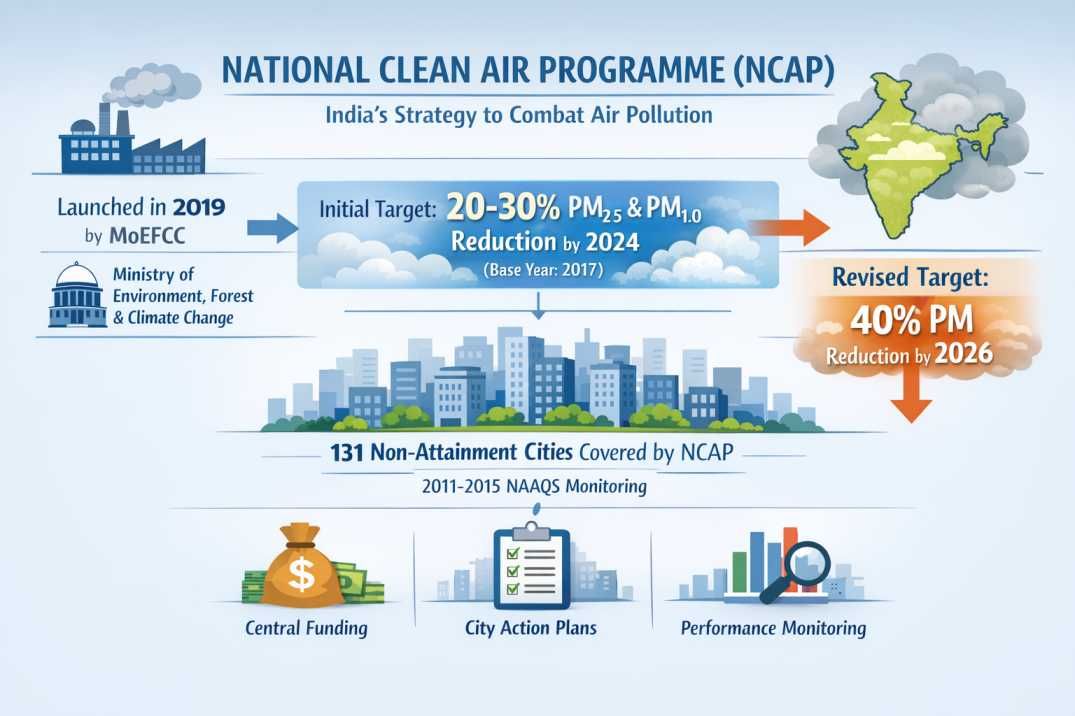
- Launched in 2019 by the Ministry of Environment, Forest and Climate Change (MoEFCC) as a long-term, national-level strategy to combat air pollution.
- Initially set a target of 20–30% reduction in Particulate Matter (PM₂.₅ and PM₁₀) concentrations by 2024, with 2017 as the base year.
- The target was later revised to a 40% reduction in PM concentration by 2026 for cities covered under NCAP.
- Covers 131 non-attainment cities, identified as cities that failed to meet National Ambient Air Quality Standards (NAAQS) during 2011–2015 under the National Air Quality Monitoring Programme (NAMP).
- Backed by central funding, city-specific action plans, and performance-based monitoring mechanisms.
What are Non-Attainment Cities?Under the National Clean Air Programme (NCAP), non-attainment cities are those that failed to meet the National Ambient Air Quality Standards (NAAQS) during the period 2011–2015.
|
Objectives of the National Clean Air Programme (NCAP)
The key objectives of the National Clean Air Programme (NCAP) are:
- Reduce Air Pollution Levels: Achieve a significant reduction in PM₂.₅ and PM₁₀ concentrations in polluted cities through time-bound and outcome-oriented measures.
- Strengthen Air Quality Monitoring: Expand and upgrade the national air quality monitoring network to ensure accurate, real-time, and reliable air pollution data.
- City-Specific Action Plans: Implement targeted action plans for non-attainment cities based on local pollution sources and regional conditions.
- Capacity Building and Institutional Strengthening: Enhance the technical and administrative capacity of urban local bodies, state pollution control boards, and implementing agencies.
- Public Awareness and Participation: Increase public awareness about air pollution, its health impacts, and promote community participation in pollution control efforts.
- Long-Term Air Quality Management: Work towards meeting the National Ambient Air Quality Standards (NAAQS) across all regions of the country in a sustainable and long-term manner.
Must read: Climate Change UPSC Notes: Meaning, Types, Causes & Key Initiatives
Implementation Framework of the National Clean Air Programme (NCAP)
The National Clean Air Programme (NCAP) follows a coordinated and multi-level implementation framework, ensuring effective action across sectors and governance levels.
1. Multi-Level Governance Approach
NCAP promotes collaborative coordination among central ministries, state governments, and urban local bodies, recognising that air pollution is a cross-sectoral and multi-regional issue.
2. Central Role of CPCB
The Central Pollution Control Board (CPCB) acts as the nodal implementing agency, responsible for executing nationwide programmes related to the prevention, control, and abatement of air pollution under NCAP.
3. Institutionalisation Across Ministries
NCAP is institutionalised within concerned ministries, ensuring policy continuity and integration with sectoral schemes related to transport, energy, health, urban development, and industry.
4. Inter-Sectoral Coordination Mechanism
The programme is organised through inter-ministerial and inter-sectoral groups, involving key stakeholders such as the Ministry of Finance, Ministry of Health, NITI Aayog, and domain experts.
5. State and City-Level Execution
States and non-attainment cities prepare and implement city-specific action plans, aligned with national targets and local pollution sources.
6. Technical Support and Expert Involvement
Experts from various fields provide technical guidance, research inputs, and policy evaluation, strengthening evidence-based decision-making.
This structured implementation framework ensures that NCAP functions as a comprehensive national strategy rather than a standalone pollution control scheme.
UPSC Prelims Practice PYQ
QUESTION 1
In the cities of our country, which among the following atmospheric gases are normally considered in calculating the value of Air Quality Index?
- Carbon dioxide
- Carbon monoxide
- Nitrogen dioxide
- Sulphur Dioxide
- Methane
Select the correct answer using the code given below
Performance Assessment of the National Clean Air Programme (NCAP)
The implementation of the National Clean Air Programme (NCAP) shows mixed progress, with notable achievements in monitoring infrastructure. Let's understand!
Air Information Centres and Pollution Forecasting
- NCAP envisaged setting up Air Information Centres at central and regional levels by 2020 to support data dissemination and policy decisions.
- As of December 2023, only the central PRANA portal (Portal for Regulation of Air Pollution in Non-Attainment Cities) developed by the CPCB is fully functional.
- Although NCAP targeted air pollution forecasting systems in non-attainment cities by 2022, Delhi remains the only city with an operational forecasting system till December 2023.
- This indicates a major shortfall in early-warning and preventive planning mechanisms.
Institutional Mechanisms and Fund Utilisation
- NCAP proposed committees at the national, state, and city levels for coordinated implementation and monitoring.
- However, issues related to functionality, transparency, and public disclosure of committee outcomes persist.
- According to PIB data, ₹1,253 crore was allocated to 82 non-attainment cities, but only ₹498 crore (around 40%) was utilised till November 2023.
- The low utilisation rate highlights capacity constraints at the urban local body and state levels.
Expansion of Air Quality Monitoring Infrastructure
- NCAP aimed to expand the number of manual monitoring stations under NAMP from 703 to 1,500 by 2024.
- As of December 2023, only 931 manual stations are operational, reflecting a significant gap from the target.
In contrast, progress under Continuous Ambient Air Quality Monitoring Stations (CAAQMS) has been strong:
- Against a target of 150 stations, 531 CAAQMS are operational, exceeding initial expectations.
- This marks a positive shift towards real-time air quality monitoring.
Rural Air Quality Monitoring
- Rural monitoring remains a weak area, with only 26 manual monitoring stations covering limited regions.
- NCAP’s goal to establish 100 rural monitoring stations by 2024 appears challenging to achieve within the stipulated timeline.
Key Challenges in the Implementation of NCAP
The National Clean Air Programme (NCAP) faces several implementation and governance challenges that limit its effectiveness.
- Non-Statutory Nature: NCAP is not backed by a legal mandate, making its targets non-binding and weakening enforcement at the state and city levels.
- Underutilisation of Funds: Significant gaps exist between fund allocation and utilisation due to the limited administrative and technical capacity of urban local bodies.
- Weak Inter-Agency Coordination: Air pollution is a cross-sectoral issue, but coordination among ministries, states, and local bodies remains inconsistent.
- Limited Air Pollution Forecasting Systems: Most non-attainment cities still lack early warning and forecasting mechanisms, reducing the scope for preventive action.
- Inadequate Rural Air Quality Monitoring: NCAP continues to focus largely on urban areas, while rural air pollution sources such as biomass burning remain under-monitored.
- Capacity Constraints at Local Level: Urban local bodies and State Pollution Control Boards often face a shortage of skilled manpower, data, and technical expertise.
- Lack of Public Transparency and Accountability: Limited public access to data on committee functioning, progress reports, and outcomes affects accountability and citizen participation.
These challenges highlight the need for stronger institutional backing, better coordination, and outcome-based monitoring to ensure the long-term success of NCAP.
Must cover: National Pollution Control Day 2025: History, Significance, Theme & Relevance for UPSC
UPSC Mains PYQ on NCAP (GS Paper III – Environment):
What are the key features of the National Clean Air Programme (NCAP) initiated by the Government of India? (UPSC Mains 2020) (15 Marks)
Evaluate your answer within 60 secondsWay Forward
“Clean air is not a privilege, it is a basic human right.” — WHO
To make the National Clean Air Programme (NCAP) future-ready and impactful, a focused and reform-driven approach is essential:
- Provide legal backing to NCAP to ensure enforceable targets and accountability
- Strengthen urban local bodies through technical training and dedicated manpower
- Improve fund utilisation with outcome-based monitoring and real-time audits
- Expand air quality forecasting systems beyond metros to all non-attainment cities
- Integrate health and climate goals into air pollution planning
- Incorporate technology such as AI, satellite data, and real-time analytics for policy decisions
Start your UPSC Preparation 2026/2027 with SuperKalam
SuperKalam is your personal mentor for UPSC preparation, guiding you at every step of the exam journey. Practice, revise, and evaluate– all in one place.
Download Now