India-Middle-East-Europe Economic Corridor (IMEC) - UPSC Notes
IMEC (India–Middle East–Europe Economic Corridor) is a multimodal trade corridor linking India, the Middle East, and Europe. Understand its significance, route map, and challenges for UPSC Prelims & Mains.
Apr, 2026
•8 min read
The India–Middle East–Europe Economic Corridor (IMEC) is one of the most significant connectivity projects announced in recent years, aiming to link India with Europe through the Middle East via a network of railways, ports, and digital infrastructure. Launched during the G20 Summit 2023, IMEC reflects India’s growing role in global trade, supply chains, and strategic geopolitics.
IMEC is an important topic for UPSC Mains (GS Paper II and III) for its implications on international relations, regional cooperation, and competition with initiatives like the Belt and Road Initiative.
About India–Middle East–Europe Economic Corridor (IMEC)
The India–Middle East–Europe Economic Corridor (IMEC) is a connectivity initiative aimed at strengthening trade, infrastructure, and economic integration between India, the Middle East, and Europe. IMEC will be designed as a multimodal transport network, combining sea routes, rail corridors, and digital infrastructure.
The project was announced during the G20 Summit 2023, which was held under the presidency of New Delhi, India. Its signatories include India, the United States, Saudi Arabia, the United Arab Emirates, France, Germany, Italy, and the European Union.
- It will connect Indian ports to the UAE through maritime routes, and then extend via a high-speed and efficient railway network across countries like Saudi Arabia, Jordan, and Israel, ultimately linking to the Haifa Port for further access to European markets.
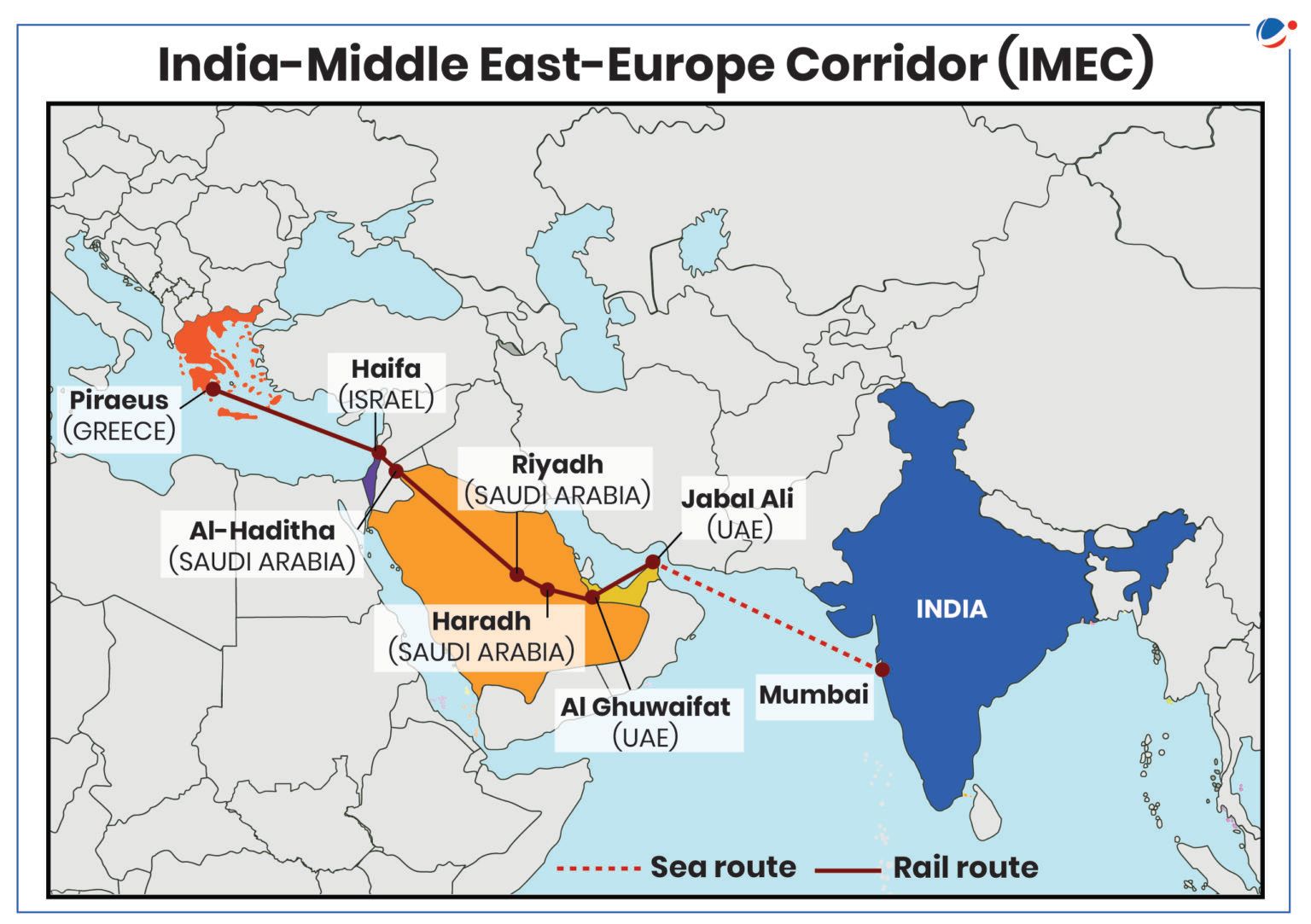
- The corridor reflects a strategic effort to build resilient and efficient supply chains in an increasingly interconnected global economy.
- Strategically, IMEC is being positioned as a credible alternative to China’s Belt and Road Initiative (BRI).
- IMEC is also a part of the Partnership for Global Infrastructure and Investment (PGII), an initiative launched by the G7 in 2021.
- PGII was developed to support infrastructure development in developing and emerging economies through transparent and sustainable financing.
Beyond physical connectivity, IMEC is envisioned as a comprehensive economic corridor. It includes plans for:
- Energy infrastructure, such as electricity grids and clean hydrogen pipelines
- Digital connectivity, including undersea data cables to enhance communication networks
- Logistics modernisation, reducing transit time, cost, and dependency on traditional routes like the Suez Canal
Structure of IMEC Corridor
To understand how the India–Middle East–Europe Economic Corridor (IMEC) will function in practice, it is important to look at its structural design.
1. Two Key Corridors
- East Corridor: Connects India to the Arabian Gulf, acting as a crucial link between South Asia and Middle Eastern economies for trade and transit.
- North Corridor: Extends from the Gulf region to Europe, enabling seamless movement of goods, services, and people toward European markets.
2. Transit Network (Rail Focus)
The backbone of IMEC is a cross-border railway network. It is designed to:
- Speed up cargo movement
- Reduce logistics costs and transit time
- Provide an alternative to traditional routes like the Suez Canal
3. Supplementary Transport Routes
Along with railways, maritime and road networks will support the corridor. This multimodal approach ensures:
- Flexibility in transport
- Better risk management during disruptions
- Seamless cargo movement across different routes
4. Supporting Infrastructure Development
IMEC goes beyond transport and focuses on building future-ready infrastructure:
- Electricity Networks: To ensure a stable energy supply across regions
- Digital Infrastructure: For smart logistics, real-time tracking, and efficient communication
- Green Hydrogen Ecosystem: To support clean energy transport and develop sustainable supply chains
Strategic and Economic Importance of IMEC for India
The India–Middle East–Europe Economic Corridor (IMEC) holds significant strategic and economic value for India. It is a long-term initiative that strengthens India’s global connectivity, boosts exports, and enhances its geopolitical position. Here’s why IMEC is important for India:
- Diversification of Trade Routes: IMEC reduces India’s dependence on traditional chokepoints like the Suez Canal, ensuring more secure and reliable supply chains.
- Better Access to European Markets: The corridor provides a faster and more efficient route to Europe via the Mediterranean, helping India expand its presence in high-value markets and reduce reliance on routes influenced by the Belt and Road Initiative.
- Boost to Trade with Europe: The European Union is India’s largest trading partner, with bilateral trade crossing $136 billion in 2024. Improved connectivity through IMEC can further increase exports and economic engagement.
- Enhancing Export Competitiveness: Europe’s high purchasing power and advanced technology markets offer India an opportunity to export more goods and services, making Indian products more competitive globally.
- Strengthening ‘Act West’ Policy: IMEC supports India’s ‘Act West’ policy by deepening ties with Middle Eastern countries, key partners for energy imports, trade, and the Indian diaspora.
- Energy and Diaspora Linkages: Stronger connectivity with the Gulf region ensures better energy security and supports millions of Indians working there through improved economic integration.
- Geopolitical Advantage: IMEC helps India strengthen its presence in West Asia and counterbalance regional influences, including strategic alignments involving neighbouring countries.
Also read: India-Middle East Relations: History, Trade, and Strategic Ties
Challenges and Geopolitical Complexities of IMEC
The India–Middle East–Europe Economic Corridor (IMEC) faces significant challenges due to the rapidly evolving geopolitical situation in West Asia. Recent conflicts have exposed the vulnerability of regional connectivity projects and highlighted the risks associated with long-term infrastructure planning in unstable regions.
1. Escalation of Iran–Israel Conflict (2026)
The ongoing Iran–Israel conflict has intensified into a broader regional war in 2026, involving direct military strikes between Iran, Israel, and the United States. The conflict began with large-scale airstrikes and has expanded into missile and drone attacks across multiple countries.
2. Regional Spillover and Instability
The conflict is no longer limited to two countries. It has spread across West Asia, impacting Gulf nations, critical infrastructure, and even global energy routes. This widespread instability directly threatens IMEC’s proposed transport and energy corridors.
3. Disruption of Energy and Trade Routes
Attacks near key maritime zones and threats around strategic chokepoints like the Strait of Hormuz have increased global concerns over oil supply and trade security. Rising oil prices and shipping risks directly affect the economic feasibility of IMEC.
4. Maritime Security Threats and Route Diversions
Ongoing tensions, along with earlier Red Sea disruptions by groups like the Houthi movement, have forced shipping companies to reroute vessels via longer paths such as the Cape of Good Hope, increasing costs and delays.
5. Breakdown of Regional Cooperation
IMEC depends on cooperation between countries like Israel and Arab nations. However, conflicts such as the Gaza crisis and now the Iran–Israel war have strained diplomatic ties, making coordinated infrastructure development more difficult.
6. Global Supply Chain Uncertainty
The ongoing war has disrupted global markets, especially energy and logistics, reinforcing the risks associated with overdependence on politically sensitive regions.
7. Emerging Alternative Trade Routes
Climate change is opening new options like the Northern Sea Route, which countries such as Russia, the US, and China are exploring as faster Asia–Europe links, posing long-term competition to IMEC.
8. Execution and Coordination Challenges
IMEC involves multiple stakeholders with differing geopolitical interests. Ongoing conflicts further complicate funding, security, and timely execution of projects.
Current Status of IMEC
The India–Middle East–Europe Economic Corridor (IMEC) is currently in a developing yet slow-moving phase. While the long-term vision remains intact, implementation is gradual and uneven.
- Construction of key infrastructure components, such as rail links, ports, and logistics networks, started around 2025.
- Some parts of the corridor, especially in the Gulf region (such as UAE–Saudi connectivity and port upgrades, such as Haifa Port), have seen gradual development.
- Steps like the India–UAE “Virtual Trade Corridor” are being developed to simplify customs and logistics processes, showing movement beyond physical infrastructure.
- Projects related to green hydrogen pipelines, electricity grids, and undersea cables have seen limited progress so far due to regional instability and funding challenges.
- The Israel–Hamas War and continued tensions in West Asia have delayed coordination among participating countries, putting parts of the project effectively “on pause” at times.
Despite challenges, countries like India, the US, and European partners are continuing discussions to revive momentum. Agreements like India–UAE CEPA and a potential India–EU trade deal are expected to strengthen the economic foundation of IMEC.
Must see: International North-South Transport Corridor (INSTC) - UPSC Notes
UPSC Prelims Practice MCQ on IMEC
QUESTION 1
With reference to the India–Middle East–Europe Economic Corridor (IMEC), consider the following statements:
- IMEC was announced during the G20 Summit 2023.
- It aims to connect India directly to Europe only through land routes.
- It is part of the Partnership for Global Infrastructure and Investment.
- It includes components like digital connectivity and energy infrastructure.
Which of the statements given above are correct?
UPSC Mains Practice Question on IMEC
The India–Middle East–Europe Economic Corridor (IMEC) is seen as a game-changer in global connectivity and geopolitics. Discuss its strategic significance for India. (250 words, 15 marks)
Evaluate your Answer Within 60 SecondsWay Forward
The India–Middle East–Europe Economic Corridor (IMEC) is a long-term strategic project with huge potential, but its success depends on how effectively current challenges are managed.
- Strengthen Diplomacy in West Asia: Promote dialogue and cooperation to ensure regional stability for smooth project execution.
- Focus on Phased Development: Prioritise key segments first to build momentum and show early results.
- Ensure Security of Trade Routes: Protect maritime and land corridors to maintain investor confidence and uninterrupted trade.
- Deepen Economic Partnerships: Enhance trade ties with partners like the European Union and Gulf countries.
- Invest in Sustainable Infrastructure: Focus on green energy, digital connectivity, and resilient systems for long-term success.
Start your UPSC Preparation 2026/2027 with SuperKalam
SuperKalam is your personal mentor for UPSC preparation, guiding you at every step of the exam journey. Practice, revise, and evaluate– all in one place.
Download Now