Places of Worship Act vs AMASR Act: Legal Clash over Shrines
As petitions challenge the 1991 freeze, the AMASR exemption tests the delicate judicial balance between constitutional secularism and historic title claims.
Nov, 2026
•13 min read
Updated 27 November 2026
At a Glance
| Question | Quick answer |
|---|---|
| What does each law do? | The Places of Worship Act, 1991 freezes religious character as of 15 August 1947; the AMASR Act, 1958 empowers the ASI to protect ancient monuments of national importance and regulate their use (Section 16). |
| Where do they collide? | Section 4(3)(a) of the 1991 Act exempts AMASR-protected monuments from the suit-abatement bar, but whether Section 3's conversion ban still applies to them is the live dispute. |
| Why is this in the news? | Petitions seeking ASI surveys of disputed medieval structures test whether ascertaining a monument's origins breaches the 1991 freeze. |
| What did the Supreme Court do in December 2024? | A Special Bench barred registration of fresh suits and stayed survey orders over existing religious structures until the constitutional challenge to the 1991 Act is decided. |
| What is the way forward? | Harmonise heritage conservation with the non-retrogression principle the Supreme Court endorsed in the Ayodhya verdict. |
Context
The statutory collision between the Places of Worship (Special Provisions) Act, 1991 and the Ancient Monuments and Archaeological Sites and Remains Act, 1958 centres on a core question. Do historical monuments of national importance remain exempt from the legislative freeze that fixes religious character as of August 15, 1947? The 1991 statute seeks constitutional finality to protect secularism and public tranquillity. Meanwhile, the 1958 legislation empowers the Archaeological Survey of India to preserve ancient heritage and regulate structural usage under Section 16.
Recent judicial petitions seeking archaeological surveys across disputed medieval structures test this boundary. They ask whether ascertaining original architectural origins breaches the substantive bar against conversion. Resolving this friction requires balancing the non-retrogression principle articulated by the Supreme Court of India with statutory heritage conservation mandates.
Why in the News? The Surge in Heritage Site Litigations
The Supreme Court of India intervened in December 2024 to manage a nationwide surge in civil litigations seeking scientific surveys of protected historical religious structures. As of December 2024, a three-judge Supreme Court bench issued an interim order restraining civil courts nationwide from registering fresh suits or passing effective orders, including ordering surveys, concerning the religious character of existing places of worship.
Key flashpoints and legal developments include:
- Sambhal Shahi Jama Masjid: Fresh tensions erupted in late 2024 surrounding this site in Uttar Pradesh, a protected monument under the Ancient Monuments and Archaeological Sites and Remains (AMASR) Act, 1958, where Hindu petitioners claimed the existence of a pre-existing Harihar temple. Violent public clashes followed a November 2024 local court-directed survey, highlighting the delicate balance between archaeological investigations and public order.
- Bypassing Statutory Freezes: Litigants across several states have increasingly invoked heritage preservation laws to bypass the statutory freeze imposed by post-independence legislation. Petitions argue that protected historical monuments possess distinct legal standing, creating conflicting interpretations between district courts and constitutional benches.
Discuss with Superkalam
Recall the exact cutoff date prescribed under Section 4 of the Places of Worship (Special Provisions) Act, 1991.
Ask NowUnderstanding the Places of Worship (Special Provisions) Act, 1991
The Places of Worship (Special Provisions) Act, 1991 freezes the religious character of all shrines across India as they stood on August 15, 1947. Parliament enacted the legislation to prohibit the conversion of any place of worship. The goal was to maintain inter-faith stability in the aftermath of widespread communal discord.
Key statutory pillars of the 1991 Act include:
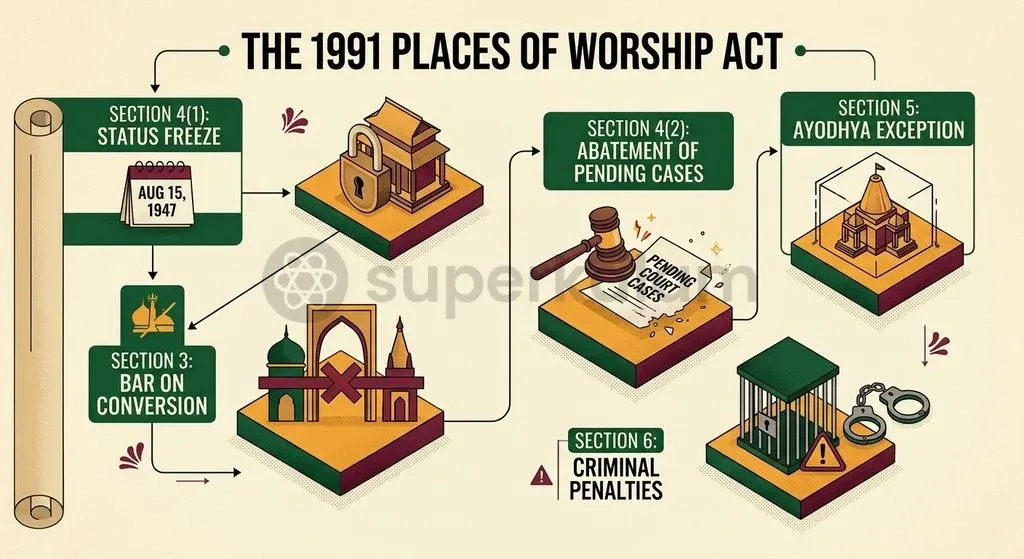
- Substantive Prohibition (Section 3): Imposes an absolute bar against converting any place of worship of any religious denomination or section into a place of worship of a different denomination or section.
- Cut-Off Date and Abatement (Section 4): Section 4(1) declares that the religious character existing on August 15, 1947 shall continue unchanged. Section 4(2) mandates that any pending suit, appeal, or legal proceeding seeking conversion abates immediately, barring fresh suits.
- Penal Consequences (Section 6): Criminalises contraventions with imprisonment for up to three years and a fine. Convictions incur electoral disqualification under Section 8(1)(j) of the Representation of the People Act, 1951.
- Statutory Overriding Effect (Section 7): Contains a non-obstante clause providing that the statute overrides all other inconsistent enactments and legal instruments.
Specific exceptions exist under the statute. Section 5 explicitly exempted the Ram Janma Bhumi-Babri Masjid site in Ayodhya and its connected legal proceedings from the Act's operation. Sections 4(3)(b) through 4(3)(e) also exempt settled disputes, matters barred by limitation, and pre-commencement conversions by acquiescence.
In the landmark 2019 Ayodhya ruling (M Siddiq v. Mahant Suresh Das), a five-judge Constitution Bench delivered a significant verdict. The bench held that the 1991 Act operationalises a non-derogable constitutional obligation to preserve secularism as a basic feature of the Constitution. The Supreme Court observed that the law embodies the principle of non-retrogression, which bars the state and citizens from regressing on secular guarantees to remedy historical wrongs.
What Is the AMASR Act, 1958, and What Does It Protect?
The Ancient Monuments and Archaeological Sites and Remains Act, 1958 governs historical structures of national importance under the administrative guardianship of the Archaeological Survey of India. The statute focuses primarily on physical conservation, excavation, and structural protection rather than adjudicating private denominational rights.
Religious sanctity within protected structures is regulated by Section 16 of the 1958 Act:
- Consistent Use (Section 16(1)): Mandates that a protected monument maintained by the Central Government that is a place of worship or shrine shall not be used for any purpose inconsistent with its character.
- Collector's Protective Powers (Section 16(2)): Empowers and obligates the District Collector to protect a religious monument from pollution or desecration, including by restricting unauthorised entry contrary to established religious usages.
Archaeological Survey of India administrative policy draws an operational distinction between protected sites:
Living monuments are structures where religious observances were active at the time of initial notification, permitting worship to continue under pre-existing custom. Conversely, non-living monuments are abandoned or secularised historical structures where the revival of worship or introduction of fresh rituals is barred to prevent communal friction and preserve antiquity.
Discuss with Superkalam
How does the Supreme Court distinguish between the ascertainment of a shrine's religious character and the substantive alteration of its religious status?
Ask NowWhere the Two Laws Collide: Section 4(2) vs Ancient Monuments
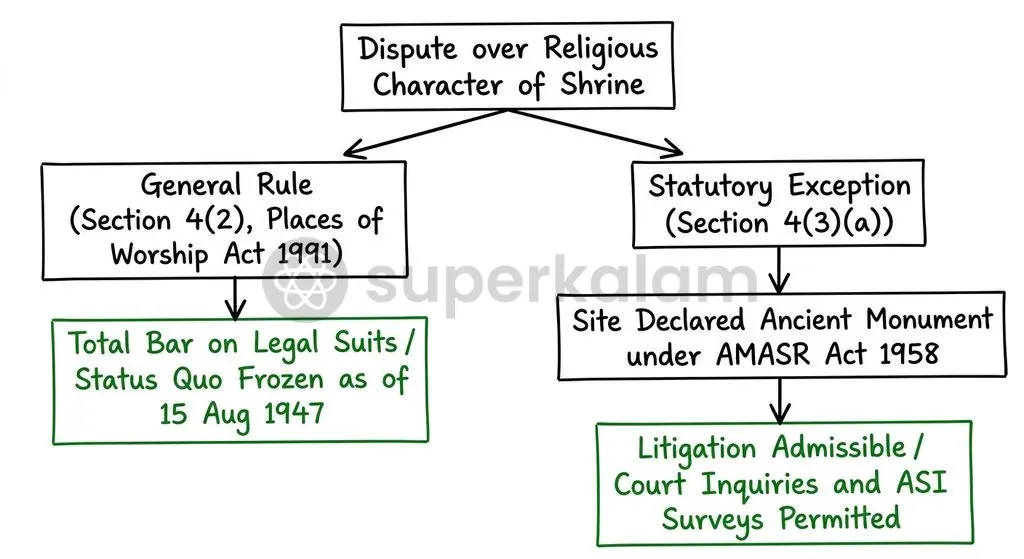
A critical statutory clash emerges where Section 4(3)(a) of the Places of Worship Act intersects with the AMASR Act, 1958. Section 4(3)(a) of the 1991 Act explicitly provides that Section 4 shall not apply to any place of worship that is an ancient and historical monument or an archaeological site covered by the AMASR Act, 1958.
Litigants interpret this exclusion as a legal gateway to bring title suits and survey applications against medieval religious complexes. Petitioners argue that if a shrine is an ASI-notified monument, the procedural abatement of suits under Section 4(2) cannot bar civil courts from investigating its origins or entertaining declaratory claims.
| Statutory Mechanism | Statutory Mandate | Impact on Heritage Litigation |
|---|---|---|
| Section 3 (1991 Act) | Absolute bar on conversion | Substantively prohibits altering religious character |
| Section 4(1)-(2) (1991 Act) | 1947 freeze & abatement of suits | Halts pending proceedings and bars fresh suits |
| Section 4(3)(a) Carve-Out | Exempts AMASR monuments from Section 4 | Used by litigants to bypass procedural suit abatement |
| Section 16 (AMASR Act, 1958) | Preserves usage from inconsistency | Prohibits structural misuse inconsistent with original character |
A statutory contradiction emerges because Section 4(3)(a) exempts ancient monuments only from the operations of Section 4, while Section 3's substantive bar on converting religious character contains no explicit statutory carve-out for ancient monuments. While a party may escape procedural abatement under Section 4(2), any ultimate decree altering a site's usage remains constrained by Section 3.
Section 7 of the 1991 Act further complicates this equation by according overriding effect over all other enactments inconsistent with its terms. The core legal clash therefore asks whether an exemption from Section 4 permits courts to alter existing religious character, or merely enables the Archaeological Survey of India to conduct physical preservation without modifying devotional status.
How Courts Are Handling the Tension: Key Judicial Rulings
Judicial benches across India have navigated statutory boundaries by distinguishing between preliminary ascertainment and substantive alteration of a shrine. In 2022, during the Gyanvapi mosque proceedings, the Supreme Court observed that conducting an expert survey to ascertain the religious character of a site is not expressly barred under the 1991 Act.
Trial courts subsequently relied on this observation to permit scientific examinations. They reasoned that establishing what a structure was on August 15, 1947 does not automatically constitute a conversion under Section 3. However, managing committees of mosques argue that allowing intrusive surveys disrupts worship and destabilises communal tranquillity.
The apex court stepped in to prevent fragmented local proceedings from outpacing constitutional clarity:
- Halt on Fresh Inquiries: The three-judge Supreme Court bench in December 2024 halted fresh survey orders nationwide.
- Safeguarding Statutory Intent: The bench recognised that unchecked survey orders risked hollowing out the substantive protections guaranteed under the 1991 statute.
Discuss with Superkalam
If a newly discovered inscription suggests a protected monument was altered centuries ago, how would Section 16 of the AMASR Act guide the District Collector's administrative response?
Ask NowComparison: Places of Worship Act, 1991 vs AMASR Act, 1958
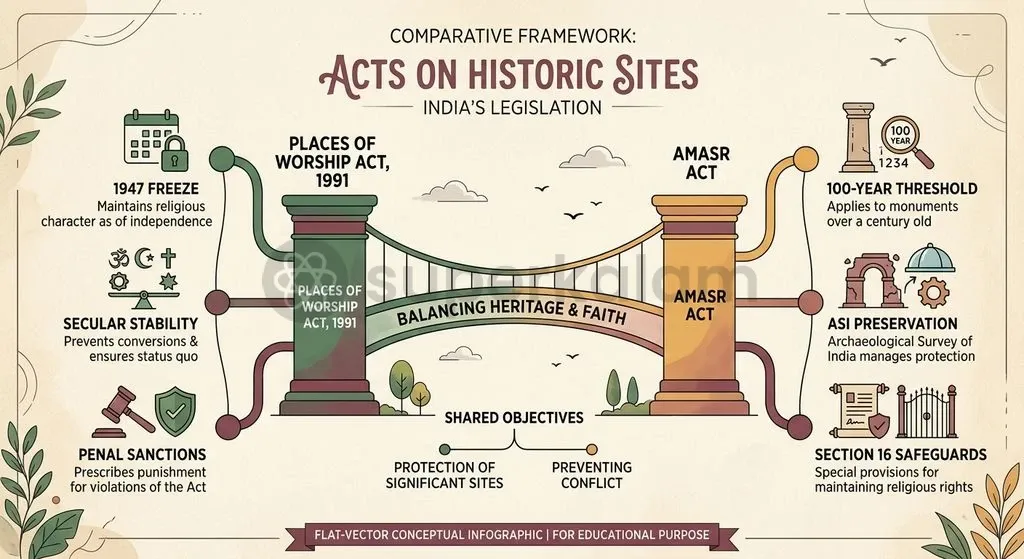
Comparing the Places of Worship Act, 1991 and the AMASR Act, 1958 highlights their fundamentally divergent legislative mandates regarding sanctity, ownership, and temporal cut-off dates.
| Analytical Dimension | Places of Worship (Special Provisions) Act, 1991 | Ancient Monuments and Archaeological Sites and Remains Act, 1958 |
|---|---|---|
| Primary Statutory Objective | Freezes the religious character of shrines and prohibits inter-faith conversion | Conserves ancient monuments, historical sites, and remains of national importance |
| Enforcing Authority | State law-enforcement machinery and criminal courts via Section 6 | Archaeological Survey of India (ASI) and District Collectors under Section 16 |
| Temporal Anchor | August 15, 1947 cut-off date | No fixed calendar cut-off date; protects ancient monuments and sites of national importance |
| Handling of Religious Character | Bars alteration or conversion of character under Section 3 | Preserves monument from misuse inconsistent with its historical character under Section 16(1) |
| Abatement of Lawsuits | Explicit abatement of pending and fresh suits under Section 4(2) | No general abatement; regulates access and structural protection |
| Statutory Interplay | Section 4(3)(a) exempts AMASR monuments from Section 4 | Operates independently under central archaeological mandates |
Constitutional challenges pending before the Supreme Court attack the validity of the 1991 Act itself. Petitions argue that Sections 2, 3, and 4 arbitrarily extinguish judicial remedies under Article 32 and Article 226, while curtailing the rights of devotees to restore places of worship under Article 25 and Article 26 of the Constitution.
The Broader Constitutional Dilemma: Secularism vs Right to Worship
The dispute between preservation statutes triggers fundamental constitutional tensions between Article 25 religious freedoms and the secular non-retrogression principle anchored in basic structure jurisprudence. Devotees seeking worship rights argue that historical structures erected over destroyed shrines violate their fundamental freedom to manage religious affairs under Article 26 and profess faith under Article 25.
Proponents of the 1991 Act point to the constitutional imperative of public order and secularism. In the 2019 Ayodhya judgment, the Supreme Court ruled that historical wrongs cannot be remedied by contemporary legal aggression, noting that historical disputes must yield to the finality of law to preserve civic peace.
This clash represents a classic dilemma between archaeological inquiry and constitutional governance:
- Truth-seeking via Science: Unearthing historical reality through ground-penetrating radar and stratigraphic excavations satisfies factual inquiry.
- Societal Stability: Reopening ancient grievances threatens societal harmony, fraternity, and public order.
Discuss with Superkalam
Compare the statutory objectives of the Places of Worship Act, 1991 with the conservation mandates of the AMASR Act, 1958.
Ask NowThe Way Forward: Balancing Preservation, Faith, and the Rule of Law
Harmonising heritage preservation with constitutional stability requires the Supreme Court of India to clarify the exact legal perimeter of Section 4(3)(a) exemptions. A definitive constitutional bench ruling must determine whether the exemption under Section 4(3)(a) allows substantive declaratory suits under general law, or whether Section 3 operates as an insurmountable bar against any conversion regardless of archaeological findings.
Key institutional measures to balance these competing interests include:
- Judicial Standards for Surveys: Establishing strict evidentiary thresholds before ordering archaeological surveys, ensuring that scientific tools are not used as fishing expeditions to unsettle long-standing religious practices.
- Strict Implementation of Section 16: Mandating that the Archaeological Survey of India strictly enforce the distinction between living and non-living monuments under the AMASR Act, 1958, shielding historical structures from unilateral attempts to alter rituals.
- Administrative Equilibrium: Empowering District Collectors under Section 16(2) to proactively maintain order and prevent unauthorised incursions into disputed religious shrines.
Institutional finality remains vital for democratic governance. By affirming the doctrine of harmonious construction between the AMASR Act, 1958 and the Places of Worship Act, 1991, Indian jurisprudence can preserve national archaeological treasures without compromising secularism and social cohesion.
Discuss with Superkalam
Assess whether ordering archaeological surveys at contested heritage shrines undermines the constitutional principle of non-retrogression recognized in the M. Siddiq judgment.
Ask NowKey Takeaways
The statutory interplay between the Places of Worship Act, 1991 and the AMASR Act, 1958 forms a critical subject for constitutional and administrative evaluation.
- The Places of Worship Act, 1991 establishes August 15, 1947 as the cut-off date to freeze the religious character of all places of worship, barring alterations under Section 3 and abating lawsuits under Section 4(2).
- Section 4(3)(a) of the 1991 Act exempts ancient and historical monuments covered under the AMASR Act, 1958 from the operations of Section 4, creating an active statutory dispute over whether Section 3 still prohibits conversions.
- The AMASR Act, 1958 charges the Archaeological Survey of India with protecting heritage sites of national importance, mandating under Section 16 that places of worship must not be used inconsistently with their character.
- In M Siddiq (2019), the Supreme Court endorsed the 1991 Act as an essential legislative instrument upholding secularism and the constitutional principle of non-retrogression.
- As of December 2024, the Supreme Court issued an interim stay restraining civil courts from registering fresh suits or passing effective orders regarding surveys, seeking to balance archaeological inquiries with communal harmony.
Exam Angle: How UPSC Tests the PoW-AMASR Tension
PYQ trend. Prelims tests which statute does what - the ASI's mandate and AMASR's Section 16 powers versus the 1991 Act's cut-off date and exemptions. Mains GS-II frames it as secularism and non-retrogression versus heritage conservation and judicial fact-finding.
Practice: UPSC Mains GS-II Polity PYQs | Prelims PYQ bank | Topic-wise Polity PYQs with explanations.
Mains answer framework. For a 15-marker comparing the two statutes:
- Map both laws: object, enforcing agency and key sections (PoW Sections 3-5; AMASR Section 16).
- Locate the collision: the Section 4(3)(a) exemption versus Section 3's conversion bar.
- Bring in case law: Ayodhya's non-retrogression principle and the December 2024 Special Bench stay on suits and surveys.
- Conclude with a balancing formula - preserve heritage without reopening settled religious character.
Common mistakes aspirants make.
- Saying the AMASR Act overrides the 1991 Act wholesale - it only carves out protected monuments from Section 4.
- Forgetting AMASR covers only monuments of national importance, not every old structure.
- Treating an ASI survey as a change of religious character - the survey question is precisely what courts are still deciding.
Mains Question
"The Places of Worship (Special Provisions) Act, 1991 operationalises constitutional secularism and non-retrogression by freezing historical disputes." In light of this observation by the Supreme Court in M. Siddiq (2019), examine the statutory mechanisms of the 1991 Act and the legal challenges confronting its enforcement. (10 Marks)
Evaluate NowMains Question
The carve-out under Section 4(3)(a) of the Places of Worship (Special Provisions) Act, 1991 has created a contentious intersection with the Ancient Monuments and Archaeological Sites and Remains (AMASR) Act, 1958. Critically analyse how judicial interpretations of scientific fact-finding versus title disputes impact the preservation of heritage and the freeze on religious character. (15 Marks)
Evaluate NowPractice MCQs
QUESTION 1
With reference to the Places of Worship (Special Provisions) Act, 1991, consider the following statements:
1. It mandates that the religious character of any place of worship shall continue to be the same as it existed on August 15, 1947. 2. It explicitly excludes the Ram Janma Bhumi-Babri Masjid site at Ayodhya from its statutory operation. 3. Section 6 of the Act prescribes capital punishment for attempts to alter the religious identity of a shrine.
Which of the statements given above are correct?
QUESTION 2
Consider the following statements regarding the Ancient Monuments and Archaeological Sites and Remains (AMASR) Act, 1958:
1. It was enacted under Entry 67 of the Union List in the Seventh Schedule of the Indian Constitution. 2. Under Section 16(2), the District Collector is tasked with the statutory duty to protect shrines from pollution, desecration, or entry contrary to customary usages. 3. Under ASI administrative policy, revival of worship is permitted at any monument irrespective of whether rituals were active at the inception of state protection.
Which of the statements given above is/are correct?
QUESTION 3
Regarding the interaction between the Places of Worship (Special Provisions) Act, 1991 and the AMASR Act, 1958, consider the following statements:
1. Section 4(3)(a) of the 1991 Act provides an express exemption for monuments covered under the AMASR Act, 1958. 2. In M. Siddiq v. Mahant Suresh Das (2019), a Constitution Bench held that the 1991 Act affirms constitutional secularism and non-retrogression. 3. The Supreme Court observed in 2022 that merely ascertaining the religious character of a site does not inherently violate Sections 3 and 4 of the 1991 Act.
Which of the statements given above are correct?
QUESTION 4
In the context of recent judicial interventions on historical shrines, what direction was issued on December 12, 2024, by the Supreme Court three-judge bench headed by Chief Justice Sanjiv Khanna?
QUESTION 5
Consider the following legal provisions and their statutory origins:
1. Section 4(2) abatements of pending proceedings — Places of Worship (Special Provisions) Act, 1991 2. Section 16(1) requirement that a protected shrine maintained by the Central Government shall not be used inconsistently with its character — AMASR Act, 1958 3. Section 5 specific exclusion of the Ram Janma Bhumi dispute — AMASR Act, 1958
Which of the pairs given above is/are correctly matched?