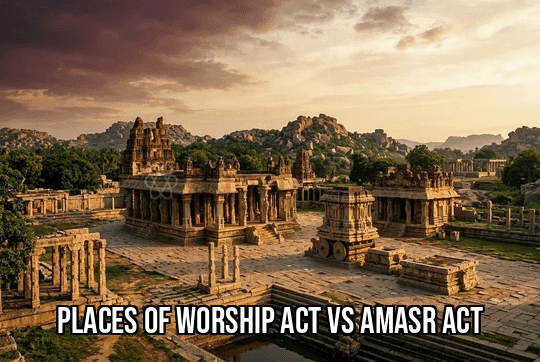
Places of Worship Act 1991: Key Provisions, SC Challenge & Stays
As the Supreme Court halts site surveys, the clash between statutory finality and constitutional rights tests India's secular framework and rule of law.
Nov, 2026
•15 min read
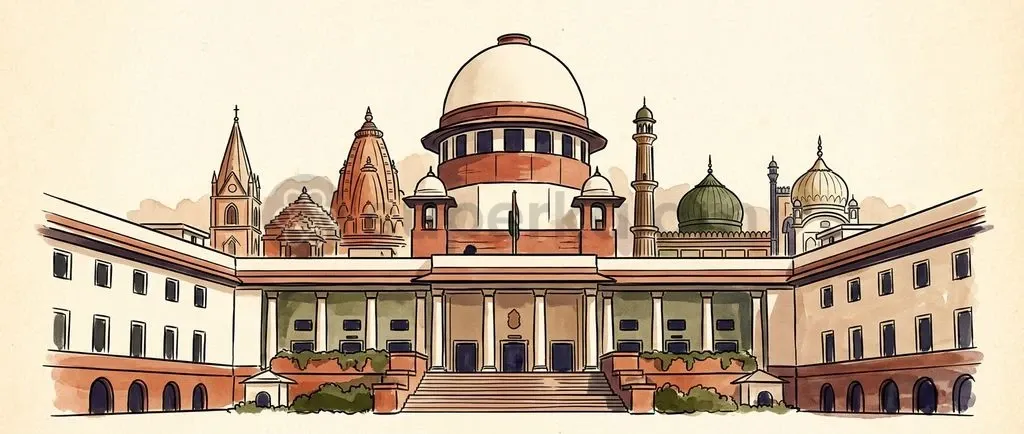
Updated 27 November 2026
At a Glance
| Question | Quick answer |
|---|---|
| What does the 1991 Act do? | It freezes the religious character of every place of worship as of 15 August 1947, bars conversion of any shrine (Section 3) and abates pending suits over religious character (Section 4(2)). |
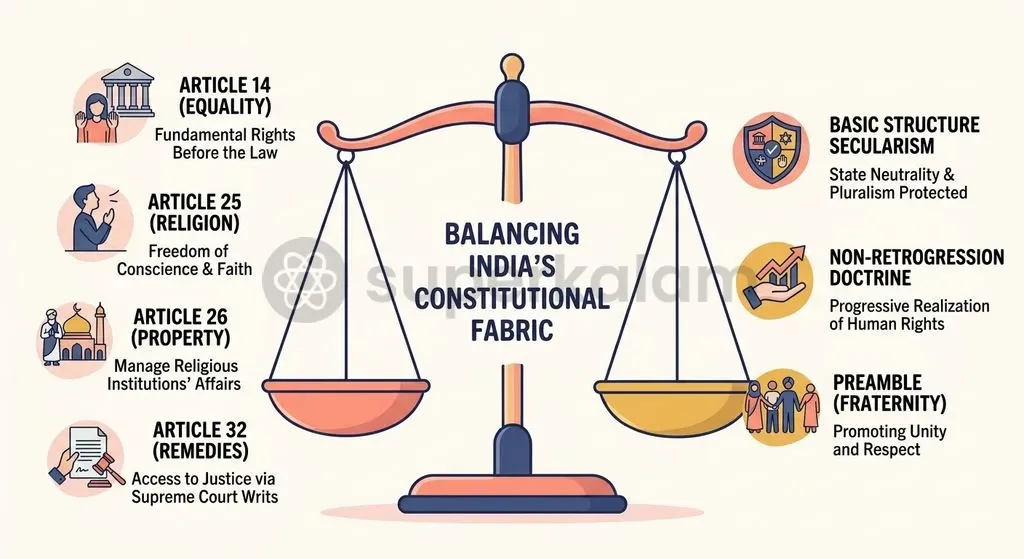
| What is the constitutional challenge? | Petitions led by Ashwini Kumar Upadhyay v. Union of India argue the Act violates equality (Article 14), religious freedom (Articles 25-26) and the right to judicial review (Article 32). |
| What did the Supreme Court say in Ayodhya (2019)? | The five-judge bench in M Siddiq v. Mahant Suresh Das treated the Act as a legislative expression of non-retrogression, tied to secularism as part of the Basic Structure. |
| What is the live procedural position? | On 12 December 2024 a Special Bench headed by CJI Sanjiv Khanna barred civil courts from registering fresh suits and restrained effective interim orders, including surveys, until the challenge is decided. |
| What is exempt from the freeze? | Section 5 excludes the Ram Janma Bhoomi-Babri Masjid site; Section 4(3)(a) exempts ancient monuments protected under the AMASR Act, 1958. |
Overview
The Places of Worship (Special Provisions) Act, 1991 faces an existential constitutional challenge before the Supreme Court of India. The fundamental dispute asks whether Parliament can extinguish judicial determination of historical religious status to secure secularism and public peace.
Enacted as Act No. 42 of 1991, the statute freezes the religious character of all places of worship across the country as of August 15, 1947. It bars the religious conversion of shrines and abates pending civil property disputes.
Petitioners argue that these blanket restrictions violate judicial review under Article 32 and religious freedoms under Articles 25 and 26. In response, defenders maintain that the statute enforces non-retrogression and protects secularism as part of the Basic Structure. The dispute tests whether this parliamentary cut-off serves as an indispensable shield for constitutional secularism or an unconstitutional bar on judicial remedies.
Why Is the Places of Worship Act in the News?
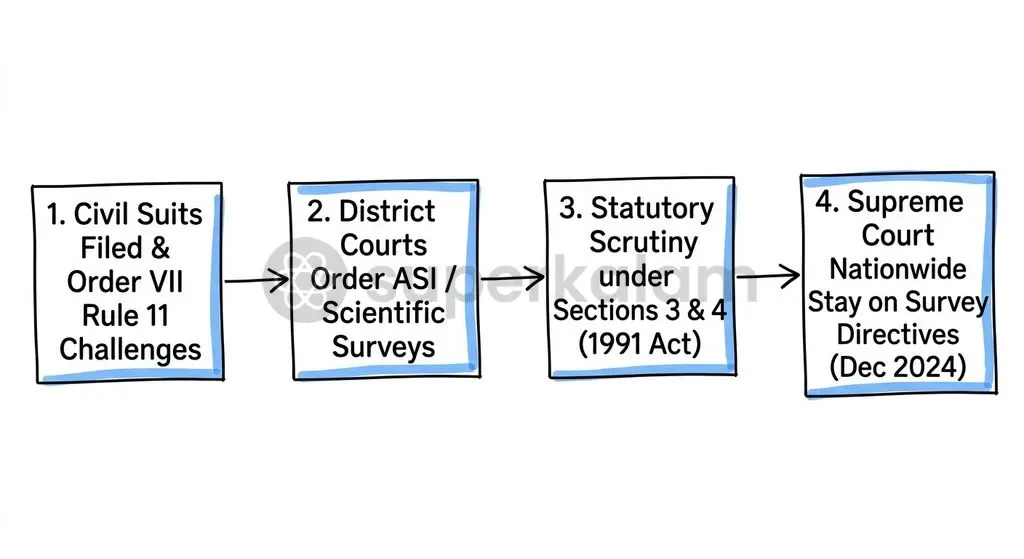
The Supreme Court of India placed significant procedural curbs on religious site litigation on December 12, 2024. A three-judge Special Bench headed by Chief Justice Sanjiv Khanna stayed trial courts from registering fresh suits and restrained all courts from passing effective interim or final orders, including directing surveys, regarding existing religious structures pending adjudication of the 1991 Act.
As of December 2024, multiple lower civil courts had entertained property suits concerning historical mosques across Uttar Pradesh, ordering physical inspections through advocate commissioners. The apex court intervened to halt this jurisdictional clash:
- Trial court orders: Subordinate courts admitted civil suits and directed local surveys of historical mosques.
- Appellate pause: The Supreme Court intervened to prevent conflicting local factual inquiries while the statutory validity remains undecided.
- Core constitutional question: The pending writ petitions place the constitutional validity of Sections 2, 3, and 4 directly before the highest court.
What Is the Places of Worship (Special Provisions) Act, 1991?
The Places of Worship (Special Provisions) Act, 1991 was enacted by Parliament to prohibit the conversion of religious sites and preserve their character as of August 15, 1947. Parliament enacted the legislation as Act No. 42 of 1991, receiving Presidential assent on September 18, 1991, with its substantive freeze provisions deemed to take effect retrospectively from July 11, 1991.
The primary objective stated in the long title of the statute is to prohibit conversion of any place of worship and to maintain the religious character of any place of worship as it existed on August 15, 1947.
The statute rests on two clear pillars:
- Historical baseline: Independent India's religious topography remains tethered to the moment of national independence.
- Legislative boundary: The statutory design emerged during heightened communal friction over the Ram Janmabhoomi movement in Ayodhya, deliberately precluding retrospective property claims.
Key Provisions and the Cut-Off Date of August 15, 1947
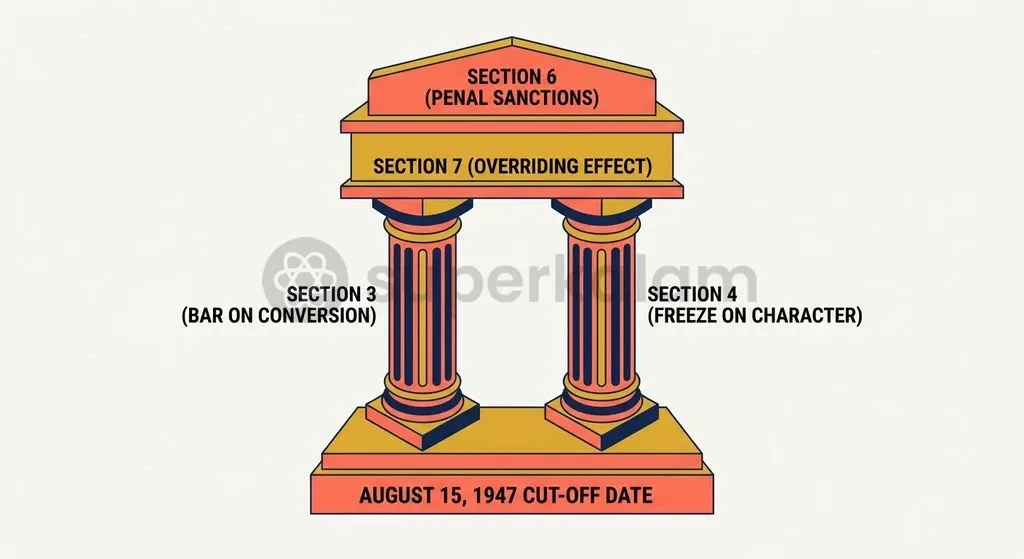
Section 3 and Section 4 constitute the operative core of the Places of Worship (Special Provisions) Act, 1991 by prohibiting conversion and abating ongoing civil litigation. These two sections function as joint legal barriers against physical alterations and judicial claims aimed at changing a shrine's religious denomination.
The statutory mechanics operate through four principal provisions:
- Absolute Bar on Conversion (Section 3): Imposes an absolute prohibition against converting any place of worship of any religious denomination or section into a place of worship of a different religious denomination or even a different section of the same denomination.
- Declaration of Religious Character (Section 4(1)): Mandates that the religious character of a place of worship existing on the 15th day of August, 1947 shall continue to be the same as it existed on that day.
- Abatement of Legal Proceedings (Section 4(2)): Directs that any suit, appeal, or legal proceeding regarding the conversion of the religious character of a place of worship existing on August 15, 1947 pending on the date of commencement shall abate, and no fresh suit or legal proceeding shall be instituted.
- Penal Sanctions (Section 6): Prescribes criminal penalties of imprisonment for up to three years and a fine for anyone who contravenes the prohibition against conversion contained in Section 3.
Parliament established August 15, 1947 as the cut-off date to coincide with India's birth as an independent, sovereign state. The statutory baseline establishes that independent India does not sit in judgment over historical actions that preceded the adoption of the republican Constitution.
Discuss with Superkalam
Recall the exact cut-off date established by the Places of Worship Act, 1991, and name the specific shrine dispute explicitly excluded by Section 5.
Ask NowExceptions Carried Under the 1991 Act
Section 5 of the Places of Worship Act explicitly excludes the Ram Janma Bhumi-Babri Masjid dispute in Ayodhya from the statutory prohibitions against conversion and civil litigation. Lawmakers crafted this explicit statutory carve-out because the dispute had already formed the subject of extensive, decades-long civil adjudication prior to the 1991 enactment.
Section 4(3) sets out several further statutory exceptions where the legislative freeze does not apply:
- Ancient Monuments: Section 4(3)(a) excludes any place of worship that is an ancient and historical monument or an archaeological site covered by the Ancient Monuments and Archaeological Sites and Remains Act, 1958 or any other corresponding law.
- Settled Matters: Section 4(3)(b) exempts suits, appeals, or legal proceedings that have been finally settled or disposed of by competent courts before the commencement of the statute.
- Compromise and Acquiescence: Section 4(3)(c) and Section 4(3)(d) exempt disputes settled by the parties themselves prior to the cut-off date or conversions effected through mutual acquiescence.
- Barred by Limitation: Section 4(3)(e) protects conversions where the limitation period for initiating legal action had expired before the Act commenced.
| Statutory Provision | Target Domain | Legal Effect Under the 1991 Act |
|---|---|---|
| Section 3 | All religious places of worship | Complete prohibition on inter-faith or intra-faith conversion |
| Section 4(1) | Status as of August 15, 1947 | Preserves historical religious identity existing at independence |
| Section 4(2) | Pending and prospective litigation | Mandates abatement of pending suits and bars new court filings |
| Section 4(3)(a) | Sites under the AMASR Act, 1958 | Fully exempted from the freeze provisions of the 1991 Act |
| Section 5 | Ayodhya Ram Janma Bhumi dispute | Explicitly excluded from the entire application of the statute |
Why Is the Act Being Challenged in the Supreme Court?
The Supreme Court of India entertained a constitutional challenge against the 1991 statute in the lead petition Ashwini Kumar Upadhyay v. Union of India. Registered as Writ Petition (Civil) No. 1246 of 2020, the litigation questions whether Parliament exceeded its powers and violated core constitutional guarantees by enacting Sections 2, 3, and 4.
Petitioners challenge Parliament's legislative competence by invoking the Seventh Schedule of the Constitution. Litigants argue that places of worship and pilgrimages fall under State List entries:
- Entry 1 (public order): Entrusting states with maintaining public order and local peace.
- Entry 7 (pilgrimages): Confining pilgrimages within India to state legislative authority.
- Entry 32 (religious corporations): Covering unincorporated religious societies and religious corporations within state remit.
Petitioners contend that Parliament lacked competence under the Union List or Concurrent List to impose a uniform statutory freeze across state subjects.
Discuss with Superkalam
Explain how the legal doctrine of a consecrated idol possessing juristic personality conflicts with the statutory freeze imposed by Section 4.
Ask NowThe Equality and Judicial Review Arguments: Articles 14 and 32
Petitioners challenging the Places of Worship Act contend that Section 4(2) subverts judicial review under Article 32, which forms an inviolable part of the Basic Structure doctrine. Judicial review represents the constitutional guarantee that citizens can approach constitutional courts to determine civil rights and test state actions.
In their pleadings, petitioners challenge Section 4 along two distinct constitutional axes:
- Closure of Judicial Remedies (Article 32): By abating ongoing claims and barring fresh filings, Section 4(2) allegedly infringes judicial review as part of the Basic Structure established in L. Chandra Kumar (1997). Aggrieved communities are denied judicial remedies for historical property expropriations.
- Arbitrary Cut-Off Date (Article 14): Litigants argue that fixing August 15, 1947 creates an arbitrary classification that legitimises medieval architectural desecrations. The date immunises dispossession before independence while penalising conversions attempted after it.
Freedom of Religion vs Legislative Freeze: Articles 25 and 26
Litigants invoke Article 25 and Article 26 to argue that the 1991 Act curtails the fundamental right of religious denominations to manage sacred properties. Religious freedoms under the Indian Constitution encompass the right to worship according to religious tenets and administer consecrated endowments.
The confrontation centres on competing interpretations of religious rights:
- Perpetual Juristic Rights: Petitioners argue that Hindu deities possess perpetual juristic personality, meaning consecrated religious endowments cannot be extinguished by adverse possession or structural destruction. Under Article 26(b) and Article 26(c), the religious character of dedicated land remains indelible.
- Public Order Limitations: Defenders respond that Part III rights are expressly subject to public order, morality, and health. Religious practice cannot operate as an unconstrained right to disrupt civil peace or reclaim sites continuously held by another community for centuries.
The Secularism Debate: Protective Shield or Constitutional Distortion?
The debate over the Places of Worship Act divides legal scholars between defending an affirmative statutory shield for secularism and opposing the statutory bar on adjudicating historical claims. The controversy turns on how the concept of secularism interacts with historical disputes in a plural republic.
| Stance | Primary Legal Contention | Underlying Constitutional Vision |
|---|---|---|
| Statutory Shield (Defenders & Interveners) | Law enforces the basic feature of secularism recognized in S.R. Bommai (1994) | Protects minority security and state neutrality by ending perpetual communal litigation over heritage sites. |
| Constitutional Distortion (Challengers & Petitioners) | Blanket bans suppress verifiable property rights and historical facts | Genuine secularism requires judicial scrutiny of past desecrations rather than legislative immunity. |
The competing positions present two distinct views: one prioritising historical reclamation through individual rights, and the other prioritising collective harmony through non-retrogression.
What Did the Supreme Court Say in the 2019 Ayodhya Verdict?
A unanimous five-judge Constitution Bench of the Supreme Court affirmed the validity of the 1991 statute in M. Siddiq v. Mahant Suresh Das in 2019. While adjudicating the title dispute over the Babri Masjid-Ram Janmabhoomi site, the bench extensively evaluated the statutory purpose and constitutional status of the Places of Worship Act.
The bench grounded the 1991 statute directly in basic constitutional values:
- Protection of secularism: Parliament enacted the statute to ensure that religious disputes do not destabilise constitutional governance.
- Principle of non-retrogression: The Court observed that non-retrogression is a foundational feature of constitutional principles of which secularism is a core component.
- Limits on historical repair: Modern constitutional democracy does not allow using historical grievances as vehicles to dismantle present-day rights.
Discuss with Superkalam
Analyse the federalism arguments raised by petitioners regarding Parliament's legislative competence under List II (State List) entries.
Ask NowRecent Judicial Developments: Gyanvapi, Mathura, and Property Surveys
Trial courts across Uttar Pradesh ordered structural and commissioner surveys at contested medieval mosques, distinguishing preliminary ascertainment of religious character from statutory conversion. These orders exposed a critical jurisdictional debate regarding what Section 4 actually prohibits.
Key judicial steps unfolded in rapid succession:
- Oral observation on ascertainment (2022): On May 20, 2022, during the Gyanvapi Mosque proceedings, the Supreme Court orally observed that ascertaining religious character as of August 15, 1947 is not per se barred by the 1991 Act.
- Lower court survey orders: Relying on that distinction, trial courts ordered scientific and advocate commissioner surveys at contested sites including Gyanvapi in Varanasi, Shahi Eidgah in Mathura, and Shahi Jama Masjid in Sambhal.
- Apex court intervention (2024): The Supreme Court paused this progression on December 12, 2024, restraining lower courts from directing interim surveys until it formally determines the constitutional validity of the statute.
Arguments in Favour of Retaining the Act Without Changes
Supporters of the Places of Worship Act maintain that the law preserves civil peace by preventing unending cycles of competitive communal litigation over centuries-old monuments. Erasing the statutory cut-off date would permit private parties to dispute the status of thousands of religious sites across the country.
Defenders articulate four primary arguments for retaining the statute without dilution:
- Preventing Inter-Religious Friction: Prohibiting property disputes over medieval conversions insulates the republic from coordinated communal mobilisation around religious sites.
- Preserving Constitutional Secularism: Upholds state neutrality by refusing to use modern state machinery to arbitrate historical religious conquests.
- Legislative Finality and Stability: Secures title, possession, and worship rights across all communities, giving stability to social relations.
- Protection of Minorities: Shields religious minority properties from majoritarian claims, preserving the fragile multi-faith compact established at independence.
Advocates argue that opening the statutory freeze would transform civil courts into arenas of historical grievance, directly undermining public order.
Discuss with Superkalam
Evaluate whether precluding preliminary fact-finding surveys by civil courts strengthens or undermines the constitutional guarantee of secularism.
Ask NowWay Forward: Balancing Fundamental Rights, Heritage, and Civil Peace
The Supreme Court of India must reconcile the constitutional guarantee of judicial review with the legislative imperative of preserving communal fraternity and secularism. A definitive constitutional ruling from the Supreme Court is essential to provide clarity for both civil courts and religious communities.
The constitutional resolution should rest on three institutional pillars:
- Clarifying the Ascertainment Threshold: The Supreme Court must clarify whether civil courts possess the power to order architectural surveys, setting strict evidentiary standards to prevent preliminary inquiries from nullifying Section 4(2)'s statutory freeze.
- Harmonising with Heritage Legislation: Courts must precisely define the relationship between Section 4(3)(a) of the 1991 Act and the Ancient Monuments and Archaeological Sites and Remains Act, 1958 to ensure protected monuments are preserved without generating fresh title litigation.
- Reaffirming Constitutional Secularism: The judiciary must reaffirm the core holding of M. Siddiq (2019) that non-retrogression is central to India's secular commitments, preventing historical grievances from destabilising contemporary civil society.
Key Takeaways
- The Places of Worship (Special Provisions) Act, 1991 establishes a statutory freeze on the religious status of worship sites as of August 15, 1947.
- Section 3 prohibits conversion of any place of worship across or within denominations, backed by penal sanctions of up to three years imprisonment under Section 6.
- Section 5 explicitly excludes the Ram Janma Bhumi-Babri Masjid site in Ayodhya, while Section 4(3)(a) exempts monuments protected under the AMASR Act, 1958.
- The constitutional challenge in Ashwini Kumar Upadhyay v. Union of India alleges violations of judicial review under Article 32, equality under Article 14, and religious rights under Articles 25 and 26.
- The Supreme Court's 2019 Ayodhya verdict described the 1991 Act as an affirmative legislative measure to protect secularism and non-retrogression as basic features of the Constitution.
- On December 12, 2024, a three-judge bench of the Supreme Court stayed trial courts from entertaining fresh suits or directing surveys of existing religious structures until constitutional validity is decided.
Exam Angle: How UPSC Tests the Places of Worship Act
PYQ trend. Prelims tests the cut-off date (15 August 1947), the Section 5 Ayodhya exemption and the AMASR carve-out; Mains GS-II asks whether a legislative freeze on religious character can coexist with judicial review and secularism as a basic-structure value.
Practice: UPSC Mains GS-II Polity PYQs | Prelims PYQ bank | Topic-wise Polity PYQs with explanations.
Mains answer framework. For a 15-marker on the constitutional challenge:
- State the Act's core: Section 3 conversion bar, Section 4(1) freeze, Section 4(2) abatement of suits.
- Put the petitioner's case: Articles 14, 25, 26 and the Article 32 remedy bar.
- Put the defence: non-retrogression and secularism from the Ayodhya verdict, plus the public-order rationale.
- Close with the December 2024 Special Bench curbs and the need for an early final hearing.
Common mistakes aspirants make.
- Mixing up Section 3 (bar on conversion) with Section 4(2) (abatement of pending suits).
- Claiming the Ayodhya site was covered by the freeze - Section 5 expressly exempted it.
- Writing that the Supreme Court has struck down or upheld the Act - the challenge is still pending; only procedural curbs exist.
Mains Question
"By prioritising historical closure over retrospective restorative justice, the Places of Worship (Special Provisions) Act, 1991 seeks to uphold secularism and civic peace." In this context, critically examine the constitutional challenges raised against Sections 3 and 4 of the Act under Articles 14, 25, and 32. (15 Marks)
Evaluate NowMains Question
The Places of Worship (Special Provisions) Act, 1991 embodies a delicate balance between freezing historical disputes and accommodating statutory exceptions. Elucidate the scope of exemptions provided under Section 4(3) and Section 5 of the Act. (10 Marks)
Evaluate NowPractice MCQs
QUESTION 1
With reference to the Places of Worship (Special Provisions) Act, 1991, consider the following statements:
1. The Act came into force with retrospective effect from July 11, 1991. 2. It explicitly exempts ancient and historical monuments governed by the Ancient Monuments and Archaeological Sites and Remains Act, 1958. 3. The statute provides that any dispute decided or settled by parties prior to its enactment remains unaffected by the statutory freeze.
Which of the statements given above are correct?
QUESTION 2
Regarding the statutory scheme of the Places of Worship (Special Provisions) Act, 1991, consider the following statements:
1. Section 3 penalises any breach of conversion with imprisonment up to three years alongside a monetary fine. 2. Section 4(2) mandates the abatement of pending title suits and bars the institution of fresh legal proceedings regarding conversion. 3. Section 5 explicitly excludes the Ram Janma Bhumi-Babri Masjid site in Ayodhya from the conversion freeze.
Which of the statements given above is/are correct?
QUESTION 3
In the constitutional challenges mounted against the Places of Worship (Special Provisions) Act, 1991, petitioners have challenged Parliament's legislative competence by citing which of the following State List (List II) entries under the Seventh Schedule?
QUESTION 4
Consider the following statements regarding the interim directions issued by the Supreme Court of India in December 2024 concerning the Places of Worship Act, 1991:
1. The bench directed that no fresh civil suits touching upon the religious character of shrines may be filed anywhere in India. 2. The bench ordered that lower courts across India shall not register fresh suits or pass effective interim or final orders, including scientific surveys.
Which of the statements given above is/are correct?
QUESTION 5
Under the Places of Worship (Special Provisions) Act, 1991, which statutory provision accords the Act overriding effect over any other inconsistent legislative enactment?