Front-of-Pack Labelling in India: Supreme Court Mandate on Warning Labels
By placing public health under Article 21 above corporate autonomy, the Supreme Court's warning label mandate fundamentally reshapes Indian food governance.
Nov, 2026
•14 min read
Updated 27 November 2026
At a Glance
| Question | Quick answer |
|---|---|
| What are the three contending models? | Warning labels (red-hexagon alerts per nutrient), Health Star Ratings (a single summary score), and Guideline Daily Amounts (numeric percentages per serving). |
| What did the Supreme Court order on 26 November 2026? | FSSAI and companies must implement front-of-pack warning labels on firm timelines - four months initially, one year at the outer limit. |
| Why do health experts favour warning labels? | They flag each excessive nutrient directly; summary scores can mask high sugar, salt or fat, and GDA percentages demand numeracy many consumers lack. |
| What does global evidence show? | Chile's warning-label law cut purchases of high-sugar products; Australia's star ratings saw uneven uptake; the UK's traffic-light labels improved choices where adopted. |
| What is the industry position? | Compliance costs, reformulation pressure and a preference for softer summary formats - arguments the Court answered with binding timelines. |
Overview
The Supreme Court of India in 3S and Our Health Society v. Union of India mandated that the Food Safety and Standards Authority of India implement front-of-pack warning labels using red hexagons. This directive resolved a long regulatory contest, rejecting summary star ratings in favour of clear pictorial warnings on packaged foods high in salt, sugar, or saturated fat.
The court grounded nutritional transparency in the fundamental right to health under Article 21, read alongside the State's duty to improve public health under Article 47. Non-communicable diseases drive roughly two-thirds of total mortality across the country. By prioritising direct interpretive warnings over algorithmic scoring models, the decision tackles an escalating epidemiological crisis and establishes a binding compliance framework for food business operators.
Why Front-of-Pack Labelling Is in the Spotlight
The Supreme Court fundamentally restructured national food safety governance on 26 November 2026 by directing mandatory front-of-pack nutritional warning labels. As of November 2026, a bench ruling in 3S and Our Health Society v. Union of India & Ors. held that clear front-of-pack nutritional warnings constitute an integral facet of the Fundamental Right to Health, safe food, and informed choice under Article 21, harmonised with the State's constitutional duty to elevate public health under Article 47.
The apex court ordered the Food Safety and Standards Authority of India (FSSAI) to enforce specific design rules for packaged foods crossing safety limits:
- Separate red hexagons: Each nutrient of concern exceeding permissible limits must display an independent red hexagon.
- Mandatory warning text: Hexagons must feature standardised pictorial representations alongside explicit text marking 'HIGH FAT', 'HIGH SUGAR', or 'HIGH SALT'.
- Minimum display area: The visual warning must occupy not less than 4% to 5% of the principal display panel.
- Specific targets: FSSAI must regulate total sugars and saturated fat rather than added sugars or added fats, closing industrial reporting loopholes.
The ruling establishes an enforceable implementation schedule. FSSAI must reformulate nutrient thresholds within four months, submit a formal progress affidavit within 10 weeks, and enforce a strict 365-day compliance transition period for food business operators with no routine administrative extensions permitted. This judicial intervention ends years of regulatory inertia, firmly establishing that public health outranks commercial convenience.
Discuss with Superkalam
Can you recall the specific statutory provision of the Food Safety and Standards Act, 2006 under which FSSAI is directed to enforce the new labelling norms?
Ask NowWhat Is Front-of-Pack Labelling and Why India Needs It
Front-of-Pack Labelling (FOPL) places simplified nutritional symbols on the principal display panel of pre-packaged goods. FSSAI relies on this system to translate complex nutritional tables into immediate consumer purchasing cues at retail shelves.
India urgently requires an effective front-of-pack architecture due to several compounding public health realities:
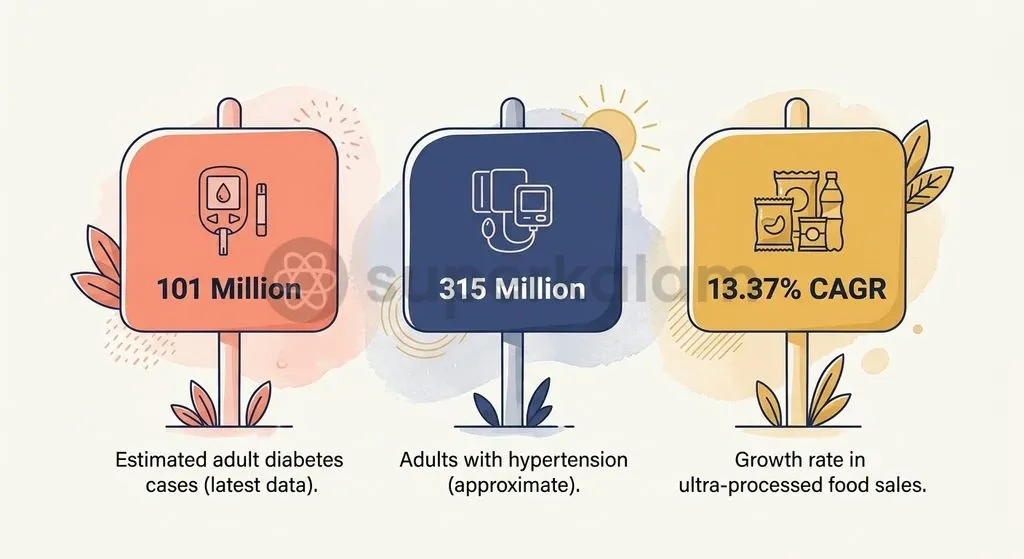
- Severe chronic disease burden: According to the World Health Organization (WHO), Non-Communicable Diseases (NCDs), including cardiovascular conditions, diabetes, and cancers, account for approximately 66% of all deaths in India, driven primarily by diets high in fat, sugar, and salt.
- Limitations of back-of-pack tables: Traditional nutritional panels fail to inform ordinary shoppers. They demand nutritional literacy, numerical fluency, and familiarity with metric portions.
- Regulatory double standards: The Supreme Court observed that several multinational food business operators maintain strict front-of-pack warning labels across their overseas operations while resisting comparable standards in India. The bench directed that Indian citizens are legally entitled to equal health protections.
Breaking Down the Three Contenders: Warning Labels, Star Ratings, and GDA
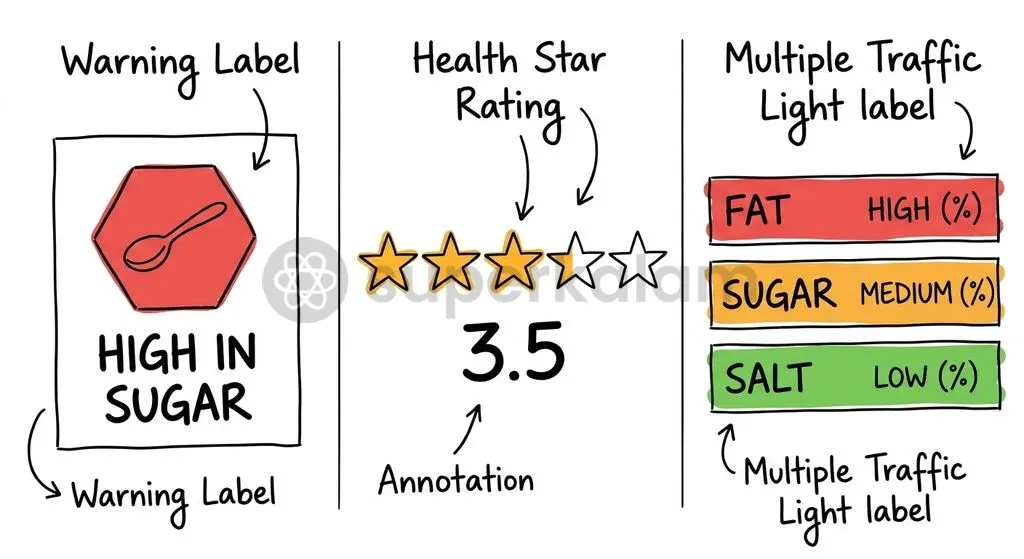
FSSAI has evaluated three principal labelling architectures to guide packaged food regulation:
- Interpretive warning symbols: Standalone visual alerts for specific high-risk nutrients.
- Algorithmic star ratings: Scaled summary scores balancing positive and negative ingredients.
- Quantitative intake summaries: Numerical metric panels reflecting guideline daily amounts.
Each model reflects divergent philosophies regarding consumer guidance and commercial obligations.
1. Interpretive Warning Labels (The Chilean Model)
Interpretive warning models alert consumers whenever specific negative nutrients breach statutory limits. Instead of evaluating a food item holistically, the system applies independent visual warnings for each offending nutrient.
In accordance with the apex court's directive, the proposed Indian format utilises separate red hexagons that combine pictorial graphics with text specifying high concentrations of salt, total sugar, or saturated fat. By focusing on total sugars and saturated fats, the standard prevents manufacturers from concealing unwholesome formulations behind industrial ingredient variants.
2. Health Star Ratings (The Proposed Indian Nutrition Rating)
FSSAI initially proposed the Indian Nutrition Rating (INR) through draft amendments to the Food Safety and Standards (Labelling and Display) Regulations, 2020.
Adapted from the Australian and New Zealand Health Star Rating (HSR) system, the INR assigns packaged goods a summary score ranging from 0.5 to 5 stars. The score is derived from an algorithm that offsets negative nutrients such as energy, saturated fat, sugars, and sodium against positive components like fruits, vegetables, nuts, legumes, protein, and dietary fibre.
3. Guideline Daily Amounts and Traffic Lights
The Guideline Daily Amount (GDA) model is a non-interpretive system that lists the numerical quantity of calories, fats, and sugars per serving alongside their percentage contribution to a standard daily diet.
The United Kingdom supplemented this metric format by adopting a Multiple Traffic Light (MTL) colour code. The UK system applies green, amber, or red visual signals to individual nutrients based on standardised thresholds per 100 grams and per portion, providing detailed nutritional data without giving a blanket warning.
Discuss with Superkalam
How does the 'health halo effect' undermine the core objective of front-of-pack nutrition labelling in ultra-processed foods?
Ask NowComparison Table: How the Three Labelling Systems Stack Up
The Food Safety and Standards Authority of India evaluates front-of-pack models across cognitive accessibility, commercial feasibility, and empirical disease-prevention efficacy. The table below delineates the core differences between the three regulatory systems:
| Dimension | Interpretive Warning Labels (Chile / Mandated India Model) | Health Star Ratings / INR (Australia / Proposed FSSAI 2022) | Guideline Daily Amount + Traffic Lights (United Kingdom) |
|---|---|---|---|
| Visual Architecture | Standalone geometric shapes (separate red hexagons carrying text and pictorial icons). | Summary rating displaying a 0.5 to 5 stars gradient. | Numeric panels featuring green, amber, and red colour-coded bands. |
| Nutrient Scoring Mechanism | Negative nutrients evaluated independently; no algorithmic offsetting permitted. | Net algorithm balancing negative nutrients against positive components (protein, fibre, produce). | Absolute nutrient values displayed per portion and per 100g against daily intake shares. |
| Consumer Accuracy in India | Achieved 60.8% accuracy in identifying unhealthy packaged items. | Achieved 45.0% accuracy among Indian adults. | Achieved 55.0% (GDA) and 54.8% (Traffic Lights) comprehension accuracy. |
| Vulnerability to Manipulation | Minimal; products exceeding specific nutrient cut-offs cannot conceal the violation. | High risk of the health halo effect through targeted fortification with isolated fibre or protein. | Moderate; requires consumers to synthesise multiple colour bars across portions. |
| Cognitive Demands | Very low; functions as an intuitive stop sign suitable for low-literacy demographics. | Moderate; communicates overall product quality but obscures single high-risk nutrient levels. | High; imposes a heavy mathematical calculation burden on general shoppers. |
The Public Health View: Why Health Experts Favor Warning Labels
Medical professionals and public health institutions advocate warning labels because simple visual markers maximise comprehension across multilingual communities. Summary scoring systems confuse shoppers in a country with varied literacy levels.
Empirical field research in India strongly validates interpretive warning designs:
- Superior identification: In a randomised controlled field experiment evaluating 2,869 Indian adults across six states, warning labels secured the highest consumer accuracy at 60.8% in identifying unhealthy foods.
- Ineffective alternatives: The same trial recorded only 45.0% for Health Star Ratings and 39.1% for the control group.
- Marketing resistance: The trial demonstrated that warning labels cut through commercial marketing imagery far more effectively than star ratings.
Medical researchers caution that summary star matrices induce a dangerous health halo effect, as highlighted by The Lancet Diabetes & Endocrinology. Under an algorithmic calculation, a food manufacturer can produce a biscuit loaded with sugar and palm oil, mix in isolated pea protein or synthetic chicory fibre, and secure an artificially inflated star score. Ultra-processed food remains detrimental to metabolic health regardless of supplemental additives.
The World Health Organization notes that monochrome GDA panels impose severe cognitive friction on shoppers with low numeracy, requiring mathematical calculations against recommended daily calorie intakes. Red warning hexagons eliminate calculation barriers by communicating health risks instantaneously.
Discuss with Superkalam
How would the mandatory red warning label influence the purchasing behavior of a semi-literate consumer compared to numerical back-of-pack nutritional facts?
Ask NowThe Industry View: Economic Pressures and Consumer Choice Arguments
The Confederation of Indian Industry and allied trade bodies argue that harsh warning labels disrupt food processing supply chains and depress regional enterprise. Packaged food manufacturers advocate voluntary frameworks or positive star ratings to safeguard commercial viability.
Industry submissions outline several direct commercial and operational concerns:
- Sales impacts on traditional foods: Mandatory warning symbols could trigger sharp sales drops across traditional Indian snacking categories, such as namkeen, bhujia, and bakery biscuits.
- Intensive lobbying: Major commercial organisations, including CII and FICCI, consistently lobbied against interpretive black or red warnings, urging FSSAI to deploy voluntary star systems or non-interpretive GDA tables.
- Stakeholder review: After receiving over 14,000 public and stakeholder representations, FSSAI constituted an Expert Committee on Front-of-Pack Labelling on February 17, 2023 to examine these competing socio-economic concerns.
Manufacturers emphasise that reformulating long-standing recipes requires substantial investment in research and production equipment. Reducing sodium, sugar, or saturated fat while maintaining product shelf life and consumer taste profiles presents complex technical hurdles for micro, small, and medium enterprises (MSMEs).
Recognising these processing limits, FSSAI clarified that single-ingredient staple foods—specifically ghee, edible oils, raw sugar, and table salt—will remain exempt from warning labels, acknowledging that their inherent compositional nature cannot be altered without changing the product itself.
Discuss with Superkalam
Compare the regulatory trade-offs between the UK Multiple Traffic Light system and Chile's black octagonal warning model in addressing dietary non-communicable diseases.
Ask NowWhat Global Evidence Shows: Lessons from Chile, Australia, and the UK
Empirical data from international regulatory bodies demonstrates how divergent front-of-pack labelling designs influence consumer purchasing behaviour and corporate recipe formulation. Cross-country experiences provide useful regulatory guidance for India's evolving framework:
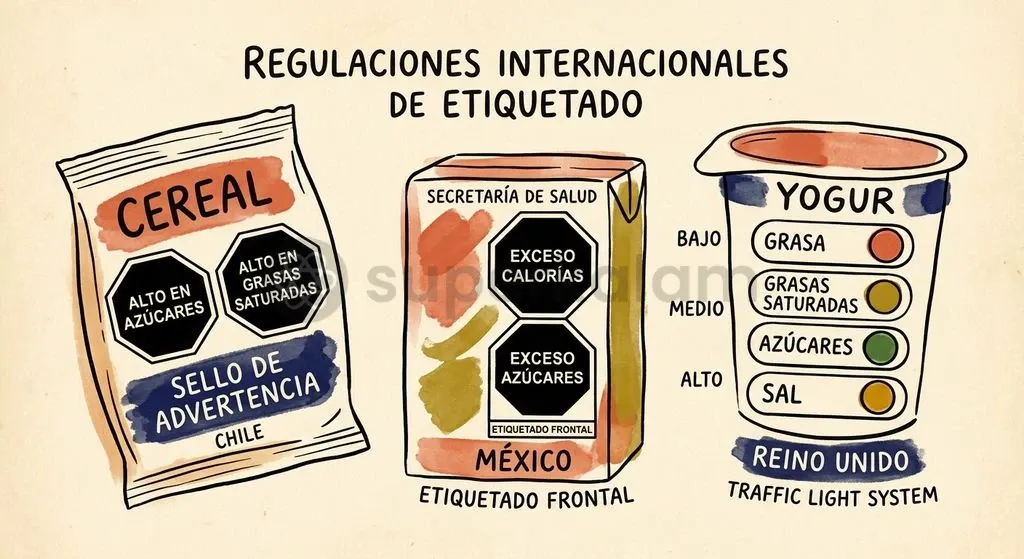
- Chile (Mandatory Warnings): Under Law 20.606, enacted in 2016, Chile introduced mandatory black octagonal warning labels displaying the text 'ALTO EN' (High in) for excessive calories, saturated fats, sugars, and sodium. Longitudinal evaluations revealed that Chilean octagons drove immediate drops in purchases of high-sugar beverages and motivated widespread industry reformulation across major processed food categories.
- Australia and New Zealand (Voluntary Star Ratings): The voluntary Health Star Rating system evaluates products from 0.5 to 5 stars based on an algorithm offsetting baseline negative nutrients with positive components. While HSR encouraged some voluntary product reformulations, independent audits revealed persistent uptake bias. Manufacturers voluntarily displayed star scores on healthier products while omitting them from unhealthier offerings, blunting public health gains.
- United Kingdom (Hybrid Traffic Lights): The UK operates a hybrid scheme combining Guideline Daily Amounts with a Multiple Traffic Light palette. While this format provides detailed information for health-conscious shoppers, public health researchers note that interpreting three colour tiers across five distinct nutrients per serving demands significant nutritional awareness from the public.
Ethical Dimensions: Right to Informed Health vs Corporate Autonomy
The Supreme Court of India framed mandatory food labelling as an ethical confrontation between the fundamental right to health and commercial corporate autonomy. The constitutional debate centres on balancing private business rights against the collective welfare of consumers.
Key constitutional and ethical dimensions raised by the court include:
- Constitutional primacy: Packaged food corporations argue that warning labels infringe on commercial speech and consumer autonomy by discouraging purchases. However, the Supreme Court ruled that commercial enterprise remains subordinate to the right to life and health under Article 21, read alongside the Directive Principle under Article 47 directing the State to improve public nutrition.
- Information asymmetry: Ethical governance requires correcting severe market information asymmetries, where ultra-processed formulations are promoted through sophisticated advertising without clear disclosure of their metabolic consequences.
- Intergenerational justice: The rising prevalence of childhood obesity, juvenile type-2 diabetes, and early metabolic syndromes across Indian cities places an unjust disease burden on younger generations. Misleading packaging that conceals high sugar and sodium content violates informed consent. Protecting children from preventable chronic diseases justifies strong state intervention over corporate marketing latitude.
Discuss with Superkalam
Weigh the food industry's arguments regarding economic compliance costs against the State's constitutional duty under Article 47 to safeguard public health.
Ask NowWay Forward: Designing an Evidence-Based Labelling Policy for India
The Food Safety and Standards Authority of India must implement a scientifically calibrated warning framework that balances health protection with viable industrial transition periods. Moving forward from the Supreme Court's verdict requires addressing four key operational imperatives:
- Recalibrate Scientific Nutrient Thresholds: The Supreme Court explicitly rejected Table 15.1 of the ICMR-NIN Dietary Guidelines for Indians (DGI) 2024 as the sole basis for regulatory thresholds, warning that metrics must be carefully calibrated to avoid either consumer warning fatigue or letting unhealthy formulations escape. FSSAI must finalise pragmatic, category-specific cut-offs within its mandated four-month timeline.
- Prevent Harmful Chemical Substitutions: The Supreme Court instructed FSSAI to institute rigorous regulatory surveillance during reformulation to prevent manufacturers from replacing excessive sugars and saturated fats with harmful artificial chemical additives and synthetic sweeteners. Food safety labs must monitor replacement ingredients closely.
- Uphold Strict Enforcement Timelines: FSSAI must enforce the court-directed 365-day compliance transition period without granting routine procedural extensions, ensuring consistent application across domestic enterprises and multinational corporations.
- Technical Support for MSME Processors: The Ministry of Food Processing Industries should extend technical and laboratory testing assistance to small-scale regional manufacturers. Providing shared research infrastructure will help MSMEs reformulate traditional recipes without compromising business viability.
Key Takeaways
Front-of-pack food labelling in India has reached a decisive regulatory milestone through judicial intervention and evidence-based public health principles.
- The Supreme Court in 3S and Our Health Society v. Union of India (November 2026) directed FSSAI to institute mandatory front-of-pack warning labels using separate red hexagons for foods high in total sugar, saturated fat, or salt.
- The apex court anchored the right to clear nutritional information firmly within the Fundamental Right to Health under Article 21, supported by the State's constitutional duty under Article 47.
- Randomised field trials across six Indian states confirm that warning labels deliver 60.8% consumer comprehension accuracy, significantly outperforming the 45.0% accuracy recorded for Health Star Ratings.
- Algorithmic star ratings create severe risks of a health halo effect, enabling ultra-processed items to artificially boost scores through isolated fibre or protein fortification.
- FSSAI must finalise revised nutrient thresholds within four months and enforce a strict 365-day compliance transition, while excluding single-ingredient staples like ghee and edible oils.
Exam Angle: How UPSC Tests Labelling Policy Models
PYQ trend. Prelims can ask factual distinctions between labelling formats and FSSAI's mandate. Mains GS-II rewards a comparison of policy instruments - nudges versus mandates - anchored in evidence and the 26 November 2026 order.
Practice: UPSC Mains GS-II Polity PYQs | Prelims PYQ bank | Topic-wise Polity PYQs with explanations.
Mains answer framework. For a 15-marker on this theme:
- Define front-of-pack labelling and why India needs it (NCD burden, ultra-processed foods).
- Compare the three models on information design: warning labels, star ratings, GDA.
- Evaluate with global evidence - Chile, Australia, UK - and the Court's reasoning against summary ratings.
- Finish with design principles for India: per-nutrient warnings, clear thresholds, phased enforcement.
Common mistakes aspirants make.
- Conflating the three models - they differ in information architecture, not just design.
- Claiming India already had mandatory warning labels before the order; earlier attempts remained drafts.
- Quoting global outcomes without naming the country or model they belong to.
Mains Question
"Commercial freedoms under Article 19(1)(g) must remain subordinate to the right to health under Article 21 read with Article 47." In light of the Supreme Court's mandate directing FSSAI to enforce mandatory red warning hexagons on packaged foods, evaluate the regulatory shift away from summary star-rating models. (15 Marks)
Evaluate NowMains Question
Highlighting findings from the ICMR-INDIAB study and ICMR-NIN Dietary Guidelines for Indians (2024), examine how front-of-pack nutrition labelling (FOPL) serves as an indispensable intervention against the rising epidemic of Non-Communicable Diseases (NCDs) in India. (10 Marks)
Evaluate NowPractice MCQs
QUESTION 1
With reference to the Supreme Court's mandate on front-of-pack nutrition labelling (FOPL) in India, consider the following statements:
1. The Court directed the Food Safety and Standards Authority of India (FSSAI) to implement a single-phase rollout rather than a phased transition. 2. The mandate enforces mandatory red warning hexagons for nutrients exceeding thresholds based on added sugars and added fats. 3. Each mandatory warning label is required to occupy no less than 4% to 5% of the Principal Display Panel of the package.
Which of the statements given above is/are correct?
QUESTION 2
Regarding the Indian Nutrition Rating (INR) proposed by FSSAI in its 2022 draft amendments, consider the following statements:
1. It was modeled as an adaptation of the Health Star Rating system used in Australia and New Zealand. 2. The system allows negative scores for energy, saturated fat, total sugars, and sodium to be offset by positive scores for ingredients like fruits, vegetables, nuts, and protein. 3. The Supreme Court upheld the INR framework as an optimal mechanism to avoid consumer confusion across diverse linguistic demographics.
Which of the statements given above is/are correct?
QUESTION 3
Consider the following statements regarding front-of-pack labelling models:
1. The Multiple Traffic Light (MTL) system relies on colour coding paired with numerical Guideline Daily Amounts (GDA). 2. Summary star rating systems are highly vulnerable to the 'health halo' effect due to nutrient compensation mechanisms. 3. Mandatory nutrient warning labels like Chile's black octagons and India's mandated red hexagons provide relative assessments comparing foods within the same category rather than isolating specific public health risks.
Which of the statements given above is/are correct?
QUESTION 4
Which constitutional provisions did the Supreme Court of India primarily invoke while mandating front-of-pack warning labels to protect public health over commercial freedoms?
QUESTION 5
According to the ICMR-INDIAB study cited in the context of India's escalating non-communicable disease burden, consider the following statements:
1. Over 100 million adults in India live with diabetes. 2. More than 300 million individuals in India suffer from hypertension. 3. Non-communicable diseases account for less than 40% of all annual deaths in India.
Which of the statements given above is/are correct?