Delimitation 2026: Why Lok Sabha Seats Depend on the 1971 Census
As the constitutional freeze on parliamentary seats nears its end, India faces an acute federal dilemma between equal voter representation and population control.
Nov, 2026
•13 min read
Updated 27 November 2026
At a Glance
| Question | Quick answer |
|---|---|
| Why 1971? | The 42nd Amendment (1976) froze inter-state Lok Sabha seat allocation on 1971 Census figures, rewarding states then adopting family planning and avoiding a penalty for population control. |
| What did the 84th Amendment (2001) do? | Extended the inter-state freeze until the first Census conducted after 2026; the 87th Amendment (2003) allowed only internal constituency readjustment on 2001 Census figures. |
| What does the Delimitation Bill 2026 propose? | A 25-year extension of the 1971-based freeze, a 50% increase in Lok Sabha seats, and use of the 2011 Census for intra-state readjustment - taken up in Parliament's 30 November-3 December special sitting. |
| Who gains and who loses when the freeze lifts? | Projections show UP rising from 80 to about 91 seats and Bihar from 40 to about 50, while Tamil Nadu could fall from 39 to about 31 - the core of the southern concern. |
| Is there a fiscal link? | Yes - the Fifteenth Finance Commission gave a 5% weighting to states that lowered fertility, an attempt to balance representation losses with resource rewards. |
Overview
India's Lok Sabha seat allocation remains anchored to the 1971 Census. Successive constitutional amendments froze inter-state seat counts so that states running effective family planning programmes would not surrender parliamentary voice to faster-growing northern populations.
As of March 2025, the constitutional deadline under Article 82 is fast approaching. The Constitution requires a nationwide reapportionment following the first census conducted after 2026.
This scheduled exercise directly exposes a fundamental constitutional fault line between equal citizen voting weight under Article 81 and federal stability. Reallocating parliamentary power purely on divergent demographic growth risks penalising demographically responsible states. What appears to be routine administrative redistricting is actually a structural test of Indian federalism.
Why Delimitation and the 2026 Horizon Are Back in the News
The third proviso to Article 82 lifts the seat reallocation freeze after the first census post-2026 is published. As of March 2025, discussions around the upcoming decennial census have revived deep federal friction across southern capitals.
Four central developments drive the issue back onto the national agenda:
- Looming constitutional expiry: Article 82 mandates a reapportionment once post-2026 census figures appear, raising concerns in southern states over lost legislative influence.
- State legislative pushback: The Tamil Nadu Legislative Assembly adopted a resolution urging the Union Government to maintain the current 543 Lok Sabha seats and extend the inter-state freeze, as reported by The Hindu in 2024.
- Expanded chamber infrastructure: The new Parliament House, inaugurated in May 2023, houses 888 seats in the Lok Sabha chamber and 384 seats in the Rajya Sabha chamber, per the Ministry of Housing and Urban Affairs.
- Linkage to women's quota: Under Article 334A(1), the 33% women's reservation takes effect only after a delimitation exercise following the first census published post-enactment.
What Is Delimitation and How Does Article 82 Regulate It?
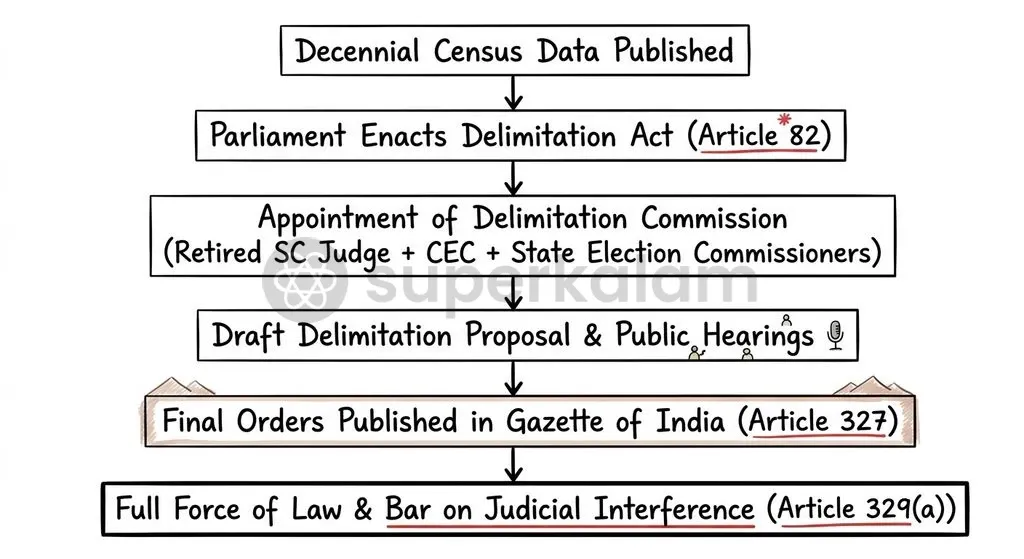
Article 82 of the Constitution provides the primary mechanism for readjusting parliamentary constituencies following each decennial census. Upon completion of each census, Lok Sabha seat allotments and territorial constituency boundaries must be readjusted by an authority determined by parliamentary statute.
Article 81(2)(a) establishes the guiding democratic principle of proportional representation across states. The clause mandates that the ratio between seat count and population remains uniform across the country, so far as practicable. Article 170(2) and Article 170(3) mirror these operational mandates for State Legislative Assemblies, binding them to the same decennial review cycle and constitutional freezes.
Parliament gives operational effect to these provisions by enacting a Delimitation Act, which establishes an independent, high-powered commission. According to Section 3 of the Delimitation Act, 2002, the Delimitation Commission of India comprises three ex-officio members:
- A retired Supreme Court judge serving as the Chairperson;
- The Chief Election Commissioner, or an Election Commissioner nominated by the CEC;
- The State Election Commissioner of the respective State under review.
The orders issued by this statutory body carry exceptional legal authority. Under Section 10(2) of the Delimitation Act, 2002, once the Commission's final orders are published in the Gazette of India, they have the full force of law and cannot be challenged in any court of law.
Constitutional provisions heavily insulate this process from litigation to prevent electoral calendars from stalling. Article 329(a) bars judicial interference in delimitation laws made under Article 327 or Article 328. A five-judge Constitution Bench of the Supreme Court affirmed this doctrine in Meghraj Kothari v. Delimitation Commission (1967), holding that gazetted delimitation orders become part of the law of the land and are completely immune from judicial review under Article 329(a).
Delimitation Commissions have been constituted four times in independent India's history: in 1952, 1963, 1973, and 2002, under separate parliamentary enactments following the 1951, 1961, 1971, and 2001 Censuses respectively.
Discuss with Superkalam
Identify the four years in which Delimitation Commissions have been constituted in independent India.
Ask NowThe 42nd Amendment (1976): Why India Froze Seat Counts to the 1971 Census
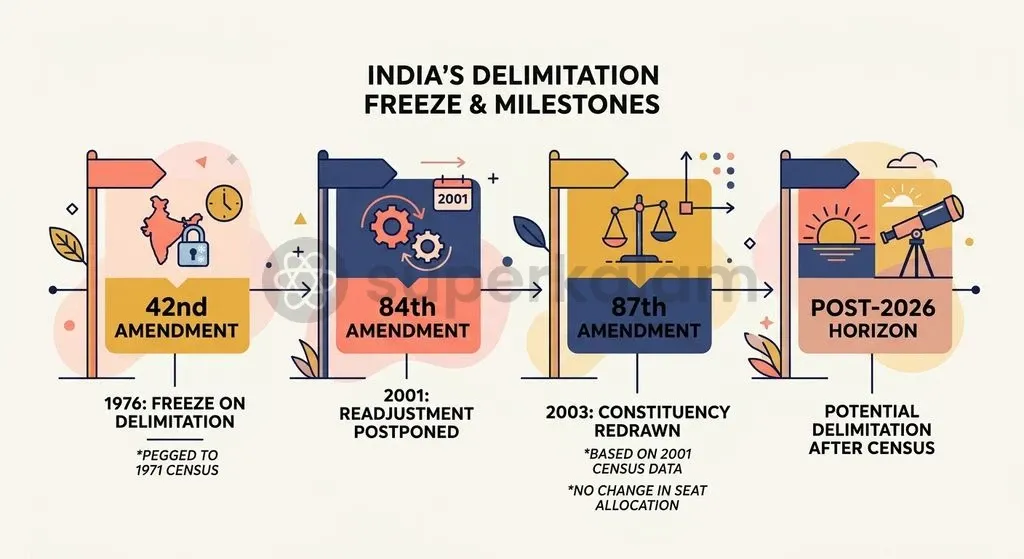
The Constitution (Forty-second Amendment) Act, 1976 introduced a structural freeze on parliamentary representation to shield national development policies. Enacted during the Emergency, the amendment altered Articles 81, 82, and 170 to pause inter-state seat reallocation until the first census figures after the year 2000 were published.
Three key factors explain why Parliament chose this intervention:
- Perverse electoral incentives: Adhering strictly to Article 81 would have punished states that curtailed birth rates while rewarding those lagging in family planning with extra seats.
- Protection of national policy: The freeze directly protected the National Family Planning Programme by removing the demographic penalty on successful states.
- Demographic benchmark: When seats were frozen using the 1971 Census (54.8 crore population), each Lok Sabha constituency held an average of approximately 10.1 lakh citizens, creating rough regional parity.
The 1976 freeze severed the link between demographic expansion and parliamentary seats. While the amendment suspended democratic adjustments, it preserved political peace between reforming and high-fertility states during critical decades of modernisation.
Discuss with Superkalam
Explain why Parliament bifurcated inter-state seat allocation and intra-state boundary delimitation in the 84th Amendment.
Ask NowThe 84th and 87th Amendments: Pushing the Freeze to 2026 and Shifting Base Years
The Constitution (Eighty-fourth Amendment) Act, 2001 deferred the reallocation debate by another quarter-century. When the 1976 freeze expired after the 2000 Census, regional demographic imbalances had widened rather than narrowed, making an immediate reallocation politically volatile.
Parliament addressed this challenge by splitting the delimitation mandate into two separate operations:
- Inter-state seat allocation freeze: The 84th Amendment extended the embargo on altering total Lok Sabha and Legislative Assembly seats per state until the first census published post-2026.
- Intra-state constituency readjustment: The amendment permitted states to redraw internal boundaries to correct uneven population distributions within their borders, using 1991 Census figures.
The Constitution (Eighty-seventh Amendment) Act, 2003 swiftly refined this framework. Passed before the Fourth Delimitation Commission concluded its field reviews, the amendment substituted the 2001 Census for the 1991 Census as the demographic baseline for internal restructuring and SC/ST constituency reservations.
Consequently, the Fourth Delimitation Commission, headed by Justice Kuldip Singh, altered internal constituency lines and updated reserved seats without changing the total number of Lok Sabha seats allocated to any single state.
Key Amendments at a Glance: 42nd vs 84th vs 87th Amendment
Constitutional provisions regulating parliamentary seat allocations have undergone three major adjustments over the past half-century. The following comparison outlines the primary legal shifts governing delimitation:
| Constitutional Amendment | Enactment Year | Benchmark Census for Inter-State Seats | Internal Boundary Readjustment | Primary Policy Objective |
|---|---|---|---|---|
| 42nd Amendment Act | 1976 | 1971 Census (frozen until post-2000 census) | Frozen at 1971 levels across states | Protect states implementing family planning programmes |
| 84th Amendment Act | 2001 | 1971 Census (freeze extended to post-2026 census) | Permitted within states using 1991 Census | Balance demographic disparities while equalising intra-state votes |
| 87th Amendment Act | 2003 | 1971 Census (retained 2026 horizon) | Updated to 2001 Census across all states | Apply contemporary population data for internal boundaries without shifting state totals |
Discuss with Superkalam
Apply the mandate of Article 81(2)(a) to a hypothetical scenario where the seat freeze is lifted entirely using modern census data: how would northern and southern representation shift?
Ask NowThe 2026 Fault Line: Fair Representation vs Penalising Population Control
The demographic divergence between India's northern and southern states presents a direct constitutional dilemma. While northern states experienced sustained population growth, southern states completed their fertility transitions decades ahead of national targets.
Data from the Office of the Registrar General shows that between 1971 and 2011, Uttar Pradesh grew by 126% (88.3 million to 199.8 million) and Rajasthan expanded by 165% (25.8 million to 68.5 million). In sharp contrast, Kerala's population grew by just 56.8% (21.3 million to 33.4 million) and Tamil Nadu's by 75.0% (41.2 million to 72.1 million).
Recent surveys highlight this enduring split. The National Family Health Survey (NFHS-5, 2019-21) recorded Total Fertility Rates below replacement level (2.1) across southern states:
- Andhra Pradesh: 1.7
- Karnataka: 1.7
- Kerala: 1.8
- Tamil Nadu: 1.8
Conversely, northern states recorded fertility rates above replacement levels, with Uttar Pradesh at 2.4 and Bihar at 3.0.
Because representation reflects population, unfreezing Article 82 creates stark political trade-offs. Demographic projections by Milan Vaishnav and Jamie Hintson for the Carnegie Endowment for International Peace suggest that reallocating the 543 Lok Sabha seats purely on projected 2026 populations would transfer more than 30 seats from southern to northern states. In this projection, Bihar and Uttar Pradesh together would gain 21 seats, while Kerala and Tamil Nadu would lose 16 seats.
| State | Current Allocation | Projected 2026 Seats |
|---|---|---|
| Uttar Pradesh | 80 | ~91 (+11) |
| Bihar | 40 | ~50 (+10) |
| Tamil Nadu | 39 | ~31 (-8) |
| Kerala | 20 | ~12 (-8) |
(Projected shifts reflect Carnegie Endowment demographic modelling; illustrative of potential transfer.)
To prevent states from suffering an absolute loss of seats, Carnegie researchers calculated that Parliament would need to expand to at least 848 seats. While expansion avoids cutting absolute numbers, it still substantially dilutes southern legislative influence as a share of the total house.
Discuss with Superkalam
Analyse the structural conflict between the principle of 'one citizen, one vote' and the preservation of federal balance among states with divergent fertility rates.
Ask NowHow Other Federal Democracies Protect Regional Balances
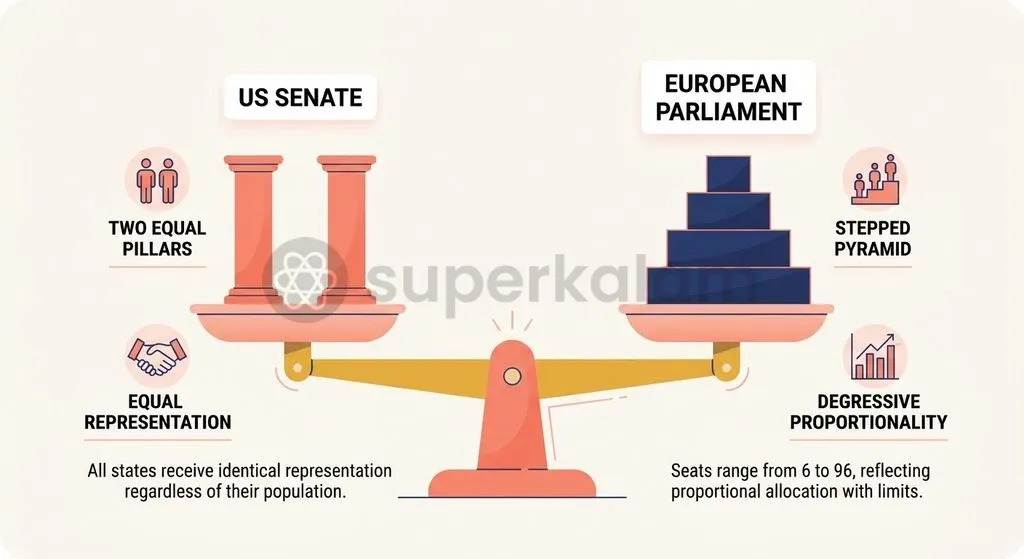
Global federal systems frequently adopt dual constitutional mechanisms to prevent high-population provinces from dominating national legislatures. These systems balance population-based lower houses with regionally protected upper chambers or weighted voting arrangements.
| System / Entity | Institutional Mechanism | Federal Safeguard Rule |
|---|---|---|
| United States | Equal state representation in Senate | Under Article I, Section 3, the US Senate allocates two seats to every state regardless of size or population. |
| European Union | Degressive proportionality in Parliament | Under Article 14(2), the European Parliament operates on degressive proportionality with a 6-seat floor and a 96-seat ceiling. |
In the American system, equal state representation ensures that populous states like California cannot override less populous states like Wyoming in federal legislation. In the European Union, degressive proportionality grants citizens in smaller member nations higher representation per capita, preventing demographic heavyweights from unilaterally setting policy.
Ethical and Federal Questions: Should Demographic Success Diminish Political Voice?
The delimitation debate raises difficult ethical and institutional questions that cut to the core of the Indian union. When state borders are permanent administrative features of a federation, applying strict majoritarian principles can penalise responsible governance.
Southern states face two primary political and economic hazards from unadjusted redistricting:
- Dilution of national lawmaking power: States risk losing legislative seats despite meeting national benchmarks in family planning, public health, and literacy.
- Erosion of fiscal bargaining strength: Reduced parliamentary clout threatens to weaken southern state leverage in national tax devolution formulas and central developmental allocations.
The Union has navigated similar demographic tensions in fiscal federalism. When southern states protested using the 2011 Census for tax sharing, the 15th Finance Commission introduced Demographic Performance with a 12.5% weighting in its horizontal distribution formula to reward states that lowered fertility rates.
A comparable compromise has yet to be designed for political representation. While Article 81 upholds the egalitarian principle of "one citizen, one vote, one value", federalism demands that sub-national units feel secure in their political partnership.
Way Forward: Institutional Solutions to Safeguard Federal Trust
Resolving the post-2026 challenge requires balancing individual democratic equality with federal stability. Relying solely on either a complete freeze extension or an unadjusted reapportionment risks fracturing national consensus.
Policy analysts and constitutional experts have proposed several structural reforms:
- Restructuring the Rajya Sabha: India could reform the Fourth Schedule to provide equal or minimum-floor representation for states in the Rajya Sabha, moving away from pure population-based allocations, as highlighted in institutional reform studies by PRS Legislative Research.
- Constitutional seat capping with house expansion: Parliament could increase total Lok Sabha seats to prevent any state from losing seats in absolute numbers, while applying a degressive proportionality cap to moderate northern seat accumulation.
- Deepening bicameral veto powers: Enhancing the Rajya Sabha's authority over federal legislation, interstate commerce, and constitutional amendments would prevent a geographically concentrated Lok Sabha majority from overriding regional concerns.
- Institutionalising fiscal compensation: Future Finance Commissions could expand demographic performance indicators to guarantee that political dilution does not trigger financial disempowerment.
By pursuing institutional redesign over crude majoritarian reapportionment, India can uphold democratic representation while reinforcing the foundations of cooperative federalism.
Discuss with Superkalam
Propose institutional or constitutional mechanisms that India could adopt to balance equal representation per citizen with safeguarding regional trust after 2026.
Ask NowKey Takeaways
- Article 82 mandates parliamentary readjustment of Lok Sabha seats after each census, but the third proviso freezes inter-state reapportionment until the first census post-2026 is published.
- The 42nd Amendment (1976) froze seats at 1971 Census levels to shield states implementing national family planning programmes from losing parliamentary power.
- The 84th Amendment (2001) extended the inter-state seat freeze to post-2026, while the 87th Amendment (2003) enabled internal constituency rationalisation using the 2001 Census.
- Section 10(2) of the Delimitation Act, 2002 and Article 329(a) grant gazetted delimitation orders the force of law and insulate them from judicial review, as upheld in Meghraj Kothari (1967).
- Southern states face a demographic penalty: while Kerala and Tamil Nadu reduced Total Fertility Rates to 1.8, states like Bihar (3.0) and Uttar Pradesh (2.4) grew faster, setting up a sharp reallocation debate.
- Sustainable solutions include expanding the Lok Sabha, reforming the Fourth Schedule for state parity in the Rajya Sabha, and introducing degressive proportionality mechanisms.
Exam Angle: How UPSC Tests the Census-Delimitation Chain
PYQ trend. Prelims tests the amendment chain precisely - 42nd (1976), 84th (2001), 87th (2003) - and which census benchmarks apply to which operation. Mains GS-II asks for the political logic of the freeze and the federal consequences of lifting it, now with the Delimitation Bill 2026 as the live peg.
Practice: UPSC Mains GS-II Polity PYQs | Prelims PYQ bank | Topic-wise Polity PYQs with explanations.
Mains answer framework. For a 15-marker on this theme:
- Trace the chain: Article 82 -> 42nd Amendment freeze (1971 base) -> 84th extension to post-2026 -> 87th internal readjustment (2001 base).
- Explain the rationale: protecting states that succeeded at population control.
- Use projections (UP ~91, Bihar ~50, TN ~31) to show the stakes, and cite the Delimitation Bill 2026's proposals.
- Close with institutional safeguards - seat-share guarantees, a strengthened Rajya Sabha, or fiscal compensation.
Common mistakes aspirants make.
- Attributing the 2001-Census internal readjustment to the 84th Amendment - it was the 87th (2003).
- Saying the freeze ends automatically in 2026 - it lifts only after the first post-2026 Census figures are published, and the Delimitation Bill 2026 proposes to extend it.
- Forgetting the original bargain: the freeze was designed to reward, not punish, population control.
Mains Question
"The constitutional mandate under Article 81 creates an inherent friction with federal stability when demographic trajectories diverge sharply across states." In light of the impending post-2026 delimitation, critically analyse the challenges confronting Indian federalism. (15 Marks)
Evaluate NowMains Question
The 42nd and 84th Constitutional Amendment Acts decoupled parliamentary seat apportionment from contemporary population growth. Examine the rationale behind freezing inter-state representation to the 1971 Census. (10 Marks)
Evaluate NowPractice MCQs
QUESTION 1
With reference to the Delimitation Commission in India, consider the following statements:
1. Under Section 3 of the Delimitation Act, 2002, the Commission includes a retired Supreme Court judge as Chairperson and the Chief Election Commissioner or an Election Commissioner nominated by them. 2. In accordance with Article 329(a) and the Supreme Court's ruling in Meghraj Kothari v. Delimitation Commission (1967), gazetted orders of the Delimitation Commission cannot be challenged in any court of law. 3. The Delimitation Commission has been constituted after every decennial census conducted in independent India.
Which of the statements given above is/are correct?
QUESTION 2
Consider the following statements regarding the constitutional amendments governing the delimitation of parliamentary seats:
1. The 42nd Amendment Act, 1976 froze the inter-state allocation of Lok Sabha seats based on the 1971 Census until the first census post-2000. 2. The 84th Amendment Act, 2001 permitted intra-state constituency readjustments using 2001 Census data. 3. The 87th Amendment Act, 2003 substituted the 2001 Census for the 1991 Census as the benchmark for internal constituency restructuring.
Which of the statements given above are correct?
QUESTION 3
Consider the following pairs of Constitutional provisions and their operational mandates:
1. Article 81(2)(a) : Uniform ratio between seats allocated to a state and its population across the country 2. Article 170(2) : Proportional seat distribution provisions mirroring parliamentary norms for State Legislative Assemblies 3. Article 334A(1) : Implementation of 33% women's reservation conditional on post-census delimitation
Which of the pairs given above is/are correctly matched?
QUESTION 4
Which of the following landmark Supreme Court judgments established that orders issued by the Delimitation Commission, once published in the Gazette of India, enjoy complete immunity from judicial challenge under Article 329(a)?
QUESTION 5
With reference to demographic trends cited in the National Family Health Survey (NFHS-5, 2019-21), consider the following statements:
1. All southern states recorded Total Fertility Rates below the replacement level of 2.1. 2. Uttar Pradesh and Bihar recorded Total Fertility Rates below the replacement level.
Which of the statements given above is/are correct?