Places of Worship Act 1991: Key Provisions, Timeline & Cases
As judicial surveys in Gyanvapi and Mathura test the 1947 freeze, unpack the constitutional debate between statutory non-retrogression and historic claims.
Nov, 2026
•17 min read
Updated 27 November 2026
At a Glance
| Question | Quick answer |
|---|---|
| What does the 1991 Act do? | It freezes the religious character of every place of worship as on 15 August 1947 (Section 4) and bars conversion of any place of worship (Section 3). |
| What is exempted? | The Ram Janmabhoomi-Babri Masjid site (Section 5); Section 4(3) also exempts monuments protected under the AMASR Act, 1958. |
| What is the punishment for violation? | Up to three years' imprisonment and a fine under Section 6. |
| What did the Ayodhya verdict (2019) say? | A Constitution Bench treated the Act as a legislative affirmation of secularism and articulated the doctrine of non-retrogression. |
| What did the Supreme Court do in December 2024? | It barred all courts from registering fresh suits or ordering surveys concerning the religious character of places of worship until the challenges to the Act are decided. |
| What is pending now? | Constitutional challenges to the Act (under Articles 14, 25, 26 and 32) and the fallout of survey orders in disputes such as Gyanvapi, Mathura and Sambhal. |
Context
The Places of Worship (Special Provisions) Act, 1991 was enacted to freeze the religious character of all places of worship as of August 15, 1947. Recent judicial interventions, however, distinguish between the prohibited conversion of a shrine and the preliminary ascertainment of its architectural history. That distinction has allowed subordinate courts to order scientific inspections across disputed sites, transforming an absolute statutory bar into an evidentiary battleground.
While proponents assert that investigating physical origins does not alter current usage, critics argue that procedural fact-finding undermines the statutory guarantee of communal finality.
Why the 1991 Act Is Back in the Courts Today
The Places of Worship (Special Provisions) Act, 1991 is back at the centre of Indian public law following an unprecedented series of survey petitions across Uttar Pradesh. The statute was designed to foreclose title disputes over historical places of worship. Litigants have nevertheless sought judicial commissions and archaeological surveys to verify whether medieval Islamic structures were erected over pre-existing Hindu temples. As of December 2024, this procedural strategy prompted the Supreme Court to intervene nationally to maintain institutional order.
In Sambhal, a Civil Judge (Senior Division) on 19 November 2024 issued an ex-parte order on the very day a civil suit was filed. The order appointed an Advocate Commissioner to conduct an immediate survey of the Mughal-era Shahi Jama Masjid. A follow-up survey on 24 November 2024 triggered intense communal unrest that led to four civilian deaths, illustrating the severe public-order risks associated with rapid judicial fact-finding.
Intervening on 29 November 2024, a Supreme Court bench of Chief Justice Sanjiv Khanna and Justice Sanjay Kumar halted proceedings in the Sambhal trial court. The bench ordered the commissioner's survey report to remain sealed, and directed the High Court to examine maintainability.
| Year | Milestone | Legal Development |
|---|---|---|
| 1991 | Act Enacted | Religious identity frozen as of August 15, 1947 |
| 2019 | Ayodhya Verdict | Constitution Bench affirms secularism and non-retrogression |
| 2022 | Gyanvapi Shift | Supreme Court makes oral remark on historical "ascertainment" |
| 2024 | Omnibus Freeze | Supreme Court halts all fresh suits and survey orders nationwide |
Local survey applications risked systemic escalation across multiple districts. On 12 December 2024, a three-judge bench led by Chief Justice Sanjiv Khanna passed an omnibus interim order barring all courts nationwide from registering fresh suits or issuing effective interim or final orders, including survey directions, regarding the religious character of places of worship. This sweeping freeze paused an accelerating wave of litigation and returned the constitutional debate to its original question: does uncovering architectural history erode statutory protection?
Discuss with Superkalam
Which specific section of the Places of Worship Act, 1991 explicitly excludes the Ram Janmabhoomi-Babri Masjid dispute from its remit?
Ask Now1991: Why Parliament Passed the Law and Fixed the August 15, 1947 Cut-Off
Parliament passed the Places of Worship (Special Provisions) Act, 1991 under the P.V. Narasimha Rao administration to preserve public peace and communal harmony during the height of the Ram Janmabhoomi movement. The statute received Presidential assent on 18 September 1991, with an operational commencement date pegged retrospectively to 11 July 1991. Its legislative purpose was to draw a statutory line over historical religious disputes, preventing historical grievances from destabilising post-independence society.
The architecture of the 1991 Act rests on four operative provisions that collectively bar the modification of religious spaces:
- Section 3 establishes an absolute statutory prohibition: It bars any person from converting any place of worship of any religious denomination or section into a place of worship of a different religious denomination or a different section of the same denomination.
- Section 4(1) imposes a temporal freeze: It declares that the religious character of a place of worship existing on 15 August 1947 shall continue to be the same as it existed on that day.
- Section 4(2) mandates statutory abatement of suits: It provides that any suit, appeal, or legal proceeding pending on 11 July 1991 regarding the conversion of religious character of an August 15, 1947 place of worship shall abate, while barring fresh suits entirely.
- Section 5 carves out a single express exclusion: It explicitly removes the Ram Janma Bhumi-Babri Masjid site in Ayodhya from the operation of the statute, alongside all related proceedings.
| Provision | Operational Legal Effect |
|---|---|
| Section 3 | Absolute bar against converting any shrine |
| Section 4(1) | Religious identity frozen as of 15 August 1947 |
| Section 4(2) | Abatement of pending suits; bars new litigation |
| Section 4(3) | Exempts ASI-protected ancient monuments and settled disputes |
| Section 5 | Expressly excludes Ayodhya (Babri Masjid site) |
| Section 6 | Imposes up to 3 years imprisonment plus fines |
| Section 8 | Disqualifies convicts from parliamentary polls |
Parliament chose 15 August 1947 as the cut-off date to anchor the statute to the founding constitutional moment of Indian independence. The legislature intended to prevent the reopening of pre-independence property transactions and medieval disputes, treating the midnight hour of freedom as a definitive break from historical conflict.
Section 4(3) created limited exceptions for monuments covered under the Ancient Monuments and Archaeological Sites and Remains Act, 1958, matters settled by courts or parties prior to 11 July 1991, and conversions effected by acquiescence or time-barred under limitation laws.
To deter defiance, Section 6 prescribes a criminal penalty of up to three years imprisonment and a fine for contravening Section 3. Operating in tandem, Section 8 of the Act amended Section 8(1) of the Representation of the People Act, 1951, inserting clause (j) to disqualify anyone convicted under Section 6 from contesting parliamentary and state assembly elections.
1994 to 2019: From the Faruqui Ruling to the Ayodhya Non-Retrogression Benchmark
The Supreme Court engaged with places of worship and statutory protections across two landmark Constitution Bench decisions between 1994 and 2019. In Dr. M. Ismail Faruqui v. Union of India (1994), a five-judge bench tested the scope of state eminent domain over religious properties, holding that state acquisition of religious property is constitutionally permissible. The Court ruled that mosques enjoy no special constitutional immunity from acquisition unless offering prayer at that particular location is an essential religious practice. Proprietary religious rights remain subject to the sovereign acquisition power of the state.
The doctrinal standing of the 1991 Act rose sharply in M Siddiq (D) Thr Lrs v. Mahant Suresh Das (2019), commonly known as the Ayodhya verdict. Section 5 expressly excluded the Ayodhya site from the Act's substantive operation. Even so, a unanimous five-judge Constitution Bench dedicated extensive analysis to the 1991 statute, affirming it as a legislative commitment to constitutional secularism.
| Parameter | Dr. M. Ismail Faruqui (1994) | M Siddiq / Ayodhya Verdict (2019) |
|---|---|---|
| Bench Composition | 5-Judge Constitution Bench | 5-Judge Constitution Bench (Unanimous) |
| Primary Issue | State acquisition of religious property under eminent domain | Title dispute over Ayodhya site & scope of the 1991 Act |
| Core Constitutional Holding | Religious sites are acquirable; no immunity without essentiality | The 1991 Act protects secularism as a basic feature of the Constitution |
| Impact on the 1991 Act | Addressed sovereign power rather than the statutory freeze | Formulated the doctrine of non-retrogression under Section 4 |
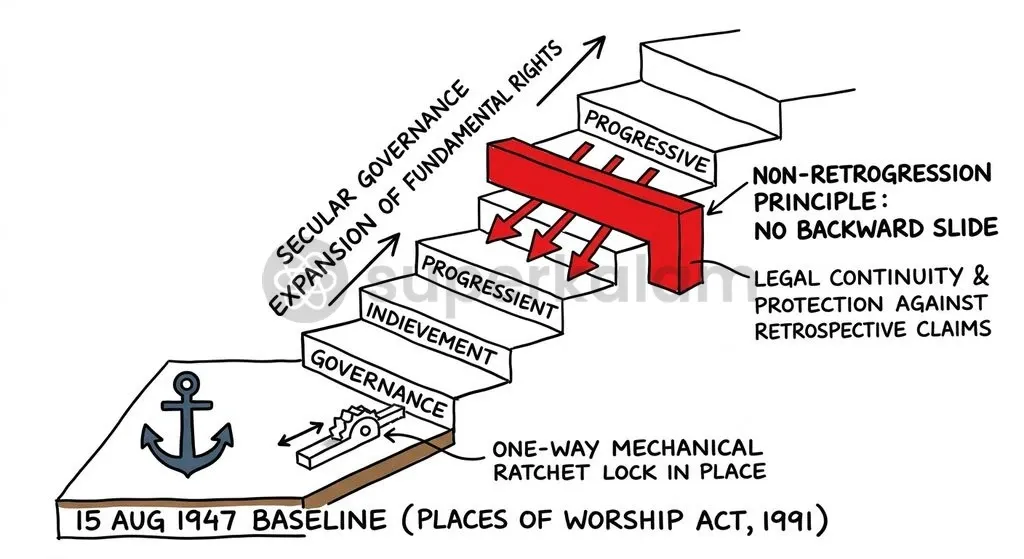
The Ayodhya bench held that secularism forms part of the basic structure of the Constitution, and that the 1991 Act gives practical legislative effect to that foundational guarantee. The Court articulated the doctrine of non-retrogression, observing that historical wrongs cannot be remedied by citizens taking the law into their own hands.
Non-retrogression dictates that constitutional rights and guarantees cannot be rolled back to an earlier, less protective standard. By freezing the character of shrines at 15 August 1947, the law imposed an affirmative constitutional duty on the Indian state to preserve religious pluralism and maintain the finality of historical boundaries.
Discuss with Superkalam
How does the doctrine of non-retrogression, as articulated in the 2019 Ayodhya ruling, connect with the statutory freeze established by the 1991 Act?
Ask Now2021 to 2022: The Gyanvapi Shift and the Rise of the Survey Exception
The post-Ayodhya legal consensus shifted in 2021 when Hindu devotees filed civil suits in Varanasi seeking daily worship rights at the Gyanvapi Mosque complex. The plaintiffs claimed that worship of deities on the outer wall of the Gyanvapi compound had continued uninterrupted. They framed their plea under the Code of Civil Procedure (CPC), 1908, as an enforcement of civil and religious rights rather than a plea for conversion. The managing committee of the mosque contested the suits at the threshold, invoking Order 7 Rule 11 of the CPC, which requires trial courts to reject a plaint if the suit is barred by any statute—specifically citing the 1991 Act.
In May 2022, during appellate proceedings arising from the dispute, a three-judge Supreme Court bench headed by Justice D.Y. Chandrachud made a notable oral observation. The bench noted that the 1991 Act does not expressly bar the mere ascertainment of the religious character of a place of worship. This oral remark drew a sharp conceptual line: investigating a site's baseline religious character on 15 August 1947 was not identical to ordering its substantive conversion under Section 3.
- The Plaint: Devotees file a civil suit pleading existing rights to worship outer deities or inspect premises under Order 26 Rule 9 of the CPC.
- The Procedural Objection: The mosque committee files an Order 7 Rule 11 application, asserting that Section 4(2) bars the suit at the threshold.
- The Judicial Interpretation: The court holds that determining a shrine's 1947 identity constitutes ascertainment, not conversion.
- The Evidentiary Direction: The trial court admits the plaint and orders an ASI scientific survey to examine structural antiquity.
Relying on this emerging distinction, the Varanasi District Court dismissed the Muslim side's Order 7 Rule 11 rejection application on 12 September 2022. The trial judge ruled that because the Hindu plaintiffs were claiming an existing customary right to worship deities, the suit did not seek a structural conversion and was therefore maintainable.
This procedural interpretation gained formal appellate approval the following year. On 3 August 2023, the Allahabad High Court dismissed the mosque committee's challenge against an order directing the Archaeological Survey of India (ASI) to carry out a comprehensive scientific survey of the complex, a position affirmed by the Supreme Court on 4 August 2023. The resulting report, submitted in January 2024 to the trial court, concluded that a large Hindu temple existed prior to the construction of the mosque in the 17th century. The procedural distinction had generated substantive archaeological findings.
2023 to 2024: Mathura, Sambhal, and the Spread of Historical Ascertainment Claims
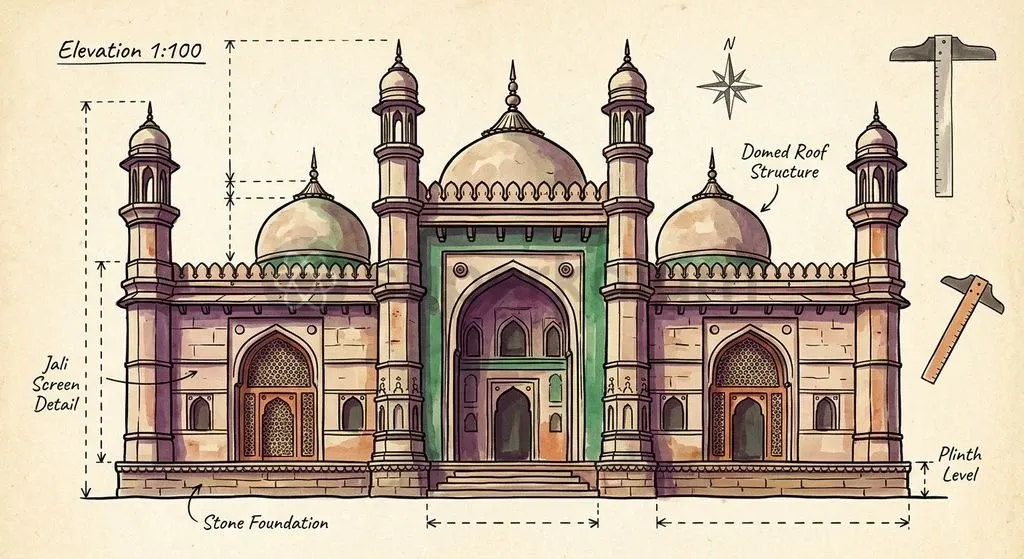
The Gyanvapi orders created a legal template that litigants swiftly deployed across other historical monuments in northern India. In Mathura, plaintiffs initiated 18 separate suits before civil courts seeking the removal of the Mughal-era Shahi Idgah mosque adjacent to the Shri Krishna Janmabhoomi complex. The Shahi Idgah Management Committee filed an application under Order 7 Rule 11 of the CPC, contending that the consolidated suits were barred by Section 4 of the 1991 Act and barred by limitation.
On 1 August 2024, the Allahabad High Court dismissed the mosque committee's challenge, ruling that the 18 consolidated suits were maintainable at the preliminary stage. The High Court held that whether the Shahi Idgah possessed an independent Islamic character on 15 August 1947, or whether its existence was subject to pre-existing Hindu proprietary rights, was a mixed question of fact and law that could only be determined after recording evidence at trial.
The expansion of this procedural exception reached a flashpoint in late 2024 through the Sambhal litigation:
- Immediate survey order (19 November 2024): A civil suit was filed asserting that the Shahi Jama Masjid in Sambhal was built atop the ancient Harihar temple. On the very same day, the local Civil Judge appointed an Advocate Commissioner to inspect the premises.
- Execution and civil clashes (24 November 2024): The commissioner carried out a second inspection early on a Sunday morning, triggering intense public protests, police firing, and civilian deaths.
- Appellate intervention (29 November 2024): The Supreme Court stayed trial proceedings, ordered the commissioner's inspection report to remain in a sealed cover, and directed the High Court to hear the mosque's revision petition.
- Nationwide judicial freeze (12 December 2024): Chief Justice Sanjiv Khanna's bench issued an omnibus order directing all civil courts across India to desist from entertaining fresh plaints or ordering new surveys of disputed religious structures.
Discuss with Superkalam
If a civil suit seeking worship rights in a historical mosque is filed today, how should a court balance Order VII Rule 11 of the CPC against Section 4 of the 1991 Act?
Ask NowThe Core Legal Dilemma: Does Ascertaining History Hollow Out Non-Retrogression?
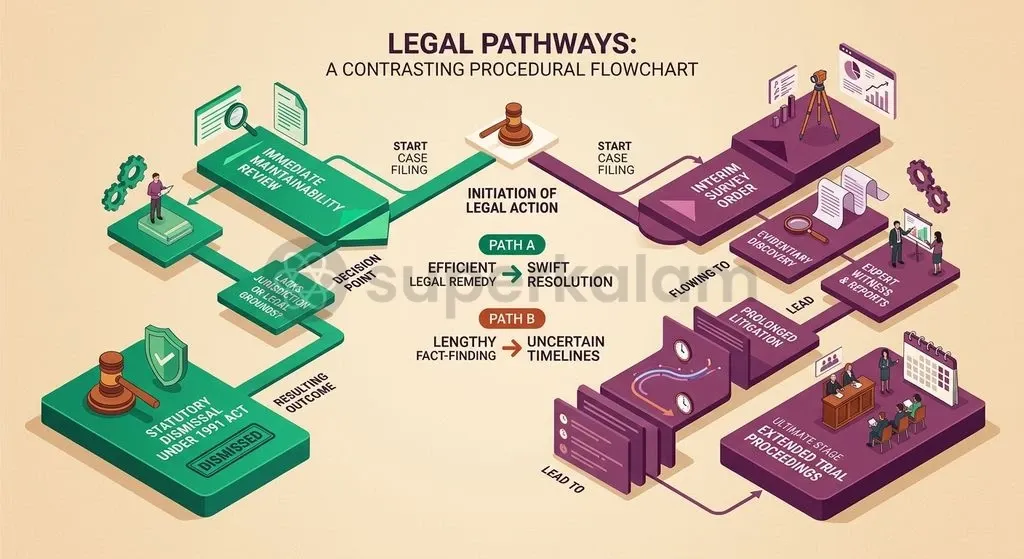
The conflict between Section 3's substantive bar and procedural fact-finding under the Code of Civil Procedure raises a fundamental question of jurisprudence: can an evidentiary inquiry be separated from its substantive legal outcome? The argument for ascertainment contends that the 1991 Act freezes a site's religious character, but does not identify what that character actually was on 15 August 1947. Proponents argue that where dual worship or mixed architectural provenance exists, discovering archaeological facts through expert bodies like the ASI does not convert the site, but merely establishes the factual baseline required to apply Section 4.
Critics counter that allowing scientific surveys hollows out the substantive bar of the 1991 Act. In civil litigation, ordering an expert commission or an archaeological excavation is rarely a neutral evidentiary step. When a court orders an excavation beneath a functional place of worship, it introduces profound uncertainty over the status of the site, destabilising the very social peace Parliament intended to protect under the Statement of Objects and Reasons.
| Perspective | Restorative Justice & Evidence Gathering | Constitutional Non-Retrogression |
|---|---|---|
| Constitutional Basis | Articles 25 and 26 (right to worship and reclaim desecrated shrines) | 2019 Ayodhya Verdict (secularism as basic constitutional structure) |
| Procedural Mechanism | Order 26 Rule 9 CPC (commissions to elucidate facts and site history) | Section 4(2) of the 1991 Act (mandatory abatement of title claims) |
| Core Argument | Historical fact-finding is merely ascertainment, not conversion | Sub-surface excavations destabilise peaceful possession and fuel discord |
| Ultimate Objective | Correct historical wrongs and verify architectural provenance | Preserve finality of dispute resolution and constitutional fraternity |
From the perspective of constitutional ethics, this clash represents a profound dilemma between historical grievance redressed through restorative justice and the democratic imperative of finality of dispute resolution. Redressing medieval temple destruction through contemporary litigation undermines the civic expectation that a sovereign republic provides a clean break from pre-constitutional wrongs.
The Supreme Court highlighted in the 2019 Ayodhya judgment that the 1991 statute obliges both the state and its citizens not to take the law into their own hands. Historical disputes must yield to the overarching constitutional value of fraternity.
Pending Supreme Court Challenges and the Future of the 1991 Freeze
The Supreme Court is currently seized of direct constitutional challenges to the Places of Worship Act, 1991 itself. In the lead petition, Ashwini Kumar Upadhyay v. Union of India, petitioners have challenged the constitutional validity of Sections 2, 3, and 4 of the Act, alleging that the statutory bar violates fundamental rights under Articles 14, 15, 21, 25, 26, and 29 of the Constitution.
The primary legal challenges raised in the writ petitions encompass several distinct arguments:
- Infringement of Judicial Review: By declaring under Section 4(2) that pending suits abate and fresh suits cannot be filed, the Act allegedly closes the doors of the judiciary, undermining judicial review as a basic feature of the Constitution.
- Arbitrary Temporal Classification: Petitioners argue that fixing 15 August 1947 as a blanket cut-off date violates Article 14 by arbitrarily discriminating against Hindus, Jains, Buddhists, and Sikhs whose shrines were historically destroyed prior to independence.
- Denial of Religious Freedom: Petitioners contend that barring devotees from reclaiming temple property under Sections 3 and 4 infringes upon the core fundamental right to worship guaranteed under Article 25 and the right to manage religious affairs under Article 26.
- Disproportionate Statutory Exclusion: Petitioners challenge the exceptional exclusion carved out for the Ayodhya dispute under Section 5, arguing that providing a statutory exception for one site while denying relief to identical historical grievances violates Article 14.
The Union Government's formal response on the constitutional validity of the 1991 Act - sought by the Court as far back as March 2021 - remained pending even as the Court, in December 2024, allowed the Centre further time to file it.
The Supreme Court now faces a delicate choice. The Court must either reaffirm the Ayodhya bench's declaration that the 1991 Act is an unalterable legislative pillar of secularism, or formulate a structured judicial standard governing how lower courts ascertain the religious character of mixed heritage sites. Without unambiguous appellate guidelines, subordinate courts will continue to struggle between enforcing statutory abatement and entertaining procedural survey applications.
Discuss with Superkalam
In what ways does bifurcating the ascertainment of a shrine's character from its actual conversion challenge the legislative intent of the 1991 Act?
Ask NowKey Takeaways
- Parliament passed the Places of Worship (Special Provisions) Act, 1991 to freeze the religious character of all places of worship as of 15 August 1947, barring conversions under Section 3 and abating pending suits under Section 4(2).
- Section 5 of the Act explicitly excluded the Ram Janma Bhumi-Babri Masjid site in Ayodhya, while Section 6 prescribed up to three years imprisonment for violations.
- In the 2019 Ayodhya ruling, a unanimous Constitution Bench held that the 1991 Act operationalises secularism as a basic feature of the Constitution through the doctrine of non-retrogression.
- Lower court rulings between 2022 and 2024 permitted ASI surveys at Gyanvapi and Mathura by distinguishing the preliminary ascertainment of religious character from statutory conversion, weakening the threshold application of Order 7 Rule 11 of the CPC.
- On 12 December 2024, the Supreme Court imposed a nationwide freeze on fresh suits and interim survey orders to resolve the underlying constitutional friction.
- The Union Government's counter-affidavit on the constitutional validity of the Act in WP (C) No. 1246/2020 remained pending, with the Court granting the Centre further time in December 2024.
Exam Angle: How UPSC Tests the Places of Worship Act
PYQ trend. Prelims has repeatedly tested the statute's hard facts - the 15 August 1947 cut-off, the Ayodhya exemption, and which sections do what. Mains GS-II uses the Act to examine secularism, judicial review and the non-retrogression doctrine, most recently through the 2019 Ayodhya Constitution Bench.
Practice: UPSC Mains GS-II Polity PYQs | Prelims PYQ bank | Topic-wise Polity PYQs with explanations.
Mains answer framework. For a 15-marker on this theme:
- Open with the 1991 context and legislative intent: freezing communal status quo amid the Ram Janmabhoomi movement.
- Break down Sections 3, 4(1), 4(2), 4(3), 5 and 6 precisely.
- Trace the judicial arc: Faruqui (1994), Ayodhya non-retrogression (2019), Gyanvapi survey shift, December 2024 freeze.
- Close with the live dilemma: whether ascertaining a site's history hollows out the statutory freeze, and what the pending challenges could change.
Common mistakes aspirants make.
- Mixing up Section 3 (conversion ban) with Section 4 (the 1947 character freeze).
- Forgetting that Ayodhya was explicitly exempted by Section 5.
- Assuming the Act bars all litigation - courts allowed surveys to "ascertain character" until the Supreme Court's December 2024 stay.
Mains Question
"The judicial bifurcation between ascertaining pre-existing religious character and converting that character fundamentally weakens the substantive freeze established by Parliament." In light of this statement, critically analyse the operational friction between procedural discovery under the Code of Civil Procedure and the substantive mandate of the Places of Worship (Special Provisions) Act, 1991. (15 Marks)
Evaluate NowMains Question
The Supreme Court in its 2019 Ayodhya verdict characterised the Places of Worship (Special Provisions) Act, 1991 as an affirmative manifestation of constitutional secularism and non-retrogression. Elucidate. (10 Marks)
Evaluate NowPractice MCQs
QUESTION 1
With reference to the Places of Worship (Special Provisions) Act, 1991, consider the following statements:
1. Section 3 imposes a blanket prohibition on converting a place of worship belonging to one religious denomination into that of another denomination or sect. 2. Section 4(2) mandates that any litigation concerning the conversion of a site's character pending before the commencement of the Act immediately abates. 3. Section 5 explicitly exempted the Ram Janmabhoomi-Babri Masjid dispute at Ayodhya from the remit of the statute.
Which of the statements given above are correct?
QUESTION 2
Regarding the Supreme Court's jurisprudence on religious structures and secularism, consider the following statements:
1. In M. Ismail Faruqui (1994), the Court held that the State possesses the sovereign authority to acquire places of religious worship under eminent domain. 2. In the 2019 Ayodhya verdict, a five-judge Constitution Bench held that the Places of Worship Act, 1991 enforces the doctrine of non-retrogression. 3. The 1991 Act established January 26, 1950, as the cut-off date to freeze the religious character of places of worship.
Which of the statements given above is/are correct?
QUESTION 3
Consider the following statements regarding civil suits concerning contested religious sites:
1. Order VII Rule 11 of the Code of Civil Procedure, 1908 requires the rejection of a plaint where a suit appears to be barred by any law. 2. In recent litigation involving the Gyanvapi mosque, appellate courts reasoned that conducting an inspection to ascertain historical religious character does not equate to converting that character under Section 3 of the 1991 Act. 3. A trial court must mandatorily decide maintainability under Order VII Rule 11 before directing any commissioner-led scientific survey.
Which of the statements given above is/are correct?
QUESTION 4
Under the Places of Worship (Special Provisions) Act, 1991, which specific date was chosen by Parliament to freeze the religious character of places of worship across India?
QUESTION 5
With reference to the doctrine of non-retrogression articulated in the 2019 Ayodhya verdict, consider the following statements:
1. It ensures that protections and rights granted by the State cannot be diminished or rolled back over time. 2. It permits historical conquests and wrongs to serve as legitimate legal grounds for altering current religious property rights.
Which of the statements given above is/are correct?
Discuss with Superkalam
Does allowing preliminary scientific surveys serve justice by uncovering historical facts, or does it undermine constitutional secularism by disturbing communal harmony?
Ask Now