Front-of-Package Labelling: SC Mandate & the Right to Health
By tying food warnings to the right to health under Article 21, the Supreme Court has turned nutritional transparency into an enforceable constitutional duty.
Nov, 2026
•12 min read

Updated 27 November 2026
At a Glance
| Question | Quick answer |
|---|---|
| Which constitutional provisions apply? | Article 21 (right to health within the right to life), Article 19(1)(a) (consumers' right to information), and Article 47 (the State's duty to raise nutrition and public-health levels). |
| What did the Supreme Court do on 26 November 2026? | Set binding timelines for front-of-pack warning labels, grounding the mandate in the right to health and informed choice. |
| What is the core tension? | Public-health imperatives and consumer vulnerability versus industry's commercial-speech and economic-freedom arguments. |
| Which regulator implements it? | FSSAI, the statutory food-safety authority under the FSS Act, 2006. |
| What global precedent exists? | Chile and several Latin American countries mandate warning labels and report measurable falls in purchases of high-sugar products. |
Context
In 3S and Our Health Society v. Union of India & Anr. (2026), the Supreme Court of India established that front-of-package warning labels are a positive constitutional obligation under Article 21 and Article 19(1)(a) to protect citizens from diet-related non-communicable diseases. The ruling invalidates industry-backed summary scorecards.
It orders the Food Safety and Standards Authority of India to enforce mandatory red hexagonal warnings across packaged foods within a strict timetable. These warnings must flag excess salt, total sugars, and saturated fat. This transition converts nutritional transparency from a discretionary executive policy into an enforceable fundamental right. The shift directly addresses an escalating public health crisis where chronic lifestyle illnesses cause the majority of premature deaths nationwide.
Why Front-of-Package Labelling Is Back in Focus
Judicial intervention has replaced years of regulatory inertia with a binding countdown. On November 26, 2026, the Supreme Court delivered a landmark judgment mandating interpretive front-of-package nutrition labelling for packaged foods in 3S and Our Health Society v. Union of India & Anr..
The bench directed the Food Safety and Standards Authority of India (FSSAI) to enact enforceable rules under a tight schedule:
- Four-Month Rulemaking Deadline: FSSAI must formally notify binding front-of-pack regulations within four months of the order.
- Interim Progress Review: As of November 2026, the apex court ordered FSSAI to submit an interim progress affidavit within 10 weeks to prevent bureaucratic drift.
- Strict Transition Window: Food Business Operators receive a single 365-day transition window to exhaust existing packaging inventories and apply compliant designs.
The Court explicitly ruled that authorities must grant no ordinary extensions. Commercial convenience cannot override community health.
Discuss with Superkalam
Which three specific nutrients of concern did the Supreme Court mandate for front-of-package red hexagonal warnings?
Ask NowUnderstanding India's Labelling Debate: Warning Labels vs Health Star Ratings
Interpretive nutritional formats communicate dietary risks on retail packaging through either direct negative warnings or aggregate positive scores. Front-of-package labelling (FOPL) aims to provide quick, intelligible nutritional information to shoppers at the point of purchase.
Traditional back-of-pack nutrition tables list technical numerical values per serving. These figures demand mathematical literacy and nutritional expertise that most shoppers lack.
Interpretive systems translate these dense numbers into immediate visual signals. The primary debate in India has centred on whether to adopt diagnostic warning labels or summary scoring algorithms.
The Supreme Court directed FSSAI to implement separate red hexagonal warning labels for each nutrient of concern, rejecting combined graphic symbols. Each symbol must display a standardised pictogram accompanied by the explicit words "HIGH FAT", "HIGH SUGAR", or "HIGH SALT". Furthermore, each warning hexagon must occupy between 4% and 5% of the package's Principal Display Panel.
| Analytical Dimension | Red Hexagonal Warning System (Judicial Mandate) | Indian Nutrition Rating (INR) System (FSSAI 2022 Draft) |
|---|---|---|
| Visual Architecture | Separate red hexagons with pictograms and explicit textual warnings | Single summary rating displaying 0.5 to 5 stars |
| Nutrient Baseline Assessed | Evaluates total sugars, saturated fat, and salt independently | Generates an algorithm combining positive and negative nutrients |
| Cognitive Mechanism | Directly flags specific dietary risks to discourage purchase | Creates a positive health halo effect for ultra-processed food |
| Primary Beneficiary | Time-poor consumers, low-literacy populations, and children | Manufacturers seeking product reformulations without negative labels |
| Global Regulatory Inspiration | Latin American mandatory stop-sign statutes (e.g. Chile) | Australian voluntary Health Star Rating framework |
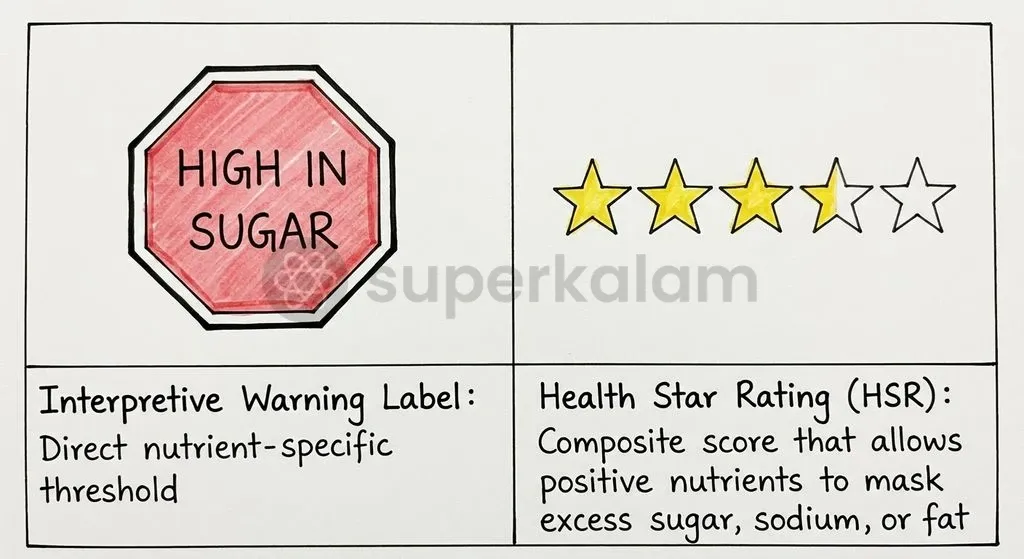
FSSAI previously proposed the Indian Nutrition Rating (INR) system in draft regulations published on September 13, 2022. The draft put forward a 0.5-star to 5-star summary score modelled on the Australian Health Star Rating.
Public health coalitions, including the Nutrition Advocacy in Public Interest (NAPi), opposed the INR system. The coalition argued that combining beneficial ingredients like fruit or fibre with high sugar levels creates an unjustified health halo over ultra-processed products. A product rich in sodium and saturated fat could secure a median 3-star rating merely by fortifying its ingredients with synthetic fibre, concealing its underlying health risks.
Discuss with Superkalam
How does the 'health halo effect' created by star-rating systems differ from the cognitive impact of diagnostic warning labels?
Ask NowThe Constitutional Canvas: How Articles 21, 19(1)(a), and 47 Interlock
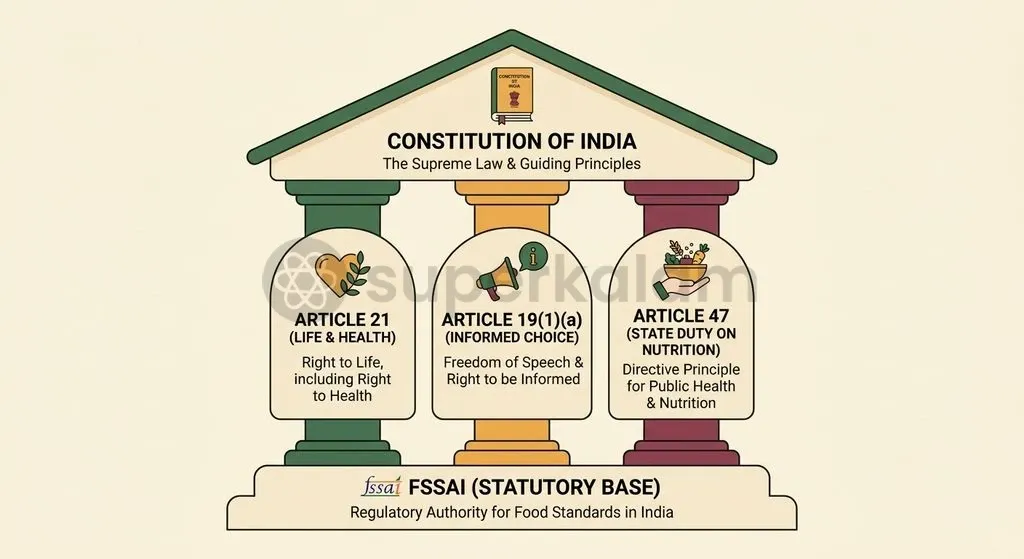
The Indian Constitution provides the foundational legal framework connecting public health, personal autonomy, and statutory food regulation. The Supreme Court harmonised Fundamental Rights under Part III with non-justiciable Directive Principles under Part IV to establish an affirmative duty for the Union government:
- Article 21 (Right to Health and Longevity): The right to life encompasses personal well-being. A state that permits misleading marketing while non-communicable diseases surge fails its obligation to protect human dignity.
- Article 19(1)(a) (Consumer Autonomy): Protects the citizen's right to receive truthful information. Obscuring high sugar or sodium content beneath dense back-of-pack metrics compromises a consumer's capacity to exercise autonomous commercial choice.
- Article 47 (Primary State Duties): Directs the state to raise nutrition levels and improve public health. The judiciary routinely applies Article 47 to interpret the expansive scope of Article 21.
By mandating unambiguous warning hexagons, the judiciary linked economic transparency directly to the preservation of life.
The Regulatory Landscape: FSSAI's Mandate and Past Policy Attempts
The Food Safety and Standards Act, 2006 empowers statutory authorities to regulate domestic packaging, manufacturing standards, and truthful food disclosures. Section 16 and Section 23 of the Act mandate that FSSAI ensure consumer protection and prevent misleading branding.
Despite comprehensive statutory authority, regulatory progress on front-of-package labelling remained stalled for years. When drafting initial guidelines, the regulator sought to evaluate only added sugar and added fat. Past expert panels proposed multiple revisions, but regulatory ambiguity allowed ultra-processed food brands to market energy-dense items without interpretive warnings.
The Supreme Court resolved several persistent regulatory loopholes through direct orders:
- Assessing Total Over Added Nutrients: FSSAI must evaluate total sugars and saturated fat alongside salt. Assessing only added sugars allows manufacturers to exploit concentrated fruit juices or maltodextrin to escape scrutiny.
- Independent Regulatory Thresholds: The Court rejected direct reliance on Table 15.1 of the ICMR-NIN Dietary Guidelines for Indians (2024) for labelling thresholds. FSSAI must calibrate cut-offs that avoid consumer label fatigue while keeping unhealthy items under mandatory warnings.
- Prohibition on Deceptive Branding: The Court prohibited beverage manufacturers whose products fall below critical thresholds from deploying look-alike hexagonal labels to advertise product categories.
This barrier guarantees that warning symbols retain unique diagnostic significance without brand dilution.
Discuss with Superkalam
If a packaged snack manufacturer reformulates a high-sodium product by adding synthetic dietary fibre, how would its status differ under INR versus the Court-mandated warning labels?
Ask NowPublic Health Imperative vs Industry Pushback: The Core Tensions
India faces an acute metabolic crisis driven by shifts toward ultra-processed foods. The Indian Council of Medical Research–India Diabetes national study revealed that 101 million Indians live with diabetes and 136 million with prediabetes. Rapid changes in Indian dietary patterns toward energy-dense items fuel this spread.
According to the World Health Organization, non-communicable diseases account for approximately 66% of all deaths across India. Cardiovascular disease and diabetes generate substantial out-of-pocket medical expenditures that push vulnerable households into poverty.
Data from the National Family Health Survey (NFHS-5, 2019–21) documented rising adult overweight and obesity rates, reaching 24.0% among women and 22.9% among men. In response, the ICMR-National Institute of Nutrition Dietary Guidelines for Indians (2024) warned against ultra-processed foods, recommending that individuals limit total added sugar intake to less than 20–25 grams daily.
| Indicator / Chronic Condition | National Prevalence / Trajectory | Reporting Agency |
|---|---|---|
| Diabetes Prevalence | 101 million individuals | ICMR-INDIAB Study |
| Prediabetes Prevalence | 136 million individuals | ICMR-INDIAB Study |
| NCD Mortality Share | Approximately 66% of total deaths nationwide | World Health Organization |
| Adult Female Obesity (NFHS-4 to NFHS-5) | Rose from 20.6% to 24.0% | NFHS-5 Compendium |
| Adult Male Obesity (NFHS-4 to NFHS-5) | Rose from 18.9% to 22.9% | NFHS-5 Compendium |
Fast-moving consumer goods industry associations actively resisted diagnostic warning labels during FSSAI's stakeholder consultations between 2021 and 2024. Commercial bodies lobbied for voluntary compliance and requested that nutrient cut-offs be calculated per suggested serving size rather than a standard 100g or 100ml baseline. A serving-size calculation allows manufacturers to manipulate portion sizes on paper, presenting an artificially reduced nutrient count to bypass regulatory thresholds.
Discuss with Superkalam
Why did food industry associations prefer nutrient cut-offs calculated per 'suggested serving size' rather than a standard 100g or 100ml baseline?
Ask NowGlobal Precedents: What India Can Learn from Chile and Latin America
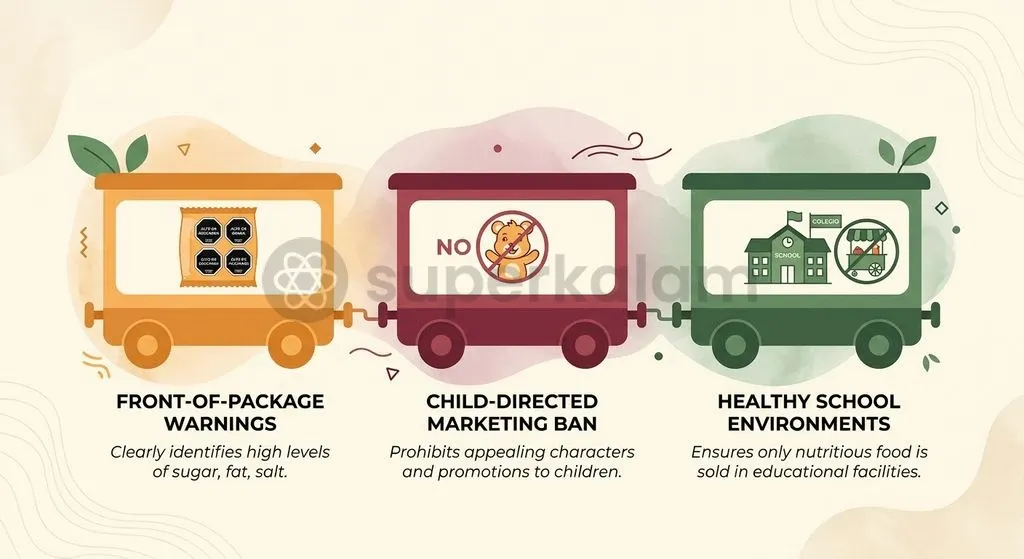
Chile established the premier global benchmark for front-of-package labelling by enacting Law No. 20,606 on Nutritional Composition of Food and its Advertising. The statute instituted mandatory black stop-sign octagonal warnings for foods exceeding limits for sugar, sodium, saturated fat, and calories.
Key policy outcomes and mechanisms from the Latin American experience include:
- Documented Dietary Reductions: A post-implementation evaluation published in The Lancet Planetary Health demonstrated that Chile's Law No. 20,606 triggered an immediate 23.7% reduction in purchases of regulated high-sugar and high-calorie beverages.
- Industry Reformulation: The policy compelled consumer brands to reformulate recipes, lowering sugar content across domestic food supplies.
- Child Protection Safeguards: Chile reinforced packaging warnings through Decree No. 13, barring commercial brands from using child-appealing cartoon characters, toys, games, and promotional mascots on packaging or marketing for items carrying warning labels.
The WHO Regional Office for South-East Asia recommends similar interpretive labels to curb rising childhood and adult obesity across developing economies.
Ethical Dimensions: Corporate Responsibility, Consumer Vulnerability, and NCDs
Food marketing practices exploit cognitive vulnerabilities through aggressive child-directed branding, cartoon mascots, and misleading health claims. Ultra-processed foods engineered with refined starches and artificial flavours target evolutionary human preferences for fat and sugar.
This corporate dynamic produces severe health burdens across low-income communities through specific structural mechanisms:
- Disproportionate Disease Burden: Vulnerable populations often lack nutritional literacy and possess limited financial capacity to treat chronic ailments like renal failure or diabetic neuropathy.
- Misleading Health Assertions: The Central Consumer Protection Authority Guidelines for Prevention of Misleading Advertisements (2022) under the Consumer Protection Act, 2019 penalise brands that conceal unhealthy baselines beneath selective health assertions. Asserting that an energy-dense drink "builds strong immunity" violates consumer protection statutes if the beverage contains excessive free sugars.
- Regressive Reformulation: Substituting sugar and fats with hazardous non-nutritive sweeteners or synthetic texturisers evades warning thresholds without improving nutritional quality.
The Supreme Court directed FSSAI to conduct rigorous post-market surveillance to ensure manufacturers do not deploy hazardous substitutes.
Discuss with Superkalam
How should FSSAI balance the need to curb ultra-processed food consumption against the risk of causing consumer 'label fatigue'?
Ask NowWay Forward: Designing an Enforceable, Citizen-Centric Labelling Regime
An effective front-of-package governance structure requires statutory coordination between food safety regulators, trade authorities, and public health ministries. FSSAI must implement scientific thresholds on a uniform 100-gram or 100-millilitre baseline to eliminate portion-size manipulation.
Institutional execution requires several complementary measures:
- Mandatory Digital Integration: Connect packaging disclosures to FSSAI's licensing portals, enabling automatic verification of nutrient profiles before products enter retail distribution.
- Restrictions on Child-Targeted Marketing: Prohibit promotional toy giveaways, cartoon sponsorships, and sports celebrity endorsements for products bearing red warning hexagons.
- Surveillance against Chemical Adulteration: Institute routine laboratory sampling across domestic supply chains to detect hazardous non-nutritive sweeteners and industrial texturisers introduced during product reformulation.
- School-Based Dietary Literacy: Implement curriculum-based nutritional education across primary and secondary schools, executing the Supreme Court's mandate directed to the Ministry of Education and the Ministry of Health and Family Welfare.
- Fiscal Alignment: Coordinate with the Ministry of Finance to structure Goods and Services Tax slabs that discourage consumption of foods carrying multiple red warning hexagons.
Treating front-of-package labelling as an enforceable constitutional right transforms preventive healthcare in India. Clear visual warning labels equip millions of households to make informed dietary choices, curbing non-communicable diseases and safeguarding the well-being of future generations.
Key Takeaways
- The Supreme Court in 3S and Our Health Society (2026) established that mandatory front-of-package warning labels are a positive constitutional obligation under Article 21 and Article 19(1)(a).
- FSSAI must enforce separate red hexagonal warning labels for excess total sugars, saturated fat, and salt, covering 4% to 5% of the display panel and superseding voluntary star ratings.
- Nutritional baselines must measure total sugars and saturated fat rather than added sugars, preventing ultra-processed foods from disguising metabolic risks.
- Food Business Operators have a strict 365-day transition window to adopt compliant packaging, with no standard extensions permitted.
- The policy targets an escalating health crisis where non-communicable diseases cause 66% of domestic deaths, with over 101 million Indians living with diabetes.
Exam Angle: How UPSC Tests the Right to Health and Food Regulation
PYQ trend. Prelims tests the constitutional provisions themselves - Articles 21, 19(1)(a) and 47 - and FSSAI's statutory basis. Mains GS-II asks candidates to weigh fundamental rights and directive principles against commercial freedoms in public-health regulation.
Practice: UPSC Mains GS-II Polity PYQs | Prelims PYQ bank | Topic-wise Polity PYQs with explanations.
Mains answer framework. For a 15-marker on this theme:
- Map the constitutional canvas first: Articles 21, 19(1)(a) and 47, and how courts have read health into Article 21.
- State the tension: consumer vulnerability and NCD burden versus industry autonomy.
- Use evidence: the 26 November 2026 order plus global precedent from Chile and Latin America.
- Conclude with an enforceable, citizen-centric design - clear thresholds, timelines and review.
Common mistakes aspirants make.
- Treating Article 47 (a directive principle) as directly enforceable - it informs, but does not by itself compel, regulation.
- Ignoring Article 19(1)(a)'s dual role: it protects both commercial speech and the public's right to information.
- Missing that the Court set process deadlines while leaving technical design to FSSAI.
Mains Question
"Nutritional transparency is not merely a discretionary executive policy but an enforceable positive obligation under Article 21 and Article 19(1)(a) of the Constitution." In light of the Supreme Court's mandate in 3S and Our Health Society v. Union of India (2026), elucidate the constitutional and public health imperatives behind mandatory diagnostic Front-of-Package Labelling (FOPL). (15 Marks)
Evaluate NowMains Question
Critically examine the regulatory contestation between diagnostic warning labels and summary scoring systems, such as the Indian Nutrition Rating (INR), under the Food Safety and Standards Act, 2006. (10 Marks)
Evaluate NowPractice MCQs
QUESTION 1
With reference to the Supreme Court's directives regarding Front-of-Package Labelling (FOPL) in 3S and Our Health Society v. Union of India & Anr. (2026), consider the following statements:
1. The Court mandated separate red hexagonal warning labels for each nutrient of concern, rejecting summary scorecards. 2. The labelling thresholds must evaluate total sugars and saturated fat rather than added sugars and added fats. 3. The judgment directed FSSAI to adopt Table 15.1 of the ICMR-NIN Dietary Guidelines for Indians (2024) directly as the statutory cut-off for warnings.
Which of the statements given above is/are correct?
QUESTION 2
Consider the following statements regarding the regulatory framework for food safety and nutrition labelling in India:
1. Sections 16 and 23 of the Food Safety and Standards Act, 2006 empower the Food Safety and Standards Authority of India (FSSAI) to ensure consumer protection and prevent misleading branding. 2. In 2022, FSSAI proposed the Indian Nutrition Rating (INR) system, which assigned star ratings based on an algorithm combining positive and negative nutrients. 3. The Supreme Court established that front-of-package warning labels are a positive constitutional obligation under Article 21 and Article 19(1)(a).
Which of the statements given above is/are correct?
QUESTION 3
With reference to the burden of non-communicable diseases (NCDs) and dietary indicators cited in national health surveys and studies, consider the following statements:
1. According to the World Health Organization, non-communicable diseases account for approximately 66% of all deaths in India. 2. The ICMR-INDIAB study revealed that more than 100 million individuals in India live with diabetes. 3. Data from the National Family Health Survey (NFHS-5) recorded a decline in adult female obesity compared to NFHS-4.
Which of the statements given above is/are correct?
QUESTION 4
Regarding the specifications mandated by the Supreme Court for Front-of-Package Labelling (FOPL) on packaged foods, which of the following is correct?
QUESTION 5
Consider the following statements regarding the Indian Nutrition Rating (INR) system previously proposed by FSSAI:
1. It featured a summary score ranging from 0.5 to 5 stars, inspired by the Australian voluntary Health Star Rating. 2. Public health coalitions opposed it on the grounds that it creates an unjustified 'health halo' over ultra-processed products. 3. The Supreme Court upheld the INR framework as an ideal citizen-centric mechanism for low-literacy consumers.
Which of the statements given above is/are correct?