Front-of-Pack Nutrition Labelling in India: Supreme Court Mandate and FSSAI Framework
By tying food labels to Article 21, the Supreme Court ended years of industry lobbying, forcing FSSAI to replace vague star ratings with mandatory warnings.
Nov, 2026
•11 min read
Updated 27 November 2026
At a Glance
| Question | Quick answer |
|---|---|
| What did the Supreme Court order on 26 November 2026? | A bench led by Justice Pardiwala set FSSAI and food companies firm timelines - an initial four-month window and a one-year outer limit - to implement front-of-pack warning labels. |
| What format did the Court favour? | Red-hexagon warning labels, applied per nutrient (sugar, salt, saturated fat) that exceeds set thresholds. |
| What was rejected? | FSSAI's proposed Indian Nutrition Rating (INR) star system, because a summary score lets high levels of harmful nutrients be offset within one rating. |
| What must FSSAI decide next? | Nutrient thresholds, the label design and rollout sequencing - and how to enforce compliance within the Court's deadlines. |
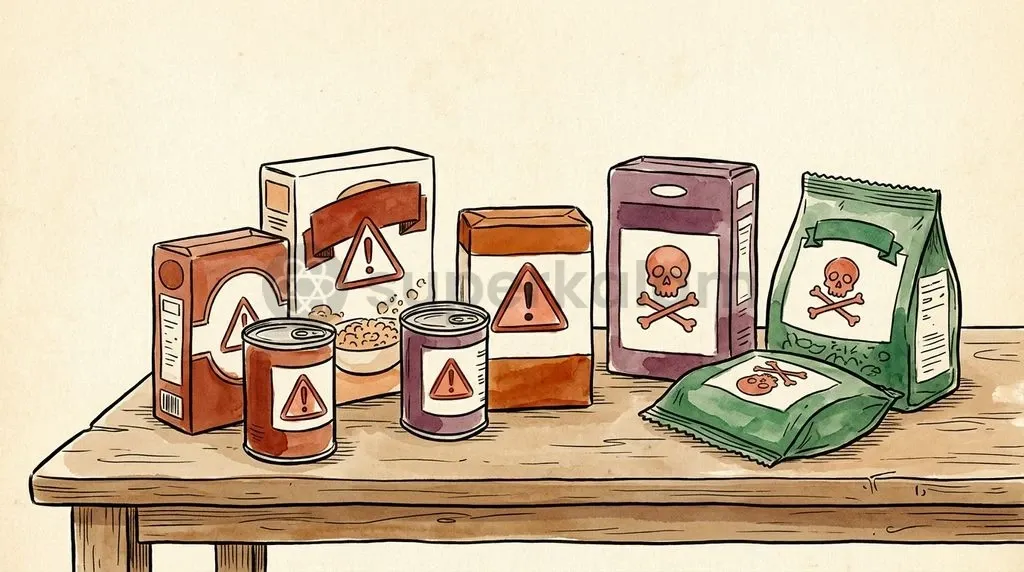
| Why does it matter? | India's rising burden of diabetes and other non-communicable diseases is linked to packaged ultra-processed foods; labels are the cheapest mass nudge available. |
Overview
The Supreme Court of India directed the Food Safety and Standards Authority of India to enforce front-of-pack nutrition labelling with mandatory red hexagonal warning symbols. It established that consumer access to clear nutritional information is an integral dimension of the Right to Health under Article 21.
By rejecting voluntary summary ratings such as the Indian Nutrition Rating, the judicial directive resolves years of regulatory indecision surrounding ultra-processed foods. As of November 2026, the judgment compels packaged food businesses to transition towards transparent disclosure of high fat, sugar, and salt content to curb preventable metabolic disease.
Why in the News: The Supreme Court Intervention on Packaged Food
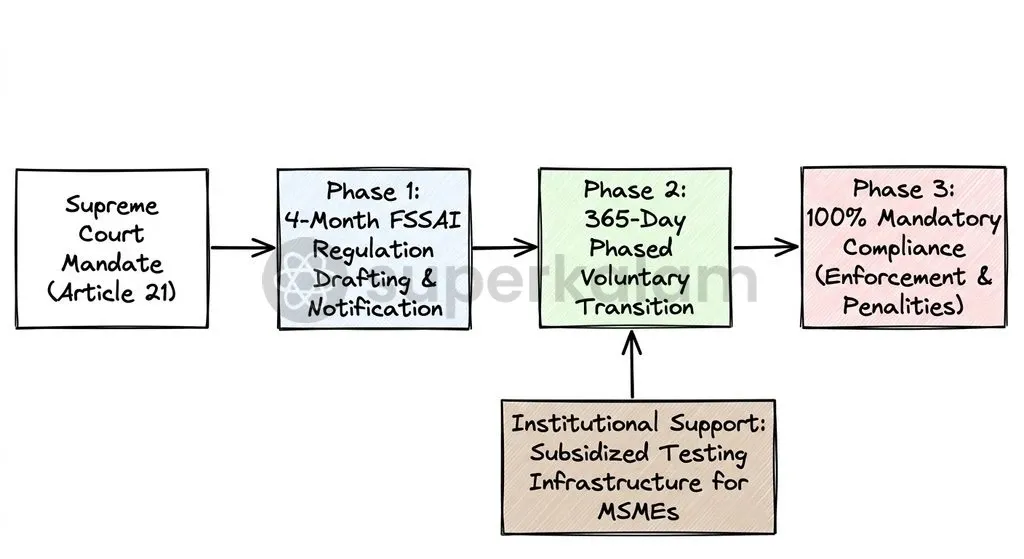
The Supreme Court of India delivered a landmark judgment on 26 November 2026 ordering strict regulations for packaged food labels. In 3S and Our Health Society v. Union of India & Ors. (2026 INSC 1275), the apex court directed the Food Safety and Standards Authority of India (FSSAI) to formulate and notify a mandatory front-of-pack nutrition labelling (FoPNL) framework within four months.
This judicial intervention transforms Indian food governance by replacing protracted consultations with binding constitutional timelines. The ruling shifts front-of-pack food labelling from a commercial compromise into an enforceable safeguard anchored in fundamental rights.
Under the court's binding orders, packaged foods exceeding statutory thresholds must implement specific safeguards:
- Warning geometry: Separate red hexagonal warning labels for each nutrient of concern ('High Sugar', 'High Fat', or 'High Salt') displaying standardised pictograms, explicitly barring single combined summary symbols.
- Mandatory display area: Each warning emblem must occupy a minimum of 4% to 5% of the principal display panel of the package.
- Transition deadline: Food Business Operators (FBOs) receive a strict 365-day voluntary transition period following final notification, after which full compliance becomes compulsory without standard administrative extensions.
Discuss with Superkalam
Recall what percentage of total deaths in India is attributed to non-communicable diseases according to the World Health Organization.
Ask NowWhat Is Front-of-Pack Labelling and Why India Urgently Needs It
Front-of-pack nutrition labelling provides simplified, interpretive nutritional evaluations printed directly on the front surface of pre-packaged foods. Unlike traditional back-of-pack nutrition tables that require numerical literacy, interpretive front warnings allow consumers to evaluate nutritional quality within seconds at the point of sale.
India faces an escalating crisis of non-communicable diseases driven by rapid dietary shifts towards ultra-processed items. According to the World Health Organization, non-communicable diseases account for an estimated 66% of all deaths in India, led primarily by cardiovascular disease, cancer, chronic respiratory disorders, and diabetes.
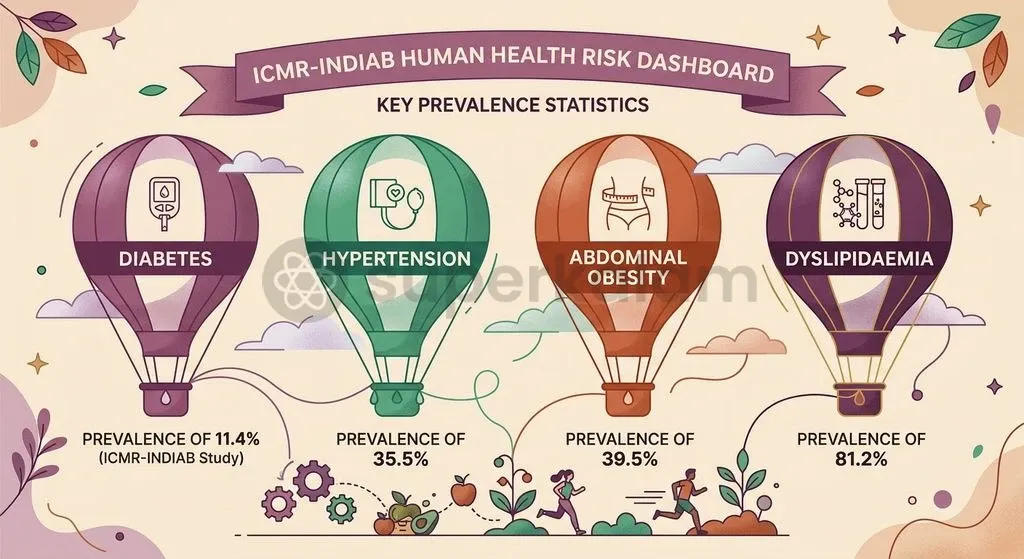
The epidemiological scale of this dietary transition is captured in national clinical surveys from the ICMR-INDIAB cross-sectional study published in The Lancet Diabetes & Endocrinology:
| ICMR-INDIAB Survey Indicator | National Population Prevalence |
|---|---|
| Dyslipidaemia | 81.2% |
| Abdominal Obesity | 39.5% |
| Hypertension | 35.5% (315 million individuals) |
| Generalised Obesity | 28.6% |
| Diabetes | 11.4% (101 million citizens) |
Without clear warning labels, consumers remain unaware of metabolic risks concealed beneath attractive commercial branding.
Star Ratings vs Warning Labels: Breaking Down the Core Design Battle
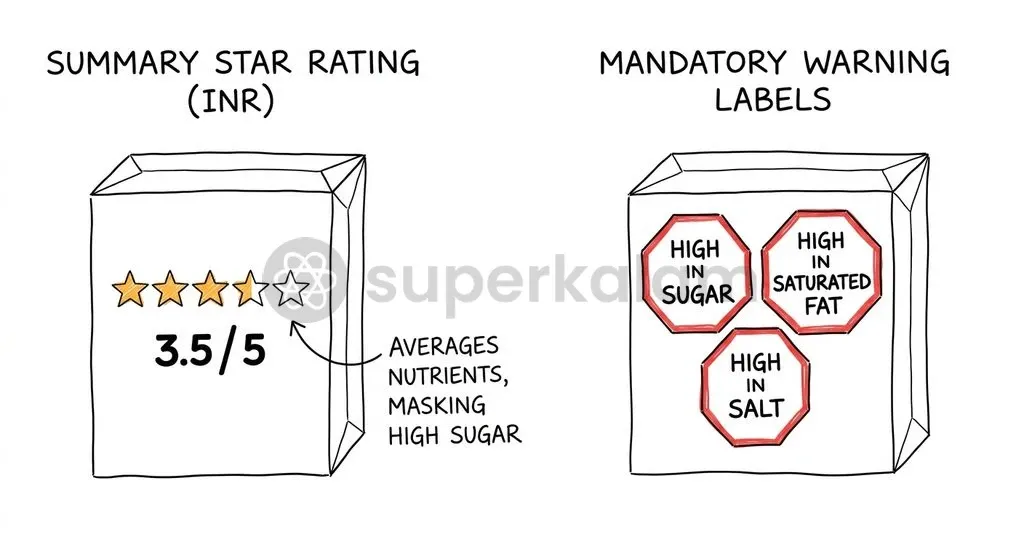
Regulatory debates over front-of-pack nutrition labelling have centred on a sharp conflict between summary scoring systems and nutrient-specific warning seals. In September 2022, FSSAI published draft amendments proposing the Indian Nutrition Rating (INR), an interpretive system assigning packaged items between 0.5 to 5 stars modelled on Australia's Health Star Rating.
Under FSSAI's draft 2022 framework, High in Fat, Sugar, and Salt (HFSS) food was defined as processed food deriving 10% or more energy from total sugar or saturated fat, or containing sodium exceeding 1 mg per 1 kcal. Public health groups, including the Nutrition Advocacy in Public Interest (NAPi) network, strongly opposed this star-rating format.
Summary ratings permit manufacturers to offset excess salt, saturated fat, or sugar by adding positive ingredients such as fibre, nuts, or millets. A confectionary product high in refined sugar can thus achieve a misleadingly respectable star score. Conversely, the World Health Organization recommends nutrient-specific warning labels as the most effective regulatory mechanism to curb harmful consumption.
The Supreme Court explicitly upheld this public health consensus. The court ordered FSSAI to abandon summary scoring in favour of individual red warning hexagons, mandating that thresholds be calculated against total sugars and saturated fats rather than merely added components.
| Dimension | Indian Nutrition Rating (INR / Star System) | Nutrient-Specific Warning Labels (SC Mandate) |
|---|---|---|
| Visual Structure | 0.5 to 5 stars depicting an aggregate nutritional profile. | Discrete red hexagonal warning labels for each excess nutrient. |
| Underlying Mechanism | Summary scoring algorithm balancing harmful and positive nutrients. | Absolute threshold triggers for total sugar, saturated fat, and sodium. |
| Consumer Effect | Creates a health halo where processed junk food appears wholesome. | Delivers immediate, unambiguous deterrence at the point of purchase. |
| Regulatory Precedent | Modelled after voluntary Australian Health Star Ratings. | Modelled after mandatory statutory systems used in Chile. |
| WHO Guidance | Disfavoured due to algorithmic masking of critical health hazards. | Explicitly recommended by WHO as the global gold standard. |
Discuss with Superkalam
Explain how the 'health halo' effect in summary star-rating systems can mislead consumers purchasing packaged foods.
Ask NowGlobal Precedents: How Chile, the UK, and Others Label Unhealthy Foods
International implementations show that mandatory, unambiguous warning systems achieve far better dietary outcomes than voluntary traffic lights. Chile established the world's most definitive front-of-pack benchmark by enacting the Law of Food Labelling and Advertising (Law No. 20,606) in 2012, formally rolling out black octagonal stop-sign warning labels on 27 June 2016.
Chile implemented its nutritional thresholds across three progressive stages between 2016 and 2019. The statutory cut-off for sugar in solid foods tightened from 22.5 grams per 100g in 2016 down to 10 grams per 100g by June 2019.
The epidemiological and market outcomes in Chile proved decisive:
- An interrupted time-series evaluation published in PLOS Medicine documented a 23.7% reduction in household purchases of sugary beverages following initial implementation.
- A longitudinal assessment by the Institute of Nutrition and Food Technology (INTA) showed that packaged foods classified as 'High in' critical nutrients dropped from 70.8% before the law to 52.5% after the final phase.
In contrast, the United Kingdom Department of Health introduced its voluntary Multiple Traffic Light (MTL) system in June 2013, combining green, amber, and red indicators for sugar, fat, saturated fat, and salt.
While the UK scheme covers over 60% of pre-packaged supermarket items, its voluntary nature leaves significant market gaps across fast-food brands and specialist processors. A cross-sectional evaluation in BMJ Medicine revealed that the UK traffic light system identified fewer than half (48.2%) of ultra-processed items as unhealthy, whereas independent dietary guidelines classified more than 98% of those items as nutritionally detrimental.
Public Health vs Industry Interests: The Major Friction Points
Industrial food manufacturers and public health advocates have maintained opposing stances throughout India's labelling consultations. Industry associations, including the Confederation of Indian Industry (CII) and the Federation of Indian Chambers of Commerce and Industry (FICCI), have actively opposed mandatory warning stamps.
Processors argue that rapid reformulation incurs steep research and development expenditures, shortens product shelf-life, and triggers commercial instability. Micro, Small, and Medium Enterprises (MSMEs), which comprise nearly 80% of India's registered food processing units, face severe structural bottlenecks.
These smaller manufacturing units struggle with:
- Recurring laboratory testing expenditures across NABL-accredited facilities for complex nutrient profiling.
- Financial losses resulting from redundant stocks of pre-printed packaging materials during sudden regulatory transitions.
- Limited technological infrastructure needed to substitute saturated palm fats and refined sugars without compromising preservation.
The Supreme Court acknowledged these industrial tensions while prioritising preventive public healthcare. The bench observed that while thresholds must be scientifically balanced to avoid consumer desensitisation and label fatigue, economic compliance costs cannot override public health safeguards.
Discuss with Superkalam
Apply the Supreme Court's packaging directives to a packaged food item that exceeds thresholds for both sugar and salt; what specific label changes are required on its principal display panel?
Ask NowLegal and Constitutional Dimensions: Article 21 and the FSS Act, 2006
The Supreme Court situated mandatory front-of-pack nutritional warnings squarely within the fundamental right to life and health guaranteed under Article 21 of the Constitution of India. The bench affirmed that Indian consumers possess an unassailable right to bodily autonomy. Domestic citizens are entitled to no less statutory protection and nutritional clarity than consumers in developed nations such as the United States or the United Kingdom.
Statutory food governance operates through interconnected legal provisions:
| Statutory Anchor | Legal Provision | Regulatory Mandate |
|---|---|---|
| Constitution of India | Article 21 | Guarantees the fundamental right to health and bodily integrity. |
| Food Safety and Standards Act, 2006 | Section 16(1) and Section 16(2) | Empowers FSSAI to set mandatory standards for food safety and consumer labelling. |
| Food Safety and Standards Act, 2006 | Section 23 | Explicitly prohibits packaging, labelling, or presentation that is false or misleading. |
| Consumer Protection Act, 2019 | Section 2(9)(ii) | Protects the consumer right to complete disclosure regarding quality, purity, and standard. |
The Supreme Court directed that sweetened beverages falling beneath trigger thresholds cannot display misleading claims of wholesome healthfulness. This aligns with the Food Safety and Standards (Advertising and Claims) Regulations, 2018, which strictly restrict deceptive comparative claims or unqualified designations like 'sugar-free' or '100% natural'.
Discuss with Superkalam
Analyse the structural differences between the United Kingdom's voluntary Multiple Traffic Light model and Chile's mandatory warning label system in terms of regulatory effectiveness.
Ask NowWhat FSSAI Must Decide Next: The Way Forward for Clear Nutrition Rules
The Food Safety and Standards Authority of India must now notify definitive statutory rules within the four-month judicial window. Navigating the operational shift requires FSSAI to balance rigorous public health standards with sustainable industrial implementation.
Key administrative and technical actions must guide this regulatory transition:
- Calibrating Scientific Thresholds: FSSAI must delineate objective limits for total sugar, saturated fat, and sodium that prevent ultra-processed foods from evading red warning labels while preventing excessive label proliferation that dulls consumer caution.
- Phased Threshold Tightening: Regulators should emulate Chile's progressive three-stage model, establishing baseline cut-offs initially and ratcheting limits tighter over three years to enable domestic product reformulation.
- Dedicated MSME Subsidies: The Ministry of Food Processing Industries should roll out technical assistance funds to subsidise NABL-accredited testing for micro-processors and support recipe re-engineering.
- Regulating Surrogate Health Claims: Packaging oversight must strictly penalise deceptive marketing that places front warning labels alongside disingenuous claims of high micronutrient vitality.
Discuss with Superkalam
Weigh the trade-off between the compliance burdens faced by food-processing MSMEs and the public health imperatives of curbing metabolic diseases under Article 21.
Ask NowKey Takeaways
- In 3S and Our Health Society v. Union of India & Ors. (2026 INSC 1275), the Supreme Court ordered FSSAI to notify mandatory front-of-pack warning labels within four months from 26 November 2026.
- The court rejected summary 5-star ratings (such as INR) and mandated separate red hexagonal warning labels for high sugar, fat, or salt, each covering 4% to 5% of the principal display panel.
- Mandatory warning labels are anchored in the Right to Health under Article 21, operationalised through Sections 16 and 23 of the Food Safety and Standards Act, 2006.
- Chile's mandatory black octagonal warning system reduced sugary drink purchases by 23.7%, providing clear empirical proof that interpretive warnings outperform voluntary traffic lights.
- FBOs have a 365-day voluntary transition window before enforcement becomes strictly mandatory, requiring targeted support for MSMEs comprising 80% of India's registered food processing units.
Exam Angle: How UPSC Tests Food-Labelling Regulation
PYQ trend. Prelims can test the institutional map - FSSAI's mandate under the FSS Act, 2006, and what front-of-pack labelling formats exist. Mains GS-II (health and governance) asks for evaluation of regulatory design: warning labels versus star ratings, industry pushback, and the public-health case.
Practice: UPSC Mains GS-II Polity PYQs | Prelims PYQ bank | Topic-wise Polity PYQs with explanations.
Mains answer framework. For a 15-marker on this theme:
- Start with the trigger: the 26 November 2026 Supreme Court order and its deadlines.
- Explain the regulatory choice: warning labels versus summary ratings, with the Court's reasoning.
- Bring in evidence - global experience such as Chile's warning-label law and India's NCD burden.
- End with implementation challenges and a way forward for FSSAI.
Common mistakes aspirants make.
- Writing as if the Court mandated one specific label - it set the direction (warning labels) and deadlines; design details rest with FSSAI.
- Mixing up front-of-pack warning labels with back-of-pack nutrient tables or GDA declarations.
- Ignoring the industry-compliance dimension, which the order explicitly addresses with timelines.
Mains Question
The Supreme Court's ruling in 3S and Our Health Society v. Union of India anchors consumer access to clear nutritional information within the Right to Health under Article 21. Elucidate how mandatory nutrient-specific warning labels overcome the structural deficiencies of summary star-rating systems. (10 Marks)
Evaluate NowMains Question
'While front-of-pack warning labels are vital for preventive healthcare, sudden regulatory transitions pose severe technological and financial bottlenecks for domestic processors.' In light of the Supreme Court's FoPNL mandate, critically examine the operational challenges faced by MSMEs in the food processing sector. (15 Marks)
Evaluate NowPractice MCQs
QUESTION 1
Consider the following statements regarding the Supreme Court's directives on Front-of-Pack Nutrition Labelling (FoPNL) in 3S and Our Health Society v. Union of India (2026): 1. The apex court mandated the adoption of the Indian Nutrition Rating (INR) star system. 2. Packaged foods exceeding statutory thresholds must display separate red hexagonal warning labels for each nutrient of concern. 3. Each warning emblem is required to occupy a minimum of 4% to 5% of the principal display panel. Which of the statements given above are correct?
QUESTION 2
With reference to Front-of-Pack Nutrition Labelling (FoPNL) systems globally, consider the following statements: 1. Chile implemented statutory black octagonal warning labels under Law No. 20,606. 2. The United Kingdom's Multiple Traffic Light system is a legally binding, mandatory framework covering all fast-food and packaged food manufacturers. 3. Summary star-rating models can generate a 'health halo' by allowing manufacturers to offset excess sugar or salt with positive ingredients. Which of the statements given above is/are correct?
QUESTION 3
Consider the following statements regarding nutritional thresholds under India's draft 2022 framework for High in Fat, Sugar, and Salt (HFSS) foods: 1. Food is classified as HFSS if it derives 10% or more energy from total sugar or saturated fat. 2. The sodium threshold was set at exceeding 1 mg per 1 kcal. 3. The Supreme Court mandated that HFSS cut-offs should only evaluate added sugars and fats rather than total sugars and saturated fats. Which of the statements given above is/are correct?
QUESTION 4
Consider the following statements regarding the prevalence of metabolic risk factors in India as reported by the ICMR-INDIAB study: 1. Dyslipidaemia was found to affect over 80% of the surveyed population. 2. Generalised obesity was found to have a higher population prevalence than abdominal obesity. Which of the statements given above is/are correct?
QUESTION 5
In the context of the food processing industry in India, Micro, Small, and Medium Enterprises (MSMEs) account for approximately what proportion of registered manufacturing units?