Delimitation 2026: The Federal Crisis in Lok Sabha Seat Allocation
As the constitutional seat freeze expires post-2026, Lok Sabha reapportionment threatens to penalise southern states for family planning success.
Nov, 2026
•15 min read
Updated 27 November 2026
At a Glance
| Question | Quick answer |
|---|---|
| What is delimitation? | The redrawing of Lok Sabha and Assembly seat boundaries and counts under Articles 82 and 170, carried out by a Delimitation Commission after each Census. |
| Why are seats frozen today? | The 42nd Amendment (1976) froze inter-state seat allocation on 1971 Census figures; the 84th Amendment (2001) extended the freeze until the first Census after 2026. |
| Why are southern states worried? | Their success in population control (TFR 1.7-1.8, vs 3.0 in Bihar and 2.4 in UP) could cost them Lok Sabha seats when allocation is unfrozen. |
| Is it only about seats? | No. The debate overlaps with fiscal federalism - states fear losing both political representation and their share of central resources. |
| What safeguards exist? | Few. Unlike the US Senate or Germany's Bundesrat, the Rajya Sabha allocates seats broadly by population, so it cannot check a population-driven reallocation. |
Context
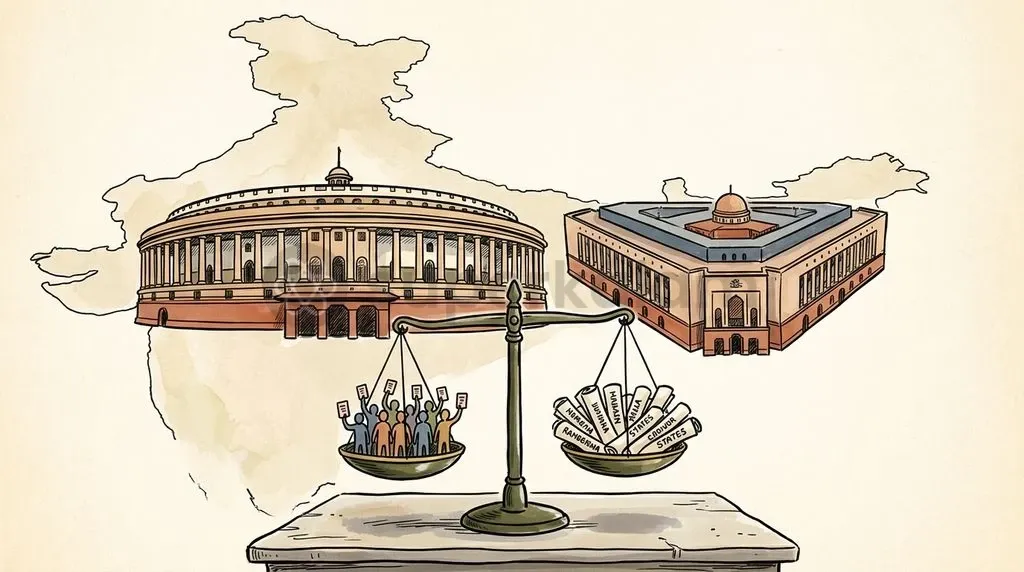
Delimitation post-2026 threatens to fracture India's federal compact by pitting democratic representation against federal fairness. While Article 81 mandates proportional seat allocation based on population, northern and southern states have experienced stark demographic divergence since the 1971 freeze. A strict population reapportionment would penalise southern states for family planning success, stripping their political voice in Parliament and centralising power in northern demographies. Reconciling this tension requires structural constitutional compromise, balancing demographic equality with protective federal safeguards.
Why Delimitation Post-2026 is Sparking Fierce Political Debate
India's impending delimitation exercise has triggered intense federal friction between demographically surging northern states and economically advanced southern states. As of mid-2024, the freeze imposed on the inter-state allocation of Lok Sabha seats by the 84th Constitutional Amendment Act, 2001 approaches its expiration, which is linked to the first census conducted after 2026.
The underlying tension stems from a clash between two core constitutional commitments. On one hand, representative democracy demands that every citizen's vote carries roughly equal weight across parliamentary constituencies. On the other hand, the federal principle demands that constituent states must not suffer political marginalisation for successfully executing national development priorities.
Political leaders across southern states argue that redrawing seats purely by population creates an electoral penalty for good governance. Under the current constitutional framework of Article 82, no reallocation of Lok Sabha seats among states can take effect until the first national Census conducted after the year 2026 has been completed and its final figures officially published. This deadline turns the upcoming Census and subsequent delimitation into an acute federal flashpoint.
How Seat Allocation Works: Constitutional Rules and Past Freezes
Constitutional rules governing seat distribution establish a direct link between population numbers and parliamentary power. According to Article 81(2)(a) of the Constitution of India, seats in the Lok Sabha must be allotted to each state such that the ratio between the number of seats and the population of the state is, so far as practicable, the same across all states.
Article 82 dictates that upon the completion of each decennial census, the allocation of seats to the states and the division of each state into territorial constituencies shall be readjusted by an authority determined by parliamentary law. Article 170 provides an identical framework for State Legislative Assemblies, mandating population-proportional territorial constituencies and census-based seat readjustments.
Parliament enforces these mandates by passing Delimitation Acts under Article 327. A statutory Delimitation Commission carries out the process. The commission is chaired by a retired Supreme Court judge and comprises the Chief Election Commissioner (or an Election Commissioner nominated by the CEC) alongside the respective State Election Commissioner as ex-officio members. Under Section 10(2) of the Delimitation Act, 2002, every order issued by the Delimitation Commission published in the Gazette of India has the force of law and cannot be called into question in any court. Furthermore, Article 329(a) bars the judiciary from questioning laws relating to constituency delimitation.
Parliament has repeatedly frozen the reallocation of parliamentary seats across states to protect national population policy:
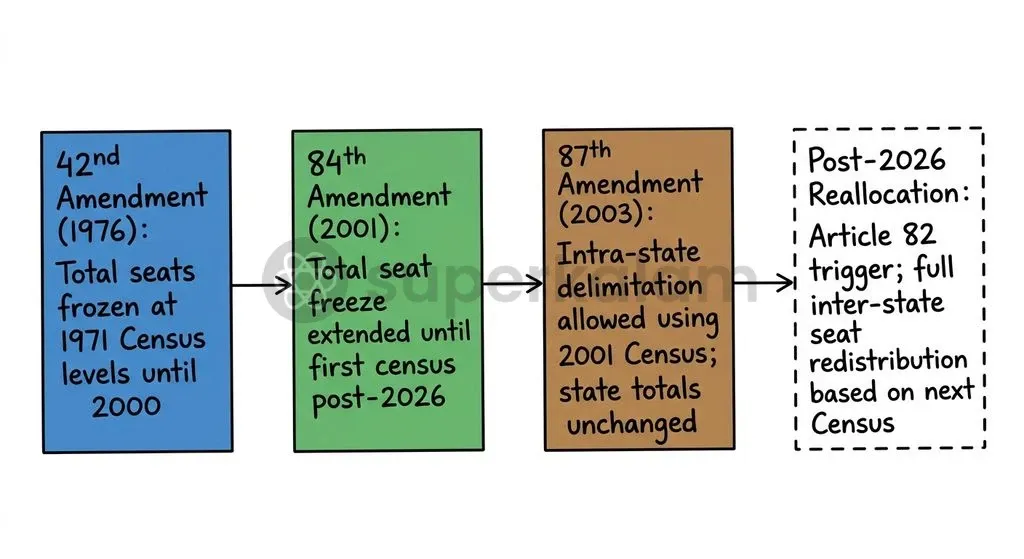
- The 42nd Amendment Act, 1976: Froze the inter-state allocation of Lok Sabha and state assembly seats at the 1971 Census levels until the year 2000. This ensured that states aggressively pursuing national family planning programmes were not penalised with diminished parliamentary representation.
- The 84th Amendment Act, 2001: Extended this inter-state seat freeze based on the 1971 demographic benchmarks until the relevant figures for the first census taken after the year 2026 are published.
- The 87th Amendment Act, 2003: Allowed internal redrawing of boundaries within states using the 2001 Census, while strictly preserving the total seat count assigned to each state.
| Constitutional Mechanism | Primary Mandate | Governing Constitutional Article / Statute |
|---|---|---|
| Inter-State Allocation | Equates representation-to-population ratios across states | Article 81(2)(a) |
| Decennial Readjustment | Readjusts seats and boundaries after each Census | Article 82 |
| State Assembly Alignment | Mirrors Lok Sabha seat apportionment rules in Vidhan Sabhas | Article 170 |
| Parliamentary Authority | Empowers Parliament to legislate delimitation machinery | Article 327 |
| Statutory Commission | Determines constituency boundaries with unchallengeable orders | Section 10(2), Delimitation Act, 2002 |
| Inter-State Seat Freeze | Locks state seat quotas to 1971 Census until post-2026 Census | 84th Constitutional Amendment Act, 2001 |
Discuss with Superkalam
Which Constitutional Amendment Act extended the freeze on inter-state Lok Sabha seat distribution until the first census post-2026?
Ask NowThe Population Divide: How Family Planning Success Created a Political Penalty
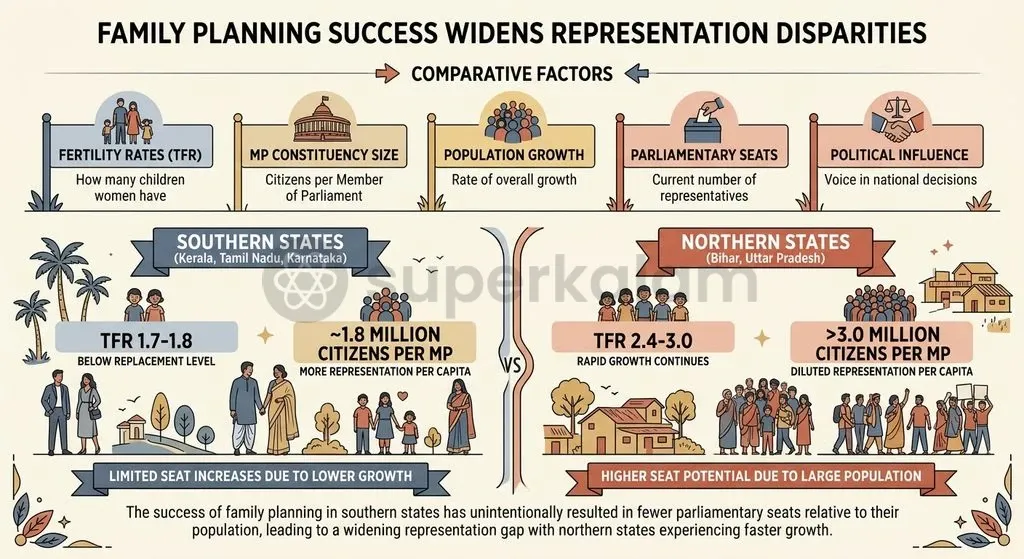
Demographic trends over the last half-century have sharply split India into two distinct regional patterns. Southern states heavily invested in female literacy, healthcare infrastructure, and family welfare, successfully pushing their fertility rates below the replacement level decades ahead of the national trajectory.
According to data from the National Family Health Survey (NFHS-5, 2019–21), southern states have achieved Total Fertility Rates (TFR)—defined as the average number of children born to a woman over her reproductive lifetime—well below the replacement threshold of 2.1. Kerala and Tamil Nadu recorded a TFR of 1.8, while Andhra Pradesh and Karnataka dropped to 1.7.
In contrast, large northern states experienced sustained population growth, lagging on key human development indicators. NFHS-5 recorded a TFR of 3.0 in Bihar and 2.4 in Uttar Pradesh.
Because Lok Sabha seat quotas remain tethered to 1971 population benchmarks, this divergence has generated severe malapportionment across India. An analysis by the Election Commission of India and national census data demonstrates that an average Member of Parliament in Uttar Pradesh currently represents over 3 million citizens, whereas an MP in Kerala or Tamil Nadu represents approximately 1.8 million citizens. Northern citizens can legitimately argue that their votes suffer dilution, while southern states maintain that strict democratic reapportionment amounts to punishment for development success.
What the Projections Show: The Potential Shift in Parliamentary Power
Demographic projections show that lifting the seat freeze without protective mechanisms would radically alter the regional balance of power in Parliament. Reallocating seats strictly by projected demographic shares transfers substantial legislative power from the south to the north.
According to independent demographic projections published by Milan Vaishnav and Jamie Hintson for the Carnegie Endowment for International Peace, if the Lok Sabha remains capped at 543 seats and is reapportioned strictly by projected 2026 population figures, four northern states—Bihar, Uttar Pradesh, Madhya Pradesh, and Rajasthan—would collectively gain 22 seats, while southern states would forfeit 17 seats.
| State | Existing Seats (1971 Census Freeze) | Projected Seats: Capped 543 House | Projected Seats: Expanded 850 House |
|---|---|---|---|
| Uttar Pradesh | 80 | Projected increase | 138 |
| Bihar | 40 | Projected increase | 72 |
| Tamil Nadu | 39 | Projected decline | 50 |
| Kerala | 20 | Projected decline | 23 |
To prevent any single state from suffering an absolute loss in its seat tally, the Carnegie Endowment's research indicates that Parliament would need to expand the Lok Sabha to at least 848 seats. However, even within an expanded chamber, southern political influence would diminish in relative terms. Reporting from The Hindu based on Carnegie projections highlights that in an 850-seat Lok Sabha based strictly on demographic shares, Uttar Pradesh is projected to surge from 80 to 138 seats and Bihar from 40 to 72 seats. In comparison, Tamil Nadu would grow modestly from 39 to 50 seats, and Kerala would inch from 20 to 23 seats.
Under such an expansion, northern states would command a dominant constitutional majority on their own, allowing national policies and constitutional amendments to pass with minimal southern legislative participation.
Discuss with Superkalam
How does the requirement of Article 81(2)(a) conflict with the demographic outcomes achieved by southern states under national population policies?
Ask NowThe Core Clash: Democratic Principle of Representation vs Federal Fairness
The delimitation debate exposes a fundamental normative impasse between the individual right to equal representation and the federal imperative of regional equity. Both positions cite valid constitutional and democratic values.
The pro-delimitation argument rests upon the foundational democratic principle of "one person, one vote, one value." Under Article 81, voters in Uttar Pradesh and Bihar endure structural under-representation, since an individual vote in the north carries roughly half the parliamentary weight of a vote cast in Kerala. Denying northern states their population-proportional share violates the basic premise of representative democracy, permanently under-representing populations that suffer from acute socio-economic deficits.
Conversely, the counter-argument rests upon the nature of the Indian Union as a holding-together federation. In this view, states entered the constitutional compact on the premise that collective national goals—including the 1976 family welfare directives—would not be turned into instruments of regional disenfranchisement. A strict majoritarian reallocation risks degrading southern states into political bystanders, undermining the foundational federal bargain.
Discuss with Superkalam
If you were advising the Delimitation Commission, how would you apply demographic data from NFHS-5 to balance equal vote value against regional equity?
Ask NowBeyond Seats: The Overlap with Financial Federalism and Resource Sharing
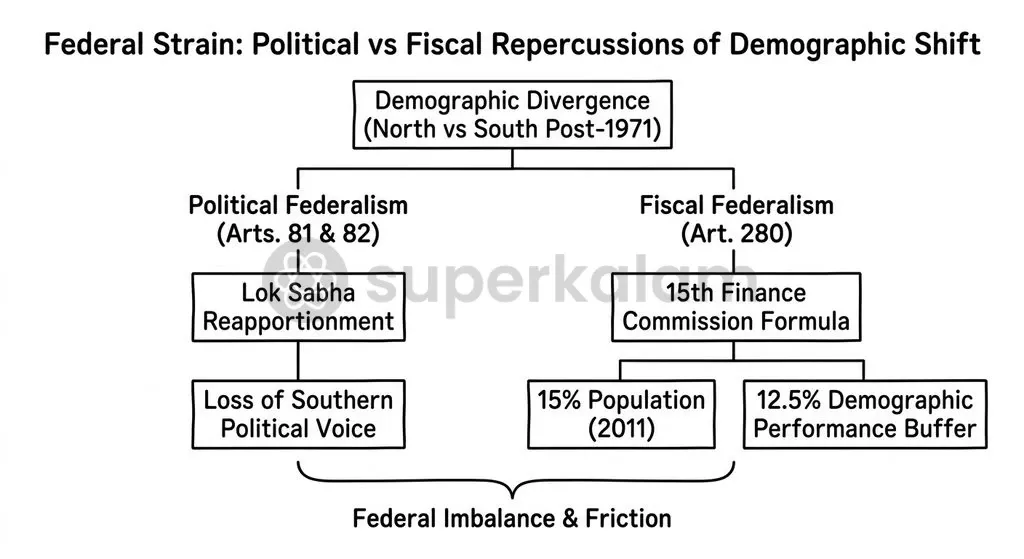
Fears over legislative marginalisation run parallel to existing southern grievances regarding fiscal federalism and horizontal tax distribution. Southern states increasingly argue that their economic contributions subsidise the Union while their own fiscal returns dwindle.
This dynamic intensified when the 15th Finance Commission altered its demographic baseline. While the commission maintained vertical devolution of the central divisible tax pool to the states at 41% for 2021–26 (a 1% reduction from the 14th Finance Commission's 42% to accommodate Jammu & Kashmir and Ladakh), it was mandated to use the 2011 Census instead of the 1971 Census for horizontal distribution.
To offset the resulting disadvantage to states with declining birth rates, the commission assigned a 15% weight to the 2011 Census and introduced a "Demographic Performance" criterion with a 12.5% weight, calculated using the inverse of a state's Total Fertility Rate. Despite this buffer, horizontal devolution shifts produced clear regional winners and losers:
- Karnataka: Suffered the steepest drop among southern states, falling from a 4.713% share under the 14th Finance Commission to 3.647% for 2021–26.
- Kerala: Saw its tax share decline from 2.500% to 1.925%.
- Tamil Nadu: Emerged as the sole southern state to record a net gain, increasing its inter-se share marginally from 4.023% to 4.079%.
- Northern States: Retained massive devolution shares, with Uttar Pradesh securing 17.939% and Bihar receiving 10.058% of the divisible tax pool.
Because fiscal redistribution already redirects resources heavily from the south to the north, southern regional parties fear that losing Lok Sabha representation will eliminate their leverage to challenge central tax allocations, centrally sponsored scheme conditions, and public finance decisions.
How Other Large Federations Protect Regional Balance
Global federal systems use explicit institutional checks to ensure that populous regions cannot dominate national governance. These mechanisms separate territorial security from raw demographic headcounts.
Under Article I, Section 3 of the United States Constitution, every state receives exactly two senators regardless of whether its population is 600,000 or 39 million. This arrangement insulates small states against the demographic hegemony of larger ones in the federal legislature. Similarly, Section 7 of the Australian Constitution assigns twelve senators to each original Australian State, irrespective of massive population differences between states like New South Wales and Tasmania.
Other federations deploy weighted voting or statutory floors. Article 51 of Germany's Basic Law utilizes an asymmetric weighted voting system in the Bundesrat, assigning each Land between three and six votes based on tiered population brackets, shielding smaller Länder from majoritarian dominance. In Canada, Section 51A of the Constitution Act (the "Senatorial Floor" rule) alongside the 1985 "Grandfather Clause" guarantees that no province can have fewer seats in the House of Commons than it has in the Senate or held in 1985.
| Country | Upper Chamber / Mechanism | Method of Regional Balancing | Constitutional Basis |
|---|---|---|---|
| United States | Senate | Strict equality: exactly 2 senators per state | Article I, Section 3, US Constitution |
| Australia | Senate | Strict equality: 12 senators per original state | Section 7, Australian Constitution |
| Germany | Bundesrat | Tiered asymmetric voting (3 to 6 votes per Land) | Article 51, German Basic Law |
| Canada | House of Commons | Senatorial Floor & Grandfather Clause seat guarantees | Section 51A, Constitution Act, 1867 |
| India | Rajya Sabha | Asymmetric, population-weighted allocation | Article 80 & Fourth Schedule |
India's Council of States operates differently. Under Article 80 and the Fourth Schedule of the Constitution, Rajya Sabha seats are distributed roughly by population, ranging from 31 seats for Uttar Pradesh to just 1 seat for several northeastern states. Because the Rajya Sabha mirrors Lok Sabha demographic imbalances instead of correcting them, India lacks an institutional chamber to protect smaller states from majoritarian legislation.
Discuss with Superkalam
Compare the implications of capping the Lok Sabha at 543 seats versus expanding it to 850 seats on the relative legislative leverage of southern states.
Ask NowWay Forward: Reforming the Delimitation Framework to Protect Federalism
Resolving the post-2026 delimitation dilemma requires structural constitutional compromises that bridge demographic justice and federal cohesion. Rather than choosing between raw population counts and another indefinite freeze, policymakers can deploy balanced institutional reforms:
- Internal Delimitation Without Inter-State Reallocation: Parliament could pursue a constitutional amendment to freeze inter-state seat quotas for another defined window while permitting a Delimitation Commission to redraw constituency boundaries exclusively within each state, as explored in analyses published by PRS Legislative Research and the Economic and Political Weekly. This approach would resolve internal malapportionment—equalising voter ratios between exploding metropolitan cities and depopulated rural areas—without destabilising the inter-state balance of power.
- Reconstituting the Rajya Sabha into a True Federal Chamber: To counterbalance an expanded Lok Sabha apportioned by population, Parliament could amend the Fourth Schedule to reconstitute the Rajya Sabha, moving toward equal or tiered state representation and granting it co-equal veto powers over federal legislation, a pathway examined in research from the Vidhi Centre for Legal Policy. Transforming the upper house into a genuine territorial chamber would ensure that national legislation requires broad geographical consent.
- Calibrated Chamber Expansion with a Regional Floor: If Lok Sabha seats expand, legislation could incorporate a demographic floor—similar to the Canadian model—guaranteeing that no state's proportion of total parliamentary power falls below a fixed threshold. Expanding the chamber to roughly 850 seats prevents absolute reductions in southern state tallies, but this must be paired with weighted legislative voting on constitutional amendments to safeguard federal principles.
- Institutionalising Federal Consensual Mechanisms: Deepening the authority of the Inter-State Council under Article 263 and expanding the Finance Commission's demographic performance weighting can build trust between the Centre and states before any redrawing begins.
India's democratic durability relies on harmonising popular sovereignty with constitutional federalism. The delimitation challenge is not merely a technical exercise in cartography, but a foundational test of whether the Indian Union can sustain political unity across distinct demographic landscapes.
Key Takeaways
- The Impending Trigger: Under Article 82 and the 84th Constitutional Amendment Act, 2001, inter-state Lok Sabha seat allocations remain frozen until the official figures of the first Census conducted after the year 2026 are published.
- The Demographic Divergence: NFHS-5 data shows southern states operating at sub-replacement fertility rates (TFR of 1.7 to 1.8), while major northern states like Bihar (3.0) and Uttar Pradesh (2.4) retain substantially higher fertility rates.
- Severe Malapportionment: An average MP in Uttar Pradesh currently represents over 3 million citizens, compared to approximately 1.8 million citizens represented by an MP in Kerala or Tamil Nadu.
- Projected Shift in Power: Projections by the Carnegie Endowment indicate that under a capped 543-seat Lok Sabha reapportioned strictly by 2026 population shares, northern states would gain 22 seats while southern states would lose 17 seats; preventing absolute seat losses requires expanding the chamber to at least 848 seats.
- The Fiscal Precedent: The 15th Finance Commission's shift to the 2011 Census—even with a 12.5% demographic performance buffer—resulted in horizontal devolution drops for southern states like Karnataka and Kerala, intensifying fears of systemic political and financial marginalisation.
- Comparative Federal Safeguards: Unlike the United States Senate (equal state representation) or Germany's Bundesrat (asymmetric tiered voting), India's Rajya Sabha allocates seats broadly by population under the Fourth Schedule, leaving it unable to serve as an institutional check against majoritarian seat reallocation.
Exam Angle: How UPSC Tests Delimitation and Federalism
PYQ trend. Prelims regularly tests the constitutional machinery - Articles 82 and 170, the 42nd and 84th Amendments, and the years of each freeze. Mains GS-II frames delimitation as a federalism-versus-representation dilemma, often asking candidates to balance democratic principle against regional equity.
Practice: UPSC Mains GS-II Polity PYQs | Prelims PYQ bank | Topic-wise Polity PYQs with explanations.
Mains answer framework. For a 15-marker on this theme:
- Open with the constitutional scheme: Article 82, the role of the Delimitation Commission, and the two freezes (1976, 2001).
- Present the demographic divergence with data - NFHS-5 fertility rates south versus north.
- Argue both principles: one-person-one-vote versus federal fairness and the penalty for population control.
- Close with safeguards: options such as freezing seat share ratios, strengthening the Rajya Sabha, or weighting development performance.
Common mistakes aspirants make.
- Confusing inter-state seat allocation (frozen till post-2026 Census) with intra-state readjustment of constituencies (done in 2008 on 2001 Census).
- Writing that the freeze "ended in 2026" - it ends only after the first Census conducted after 2026 is published.
- Ignoring the fiscal-federalism overlap and treating the issue as purely about Lok Sabha arithmetic.
Mains Question
'The impending post-2026 delimitation exercise brings the democratic principle of equal representation into direct conflict with the federal compact.' Critically examine. (15 Marks)
Evaluate NowMains Question
'The freeze on Lok Sabha seat allocation under the 42nd and 84th Constitutional Amendment Acts has created an unsustainable trade-off between democratic parity and cooperative federalism.' Elucidate. (10 Marks)
Evaluate NowPractice MCQs
QUESTION 1
With reference to the constitutional provisions and statutory framework governing delimitation in India, consider the following statements:
1. Article 81(2)(a) mandates that the ratio between the number of Lok Sabha seats allotted to each state and the population of the state must, so far as practicable, be uniform across all states. 2. Under Article 329(a) and the Delimitation Act, 2002, orders issued by the Delimitation Commission published in the Gazette of India cannot be called into question in any court of law. 3. The 84th Constitutional Amendment Act, 2001 permitted internal readjustment of parliamentary boundaries within states based on the 2001 Census benchmarks.
Which of the statements given above are correct?
QUESTION 2
Consider the following statements regarding the composition and authority of the Delimitation Commission:
1. The Commission is chaired by a serving judge of the Supreme Court of India nominated by the Chief Justice of India. 2. The Chief Election Commissioner or an Election Commissioner nominated by the CEC serves as an ex-officio member of the Commission. 3. The respective State Election Commissioner serves as an ex-officio member during delimitation proceedings for that state.
Which of the statements given above is/are correct?
QUESTION 3
Consider the following statements regarding demographic divergence and parliamentary representation based on the National Family Health Survey (NFHS-5, 2019–21):
1. All southern states recorded Total Fertility Rates below the replacement threshold of 2.1, with Kerala and Tamil Nadu reaching 1.8. 2. In contrast to southern states, Bihar and Uttar Pradesh recorded Total Fertility Rates of 3.0 and 2.4, respectively. 3. Due to the continued freeze on seat allocations, an average Member of Parliament currently represents more citizens in Uttar Pradesh than in Kerala.
Which of the statements given above are correct?
QUESTION 4
According to projections by the Carnegie Endowment for International Peace cited in demographic analyses of Indian delimitation, what would be the consequence if the Lok Sabha remains capped at 543 seats and is reapportioned strictly based on projected 2026 populations?
QUESTION 5
Which Constitutional Amendment Act originally froze the inter-state allocation of Lok Sabha and State Legislative Assembly seats at the 1971 Census levels until the year 2000?
Discuss with Superkalam
Weigh the democratic principle of 'one person, one vote, one value' against the federal principle of preventing regional political marginalisation: which should take precedence in post-2026 seat allocation?
Ask Now