Article 17: Abolition of Untouchability and Enforcement Laws
Understand Article 17 of the Indian Constitution, the abolition of untouchability, the Protection of Civil Rights Act and the SC/ST atrocities law.
Oct, 2026
•12 min read

Overview
Article 17 of the Constitution of India uniquely guarantees an absolute, non-derogable Fundamental Right by abolishing 'untouchability' in all forms without reasonable restrictions, yet bridging the gap between formal constitutional abolition and daily social reality remains an ongoing enforcement struggle across Indian society. Unlike conventional civil liberties that primarily restrain sovereign state action, this provision operates horizontally against private citizens, imposing a positive constitutional obligation upon the Union to penalise discriminatory social conduct. Parliament operationalised this mandate through specialised penal statutes, culminating in the Scheduled Castes and the Scheduled Tribes (Prevention of Atrocities) Act, 1989. However, persistent administrative bottlenecks, low judicial conviction rates, and entrenched informal practices demonstrate that statutory punishment alone cannot eradicate deep-seated historical hierarchy without structural socio-economic transformation.
Why in the News?
The October 2026 debate on untouchability asks whether criminal laws alone can change everyday caste discrimination. A reported "purification" ritual in Uttarakhand after a rally addressed by Mallikarjun Kharge brought this issue back into focus.
Article 17 abolishes untouchability, while the Protection of Civil Rights Act and the SC/ST (Prevention of Atrocities) Act provide enforcement mechanisms. The policy question is how legal protection can work alongside education, social change and accessible remedies.
Why the Framers Made Article 17 an Absolute Right Without Exceptions
The Constituent Assembly of India deliberately framed Article 17 without any provisos, exceptions, or state-interest restrictions to signal an unconditional constitutional break from historical caste oppression. Most Fundamental Rights under Part III of the Constitution are qualified by internal limitations, such as public order, morality, or state security under Article 19. By contrast, the prohibition under Article 17 admits no legal justification whatsoever, establishing that untouchability is abolished and its practice in any form is forbidden.
The framers recognised that untouchability was not merely an excess of individual prejudice, but a comprehensive system of graded inequality. B.R. Ambedkar and other members of the Constituent Assembly argued that permitting any qualification or executive discretion would dilute the moral imperative of the new republic. Placing the term in quotation marks was deliberate: the Constitution does not define 'untouchability' literally as medical contagion, but as a unique, historical social disability rooted in the caste order, as clarified by the Mysore High Court in Devarajiah v. B. Padmanna.
Discuss with Superkalam
What statutory deadline does the law mandate for completing investigations under the PoA Act?
Ask NowConstitutional morality demanded an absolute bar because the practice directly negated human dignity and equal citizenship. By denying the State any power to balance untouchability against competing interests, the Assembly positioned human equality as a foundational prerequisite of sovereign democracy rather than an adjustable policy objective.
What Sets Article 17 Apart from Other Fundamental Rights
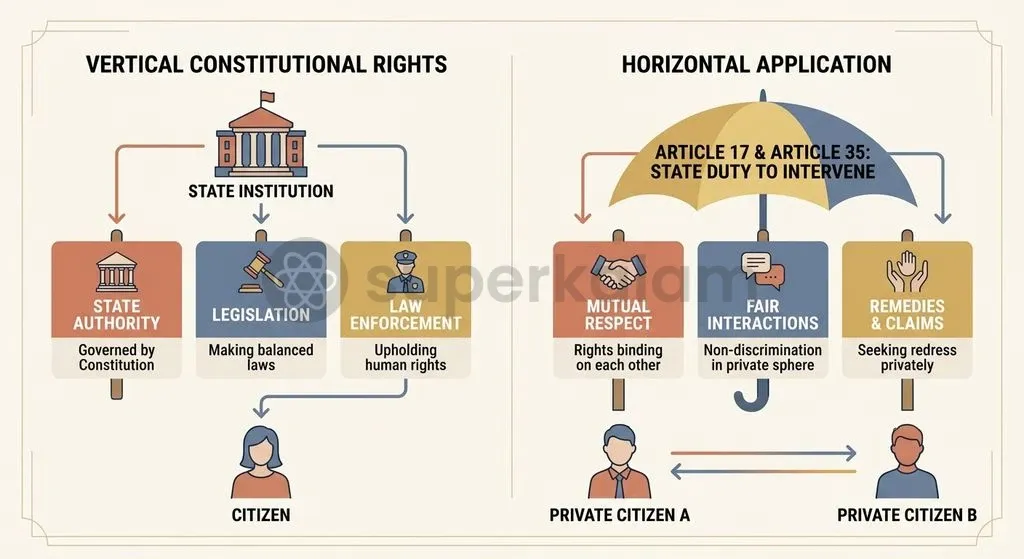
Article 17 distinguishes itself from standard Fundamental Rights through its direct horizontal applicability against private individuals and its explicit reliance on penal enforcement mandated by Article 35. While classic liberal rights are vertical guarantees protecting the individual against executive or legislative overreach, caste-based disabilities are overwhelmingly inflicted by private citizens within civil society. In People's Union for Democratic Rights (PUDR) v. Union of India, the Supreme Court held that Article 17 operates horizontally and places an affirmative constitutional duty on the State to actively intervene against private violators.
To ensure uniform criminalisation across the country, Article 35(a)(ii) vests exclusive legislative competence in Parliament to enact penal laws for offences declared under Part III. This deliberate constitutional design prevented individual state legislatures from enacting diluted measures or weakening criminal sanctions under local political pressures.
| Feature | Standard Fundamental Rights (e.g., Article 19, Article 21) | Article 17 (Abolition of Untouchability) |
|---|---|---|
| Enforceability Axis | Primarily vertical (citizen versus State action) | Horizontal and vertical (operates directly against private individuals) |
| Reasonable Restrictions | Subject to explicit exceptions (e.g., public order, morality, security) | Absolute and non-derogable (no exceptions or provisos permitted) |
| Statutory Mechanism | Self-executing or regulated via ordinary legislation | Expressly requires penal statutes via Article 35 |
| Constitutional Definition | Terms like 'liberty' interpreted broadly via judicial review | Term placed in quotes to denote historical caste disabilities |
| Nature of Obligation | Negative restraint on State interference | Positive constitutional duty to prosecute private perpetrators |
The interplay between Article 17 and Article 35 creates a composite framework where civil rights and criminal law converge. The provision is not merely an aspirational directive; it functions as a penal command embedded within Part III, directing the coercive apparatus of the State to dismantle private caste subjugation.
Discuss with Superkalam
Why was the word 'untouchability' placed in quotation marks in Article 17 instead of being given a literal medical definition?
Ask NowFrom Civil Rights to PoA: How the Law Built Its Penal Teeth
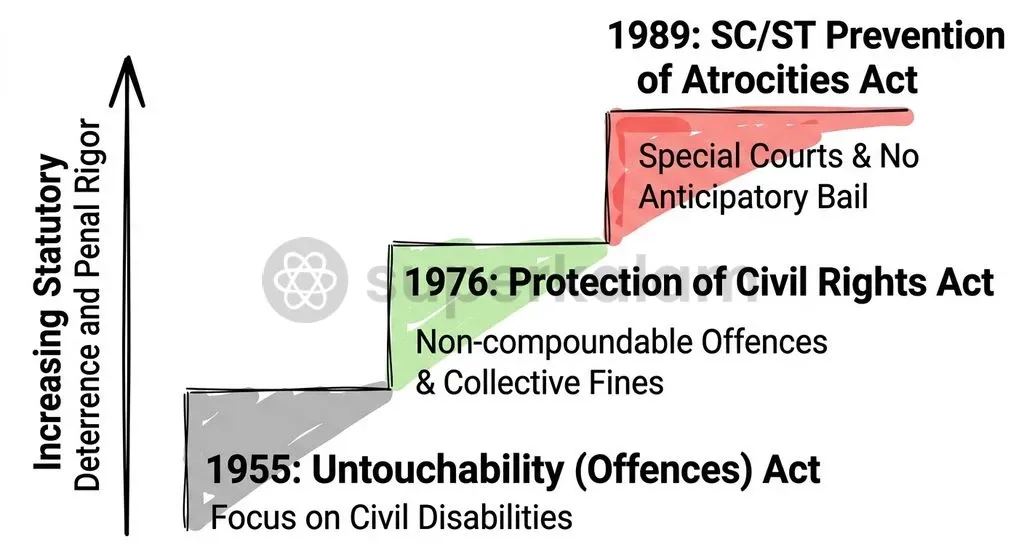
Parliament enacted penal legislation under Article 35(a)(ii) to operationalise Article 17, progressing from early civil declarations to stringent criminal remedies. The first legislative exercise was the Untouchability (Offences) Act, 1955, which penalised religious and social disabilities such as denying access to temples, public conveyances, or water bodies. Experience proved that this statute suffered from lenient sentencing, bailable offences, and weak enforcement mechanisms that failed to deter dominant caste groups.
Parliament amended the statute comprehensively through an amendment in 1976, renaming it the Protection of Civil Rights Act, 1955. This revision enhanced penalties, made all offences cognisable and non-compoundable, and introduced summary trials for specific infractions. The amendment also empowered state governments to impose collective fines on areas where caste-based offences occurred repeatedly.
Despite these changes, the civil rights framework proved inadequate to address the severe physical violence and retaliatory atrocities inflicted on Scheduled Castes when asserting their constitutional entitlements. To confront this reality, Parliament enacted the Scheduled Castes and the Scheduled Tribes (Prevention of Atrocities) Act, 1989. The 1989 statute shifted the focus from merely penalising social disabilities to criminalising targeted physical, economic, and procedural atrocities:
- Specific Offences: Criminalised acts including forced consumption of noxious substances, wrongful dispossession of land, bonded labour, and public humiliation.
- Special Courts: Mandated designated Special Courts at the district level for speedy trials and dedicated Special Public Prosecutors.
- Procedural Safeguards: Excluded anticipatory bail under Section 18 to shield victims and witnesses from intimidation during investigations.
- Public Servant Liability: Created statutory penalties for administrative and police officers who wilfully neglect their investigatory duties under the Act.
The Enforcement Trap: Why Police Treat Caste Hierarchy as Isolated Crime
The Scheduled Castes and the Scheduled Tribes (Prevention of Atrocities) Act, 1989 faces an administrative enforcement trap where local law enforcement treats systemic caste oppression as disconnected individual disputes. While the statutory text recognises that caste offences are structural acts of domination, frontline police personnel frequently reduce atrocity complaints to petty quarrels or property altercations. This procedural dilution strips the offence of its caste dimension, weakening both statutory applicability and subsequent judicial scrutiny.
National Crime Records Bureau data exposes the structural weakness of the current enforcement apparatus. According to the National Crime Records Bureau, Crime in India 2022 and 2023 Reports, Ministry of Home Affairs, the court trial pendency rate for crimes against Scheduled Castes under the PoA Act routinely exceeds 85% to 90%. Completed trial conviction rates consistently linger between 30% and 34%, reflecting widespread procedural attrition during investigation and trial stages.
Several administrative factors sustain this enforcement deficit across districts:
- Reluctance to Register FIRs: Police stations regularly refuse initial complaints or register them under general provisions of criminal law rather than the PoA Act.
- Investigation Delays: Statutory mandates requiring completion of investigations within sixty days are routinely breached, giving accused parties time to influence witnesses.
- Absence of Witness Protection: Victims and witnesses live in proximity to dominant caste perpetrators, making economic boycotts and social coercion common triggers for hostility during trial.
- Inadequate Legal Aid: Special Public Prosecutors often face heavy caseloads, limited institutional resources, and lack of specialised training in caste-based jurisprudence.
Discuss with Superkalam
How does the administrative reframing of caste atrocities into routine property quarrels weaken the statutory teeth of the PoA Act?
Ask Now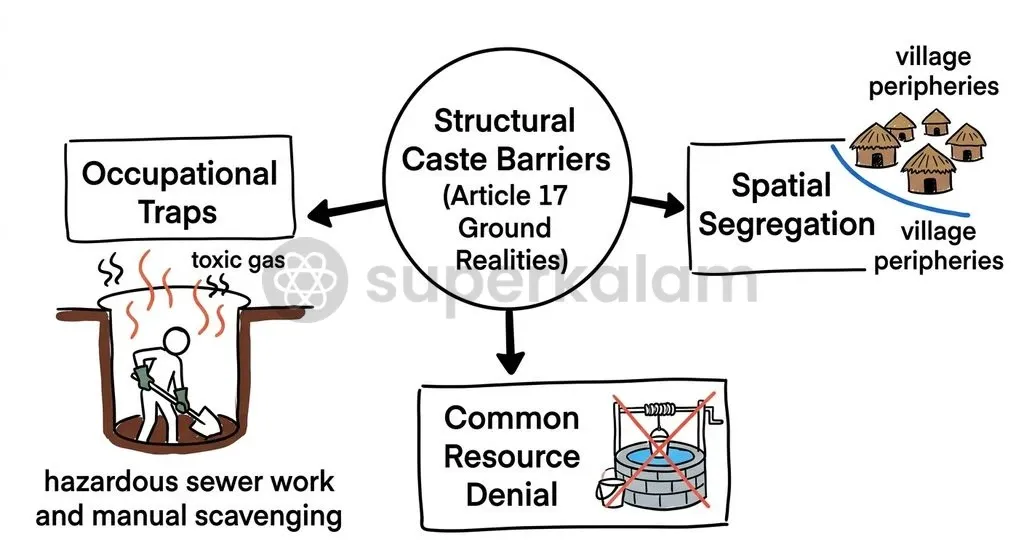
Judicial interpretation has also examined the underlying concepts of purity and pollution that sustain exclusionary practices. In the Sabarimala reference (Indian Young Lawyers Association v. State of Kerala), the Supreme Court observed that Article 17 targets notions of purity and pollution, deliberating whether denying temple entry to women based on physiological menstruation represents a form of untouchability. This judicial dialogue demonstrates that the constitutional logic of Article 17 challenges ideological hierarchies of purity beyond traditional caste boundaries.
Discuss with Superkalam
Given NCRB conviction rates between 30% and 34%, how effective has penal deterrence been in eradicating systemic caste hierarchy?
Ask NowKey Supreme Court Rulings That Gave Real Force to Article 17
The Supreme Court of India expanded Article 17 from a passive constitutional promise into an actionable socio-legal shield through successive landmark verdicts over four decades. Judicial interpretation transformed the provision by enforcing horizontal liability, invalidating customary disabilities, and defending legislative safeguards against procedural dilution.
In People's Union for Democratic Rights v. Union of India (1982), the Supreme Court established that Fundamental Rights under Article 17 can be enforced against private individuals, mandating that the Union government take proactive measures whenever private actors infringe upon these guarantees. The ruling prevented the State from remaining a passive bystander to social discrimination in the private sphere.
A decade later, in State of Karnataka v. Appa Balu Ingale (1993), the Supreme Court upheld convictions under the Protection of Civil Rights Act against upper-caste villagers who obstructed Dalits from taking water from a newly dug borewell. The Court held:
- Untouchability constitutes an indirect form of slavery and a social device designed to keep marginalised communities subjugated.
- The abolition of untouchability must be interpreted dynamically to eliminate all caste-based disabilities that deny access to basic human necessities.
- Judicial authorities must apply social justice principles rather than formalistic technicalities when evaluating evidence under anti-discrimination statutes.
The procedural resilience of these protections was reaffirmed in Prathvi Raj Chauhan v. Union of India (2020), where the Supreme Court upheld the constitutional validity of Section 18A of the Scheduled Castes and the Scheduled Tribes (Prevention of Atrocities) Act. Section 18A, enacted by Parliament to reverse judicial dilution, confirmed that no preliminary inquiry is required before registering an FIR, and no prior sanction is necessary to arrest an accused person. The Court ruled that conditioning the arrest of an accused on prior administrative approval would nullify the deterrent purpose of the Act and weaken constitutional protections under Article 17.
Beyond the Penal Code: Steps Needed to Break Structural Caste
Transforming the formal guarantees of Article 17 into substantive equality requires systemic administrative accountability alongside targeted economic and institutional reforms. Relying solely on the Indian Penal Code or the PoA Act treats untouchability as an episodic law-and-order issue rather than a pervasive social practice. To move beyond formal legal equality, public policy must dismantle the structural dependencies that leave marginalised groups vulnerable to coercion.
Parliamentary committees have highlighted that administrative accountability is the first lever of reform. The Department-Related Parliamentary Standing Committee on Social Justice and Empowerment emphasised strict enforcement of Section 4 of the PoA Act, which penalises public servants for wilful neglect of duty in atrocity cases. Holding investigating officers and district magistrates directly accountable for failing to enforce statutory timelines would curb procedural negligence at the police station level.
A comprehensive policy agenda requires coordinated interventions across three complementary domains:
- Dedicated Witness and Victim Protection: Establish specialised, funded witness-protection programmes at the district level to insulate complainants from social boycotts, physical violence, and economic displacement during trials.
- Economic De-linking and Rehabilitation: Provide time-bound rehabilitation, land entitlements, and financial independence to free marginalised workers from caste-designated labour such as manual scavenging.
- Mechanisation of Sanitation Infrastructure: Ensure municipal bodies transition fully to automated sewer-cleaning machinery under the 2013 Act, eliminating hazardous human entry into septic tanks and sewers.
Legal prohibitions establish the boundaries of state intolerance, but genuine social emancipation requires changing community practices and providing real economic independence. Aligning strict penal enforcement with targeted social and economic support transforms Article 17 from a formal paper guarantee into lived constitutional equality.
Discuss with Superkalam
What institutional safeguards would you design to prevent witness intimidation and economic boycotts during atrocity trials?
Ask NowKey Takeaways
- Absolute Constitutional Guarantee: Article 17 abolishes 'untouchability' in all forms without any exceptions, public interest provisos, or state qualifications under Part III.
- Horizontal Applicability: Unlike most Fundamental Rights that restrain the State, Article 17 operates directly against private citizens, placing an affirmative obligation on the State to penalise violations.
- Exclusive Parliamentary Competence: Article 35(a)(ii) reserves exclusive legislative power to Parliament to prescribe punishments for Article 17 offences, preventing regional dilution of anti-caste laws.
- Legislative Trajectory: The legal architecture expanded from the Untouchability (Offences) Act, 1955 to the Protection of Civil Rights Act, 1955 and the Scheduled Castes and the Scheduled Tribes (Prevention of Atrocities) Act, 1989.
- Enforcement Deficit: Despite rigorous statutes, National Crime Records Bureau data shows court trial pendency under the PoA Act exceeds 85% to 90%, with conviction rates lingering between 30% and 34%.
- Substantive Equality Imperative: Dismantling structural caste requires moving beyond penal laws to enforce administrative accountability under Section 4 of the PoA Act, protect witnesses, and achieve complete mechanisation of sanitation work.
Mains Question
"Article 17 creates a positive constitutional command operating horizontally against private individuals, departing fundamentally from conventional civil liberty guarantees." In light of Article 35 and relevant judicial rulings, elucidate. (10 Marks)
Evaluate NowMains Question
According to National Crime Records Bureau data, crimes against Scheduled Castes continue to witness high trial pendency rates alongside low conviction rates. Critically examine the structural and administrative bottlenecks undermining the Scheduled Castes and the Scheduled Tribes (Prevention of Atrocities) Act, 1989. (15 Marks)
Evaluate NowPractice MCQs
QUESTION 1
Regarding the constitutional design of Article 17, consider the following statements:
- Unlike Article 19, Article 17 is absolute and admits no reasonable restrictions or exceptions.
- Article 35(a)(ii) vests exclusive legislative competence in Parliament to prescribe penal laws for offences declared under Article 17.
- In People's Union for Democratic Rights (PUDR) v. Union of India, the Supreme Court ruled that Article 17 operates horizontally against private individuals. Which of the statements given above are correct?
QUESTION 2
With reference to the evolution of penal statutes operationalising Article 17, consider the following statements:
- The Protection of Civil Rights Act, 1955 was originally enacted as the Untouchability (Offences) Act, 1955 before being renamed following an amendment in 1976.
- The 1976 amendment made offences under the Act bailable and compoundable to promote local settlements.
- The Scheduled Castes and the Scheduled Tribes (Prevention of Atrocities) Act, 1989 expressly excludes anticipatory bail under Section 18. Which of the statements given above is/are correct?
QUESTION 3
Consider the following statements regarding the judicial interpretation and statutory enforcement of Article 17:
- In Devarajiah v. B. Padmanna, the Mysore High Court held that the term 'untouchability' refers to historical social disabilities rooted in the caste order rather than physical contagion.
- National Crime Records Bureau data indicates that court trial pendency rates under the PoA Act routinely exceed 85% to 90%.
- Statutory mandates under the PoA Act require investigation of offences to be completed within thirty days. Which of the statements given above is/are correct?
QUESTION 4
Under the Scheduled Castes and the Scheduled Tribes (Prevention of Atrocities) Act, 1989, which of the following measures was specifically enacted to deter administrative dereliction during atrocity investigations?
QUESTION 5
Consider the following statements regarding the 1976 amendment to the Untouchability (Offences) Act, 1955:
- It introduced summary trials for specific infractions.
- It empowered state governments to impose collective fines on areas where caste-based offences occurred repeatedly. Which of the statements given above is/are correct?