National SC-ST Hub Scheme: Benefits and 4% Procurement Target
Read how the National SC-ST Hub supports SC/ST entrepreneurs, NSIC's role, key benefits and the 4% public-procurement target for SC/ST-owned MSEs.
Oct, 2026
•11 min read
Overview
The National SC-ST Hub operates under the Ministry of Micro, Small and Medium Enterprises to bring Dalit and Adivasi enterprises into formal supply chains. Despite statutory purchase requirements, public procurement from these businesses consistently misses mandated targets.
The Public Procurement Policy for Micro and Small Enterprises Order, 2012 sets aside four per cent of central purchasing for enterprises owned by Scheduled Castes and Scheduled Tribes. Official monitoring confirms that procurement reached only 1.93% in fiscal year 2024-25.
Affirmative action originally focused on public sector recruitment under Article 16 of the Constitution. This procurement mandate operationalises the Directive Principles under Article 46 instead, establishing substantive economic democracy through direct commercial participation. Overcoming this shortfall requires moving beyond negative marks towards vendor development, testing subsidies, and targeted technical training.
Why in the News: The Persistent Gap in Affirmative Procurement
A PIB factsheet released on 8 October 2026 highlighted the National SC-ST Hub's support for inclusive entrepreneurship. Implemented by NSIC, the scheme supports SC/ST enterprises with finance, technology, training and market access.
As of 31 July 2026, the Hub had assisted 1,90,414 beneficiaries and trained 54,499 candidates. Procurement from SC/ST-owned MSEs rose from Rs 99.37 crore in 2015-16 to Rs 4,013.42 crore in 2025-26. These figures show the scale of participation; they do not by themselves prove that every public buyer met the 4% procurement target.
What is the National SC-ST Hub Scheme?
Prime Minister Narendra Modi launched the National SC-ST Hub in Ludhiana on October 18, 2016, to help marginalised entrepreneurs secure public contracts. The initiative functions under the Ministry of Micro, Small and Medium Enterprises as a dedicated institutional platform.
Rather than offering credit directly, the hub focuses on supplier-side technical capacity to help enterprises compete in open tenders. The National Small Industries Corporation, a Mini Ratna entity under the Ministry of MSME, implements the scheme across the country.
The scheme operates through specific institutional structures:
- Field-Level Support: Operations run through 15 dedicated field offices, known as NSSHOs, which provide tender assistance, registration aid, and credit guidance.
- Extended Cycle: Following an evaluation by NITCON Limited, the government continued the hub across the 15th Finance Commission cycle covering FY 2021-22 to FY 2025-26.
Discuss with Superkalam
Recall the year in which the Public Procurement Policy for MSEs became mandatory across central ministries and CPSEs, and the percentage earmarked for SC/ST units.
Ask Now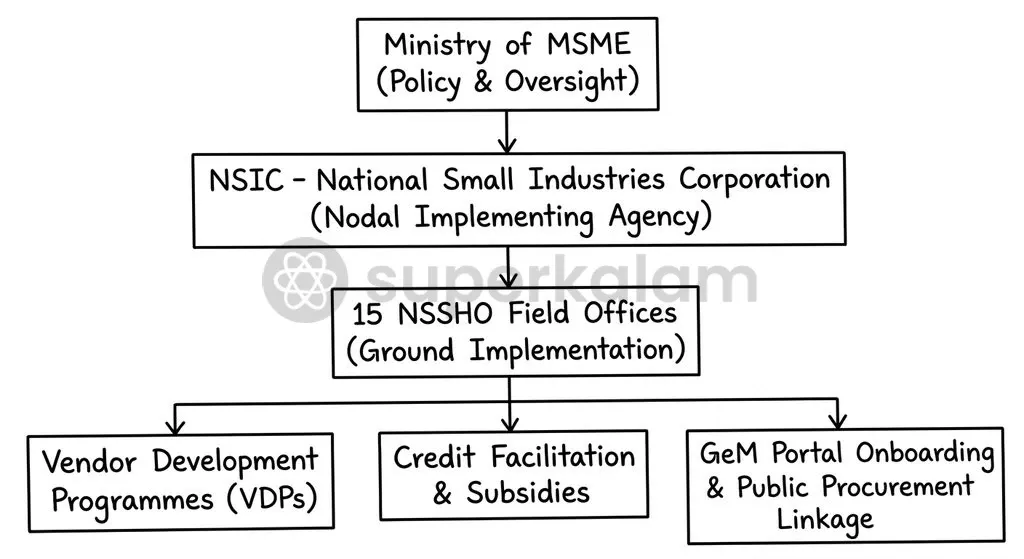
The 4% Mandate: How the Public Procurement Policy 2012 Connects to NSSH
Section 11 of the Micro, Small and Medium Enterprises Development Act, 2006 allows the Central Government to establish preferential procurement policies for micro and small units. Under this statutory power, the Central Government notified the Public Procurement Policy for Micro and Small Enterprises Order, 2012. The order came into effect on April 1, 2012, and became mandatory for all central ministries, departments, and public enterprises from April 1, 2015.
The statutory order establishes specific quotas and financial concessions to offset systemic market disadvantages:
- Overall Procurement Quota: An amendment notified in November 2018 raised the mandatory annual purchase quota from MSEs from 20% to 25% of total annual procurement.
- SC/ST Sub-Target: The policy carves out an earmarked 4% sub-target specifically reserved for enterprises owned by Scheduled Caste and Scheduled Tribe entrepreneurs.
- Women Entrepreneurship Sub-Target: The 2018 amendment introduced a dedicated 3% sub-quota for women-owned micro and small enterprises.
- Price Preference Window: Eligible MSE bidders quoting within a price band of L1 plus 15% can match the price of a non-MSE lowest bidder (L1) and secure at least 25% of the total tendered order quantity.
- Reserved Commodity List: The Central Government has reserved 358 specific items exclusively for procurement from micro and small enterprises by all central public bodies.
| Policy Provision | Regulatory Mechanism | Targeted Strategic Objective |
|---|---|---|
| Section 11, MSMED Act, 2006 | Statutory enabling framework | Establishes legislative authority for preferential public purchasing |
| Overall MSE Mandate | Mandatory 25% annual CPSE procurement | Guarantees minimum market share for smaller domestic enterprises |
| SC/ST Earmarked Sub-Quota | Dedicated 4% annual allocation | Promotes affirmative supplier diversity for marginalised groups |
| L1 + 15% Price Band Rule | Right to match lowest non-MSE bid for 25% volume | Offsets cost disparities faced by small-scale manufacturers |
| Reserved Item List | 358 items exclusively sourced from MSEs | Protects vulnerable production sectors from large-scale corporate rivalry |
Target vs Reality: Where CPSE Sourcing from Dalit and Adivasi Enterprises Stands
The Ministry of MSME monitors procurement compliance through the MSME Sambandh portal, revealing consistent underperformance by Central Public Sector Enterprises against their affirmative sourcing obligations. Launched in December 2017, the portal tracks monthly purchasing data to enforce institutional accountability across central enterprises.
Data compiled by the Ministry of MSME demonstrates nominal expansion alongside severe structural stagnation:
- Absolute Growth vs Relative Share: Public sourcing from SC/ST-owned enterprises expanded from ₹99.37 crore in FY 2015-16 to ₹1,648.51 crore in FY 2023-24, yet represented an abysmal 0.84% share of total public procurement.
- Recent Procurement Totals: As of December 2025, procurement on the MSME Sambandh portal reached ₹3,731.47 crore for FY 2024-25, lifting the collective share to just 1.93% of procurement, leaving more than half the mandate unmet.
- Shortfall Magnitude: In March 2026, the Parliamentary Standing Committee on Industry affirmed that SC/ST procurement settled at 1.85%, generating a multi-year deficit exceeding ₹18,000 crore.
Discuss with Superkalam
How does operationalising economic democracy through Article 46 via procurement differ conceptually from reservations under Article 16?
Ask Now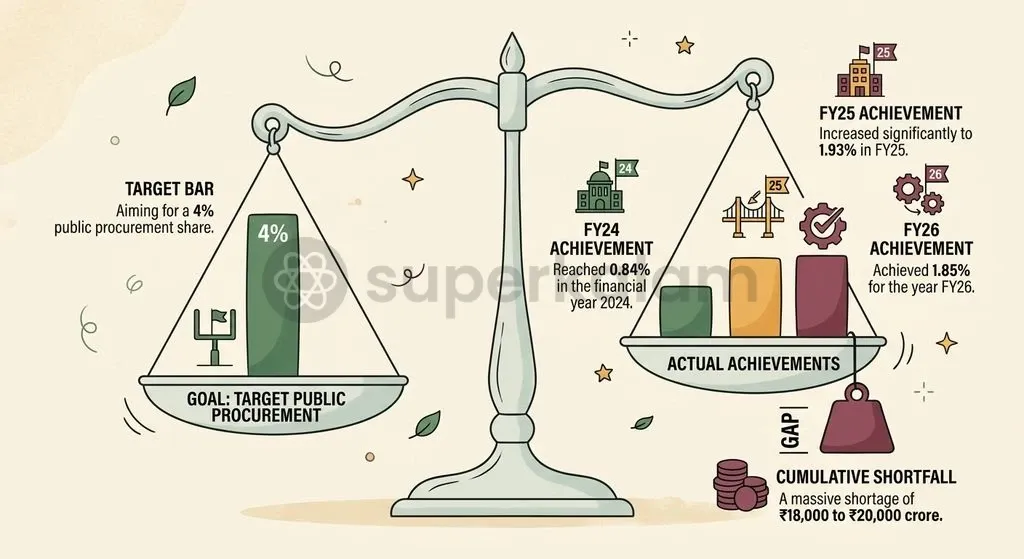
Why Do SC/ST Enterprises Struggle to Enter CPSE Supply Chains?
Central public buyers require product specifications and compliance profiles that differ sharply from the capacity of marginalised enterprises. This gap is not purely administrative. Structural entry barriers routinely exclude smaller vendors before commercial evaluation begins.
| Constraint Dimension | Operational Barrier | Practical Consequence |
|---|---|---|
| Industrial Segregation | Concentration in services and basic trading | Inability to supply specialised heavy-engineering inputs |
| Tender Covenants | Stringent turnover and past-experience thresholds | Disqualification of newer and smaller applicants |
| Working Capital | Limited collateral and long payment cycles | Severe liquidity stress during contract execution |
Sectoral Misalignment
Marginalised entrepreneurs face steep industrial concentration. According to the CPSE Conclave on Public Procurement Policy, these businesses cluster heavily in micro-scale informal trading and services. In contrast, central enterprises purchase specialised engineering inputs, heavy machinery, and industrial chemicals. Because few marginalised suppliers operate in heavy manufacturing, public buyers report an absolute shortage of qualified suppliers for major procurement packages.
Disqualifying Tender Conditions
Standard tender parameters exclude emerging small businesses. Tender documents frequently mandate prohibitive minimum turnover thresholds and require three to five years of documented supply history. Complex bidding platforms, technical paperwork, and testing demands disqualify smaller firms that lack dedicated administrative teams.
Liquidity and Capital Deficits
Working capital shortages prevent small firms from pursuing major public tenders. Marginalised suppliers struggle to secure uncollateralised institutional credit for raw materials and statutory bid deposits. Delayed public invoice clearances further stretch working capital, creating significant insolvency exposure for micro enterprises.
Discuss with Superkalam
Analyse why administrative penalties like negative markings on CPSE appraisals have resulted in superficial compliance rather than higher procurement values.
Ask NowCore Interventions Under NSSH: Vendor Development, Credit Access, and GeM Integration
The National Small Industries Corporation administers multiple financial and technical handholding schemes through the National SC-ST Hub to build vendor competitiveness. These targeted interventions systematically address the structural bottlenecks that lock marginalised businesses out of public bidding.
| Intervention Stage | Core Programme Mechanism |
|---|---|
| 1. Financial Support | Capital subsidies (SCLCSS) and tender fee waivers |
| 2. Technical Handholding | NSSHO field guidance and subsidised product testing |
| 3. Market Linkages | GeM onboarding and CPSE Special Vendor Development Programmes |
Direct institutional interventions under the scheme include:
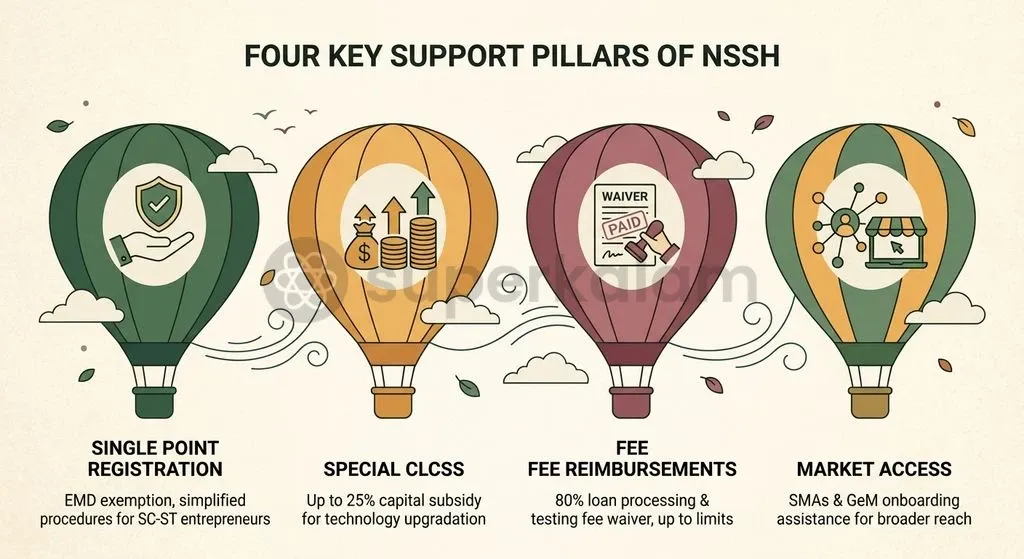
- Tender Fee and Security Waivers: Under the Single Point Registration Scheme administered by NSIC, verified SC/ST enterprises receive tender documents free of charge and obtain complete exemptions from Earnest Money Deposits.
- Special Credit Linked Capital Subsidy Scheme: Eligible manufacturing and service units can secure a 25% upfront capital subsidy on institutional credit to modernise plant equipment and purchase advanced machinery.
- Direct Financial Cost Relief: The scheme reimburses 80% of bank loan processing fees up to a maximum ceiling of ₹1,00,000 per sanction. It also covers 80% of product testing fees at NABL-accredited or government laboratories, alongside subsidies for BIS, ISO, and Zero Defect Zero Effect certifications.
- Exhibition and Marketing Subsidies: The Special Marketing Assistance Scheme funds participation in up to four domestic and two international trade exhibitions per financial year, granting financial assistance up to ₹3 lakh per enterprise.
- Structured Buyer-Seller Linkages: During FY 2025-26, the Hub conducted 247 Special Vendor Development Programmes, 197 e-tendering training sessions, and 230 buyer-seller interaction workshops across India.
- Digital Onboarding: Field offices facilitate end-to-end registration on the Government e-Marketplace and the Udyam portal, creating direct non-discriminatory market access for central and state public contracts.
Constitutional and Ethical Stakes: Moving from Formal Quotas to Economic Democracy
Article 46 directs the Indian State to promote the educational and economic interests of Scheduled Castes and Scheduled Tribes with special care. As a Directive Principle under Part IV, Article 46 establishes a core governance duty, distinct from the fundamental rights in Part III.
Historically, affirmative action concentrated on state employment and educational reservations under Articles 15 and 16. However, public disinvestment and shrinking civil service rolls have reduced these traditional avenues for social mobility. Preferential procurement shifts constitutional policy from employment quotas toward broader substantive supplier diversity, fostering asset creation among marginalised communities.
Public procurement forms a substantial portion of national expenditure. Allocating public expenditure primarily to established corporations concentrates economic power. Structured affirmative procurement uses state spending as an instrument of redistributive justice, turning regular public purchases into vehicles for democratic wealth creation.
| Governance Dimension | Employment Quotas (Articles 15 & 16) | Affirmative Procurement (Article 46) |
|---|---|---|
| Constitutional Basis | Fundamental Rights in Part III | Directive Principles in Part IV |
| Economic Function | Salaried public sector positions | Asset ownership and commercial enterprise |
| Policy Lever | Recruitment quotas | Supply chain earmarks and tender concessions |
Discuss with Superkalam
Propose two specific procurement tender reforms that CPSEs could implement to accommodate micro-scale SC/ST suppliers without compromising technical safety or quality.
Ask NowWay Forward: Making Affirmative Procurement Work in Practice
The Department-related Parliamentary Standing Committee on Industry recommended integrating the MSME Sambandh Portal directly with the Government e-Marketplace to enforce real-time transparency. A seamless technical bridge between both portals would create an auditable, centralised national vendor directory of certified SC/ST suppliers, preventing central agencies from citing vendor unavailability.
Sustainable compliance requires overhauling procurement guidelines and operational support:
- Overhauling Accountability Frameworks: Administrative penalties must move beyond paper-based negative marks for corporate scorecards. Enterprise performance evaluation systems must mandate specific oversight reviews for CPSE board directors who repeatedly default on affirmative quotas.
- Tender Unbundling: Public procurement bodies should unbundle large, consolidated multi-crore engineering contracts into manageable supply packages. Breaking requirements into smaller lots allows micro enterprises to bid without breaching turnover ceilings.
- Product Basket Expansion: Central ministries must expand the 358-item reserved procurement list to cover modern service contracts, including facilities management, digital maintenance, and specialised logistics.
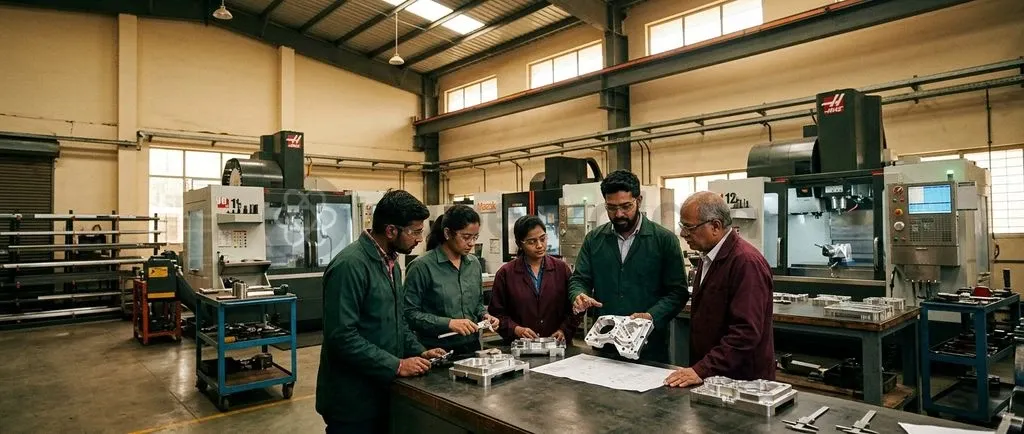
- Upstream Technical Upgradation: Field offices must leverage capital subsidy schemes to graduate suppliers from low-margin services into high-precision manufacturing. Building testing facilities and subsidising quality certifications will prepare marginalised vendors to meet stringent engineering standards.
Key Takeaways
- Statutory Foundation: Section 11 of the MSMED Act, 2006 underpins the Public Procurement Policy Order, 2012, which mandates 25% annual purchasing from MSEs, with a dedicated 4% sub-quota for SC/ST-owned units and 3% for women-owned units.
- Persistent Deficit: As of March 2026, central procurement from SC/ST enterprises reached only 1.85%, generating a multi-year procurement shortfall of ₹18,000 crore to ₹20,000 crore.
- Structural Mismatch: Underperformance stems from an industrial disconnect: Dalit and Adivasi businesses are concentrated in micro-scale trading and informal services, whereas CPSEs procure high-spec capital goods and engineering equipment.
- Institutional Architecture: The National SC-ST Hub, launched in October 2016 and implemented by NSIC, operates 15 field offices to provide technical training, tender support, and subsidised certifications.
- Constitutional Transition: Preferential procurement operationalises the Directive Principle in Article 46, transitioning affirmative action from public employment quotas under Article 16 toward capital asset formation and market diversity.
Mains Question
'Negative marking in performance appraisals has created administrative paper trails without expanding actual tender awards to marginalised entrepreneurs.' In light of the findings of the Parliamentary Standing Committee on Industry, critically examine the structural bottlenecks that impede the realisation of the 4% procurement mandate for SC/ST enterprises. (15 Marks)
Evaluate NowMains Question
Explain how the Public Procurement Policy for Micro and Small Enterprises Order, 2012, combined with the National SC-ST Hub, seeks to translate the vision of Article 46 into substantive economic democracy. (10 Marks)
Evaluate NowPractice MCQs
QUESTION 1
Regarding the Public Procurement Policy for Micro and Small Enterprises Order, 2012, consider the following statements:
- It was notified under the statutory authority of Section 11 of the Micro, Small and Medium Enterprises Development Act, 2006.
- It earmarks a mandatory annual sub-target of 4% procurement specifically for enterprises owned by Scheduled Castes and Scheduled Tribes.
- Under the price preference rule, eligible MSE bidders quoting within L1 plus 15% can match the non-MSE L1 price to secure up to 50% of the tendered order quantity.
Which of the statements given above are correct?
QUESTION 2
Consider the following statements regarding the National SC-ST Hub (NSSH):
- It operates directly under the Ministry of Social Justice and Empowerment.
- The scheme is implemented by the National Small Industries Corporation (NSIC).
- It focuses primarily on direct credit disbursement to Dalit and Adivasi entrepreneurs rather than technical capacity building.
Which of the statements given above is/are correct?
QUESTION 3
Consider the following statements regarding affirmative public procurement and CPSE performance in India:
- The 333rd Report of the Parliamentary Standing Committee on Industry noted that negative marking penalties during appraisals have substantially resolved the procurement shortfall.
- The MSME Sambandh portal was launched to monitor monthly public procurement from MSEs by CPSEs.
- The Central Government has reserved 358 specific items exclusively for procurement from micro and small enterprises.
Which of the statements given above is/are correct?
QUESTION 4
Which of the following constitutional provisions is directly operationalised by the affirmative public procurement policy to establish substantive economic democracy through commercial participation rather than recruitment quotas?
QUESTION 5
Consider the following factors cited as operational constraints preventing SC/ST enterprises from entering CPSE supply chains:
- Clustering primarily in micro-scale informal trading and services rather than specialised manufacturing.
- Onerous tender covenants such as high minimum turnover thresholds and multi-year supply history requirements.
- Difficulties in obtaining uncollateralised institutional credit for raw materials and bid deposits.
Which of the factors given above is/are correct?