Childhood Blindness in India: Causes, Screening and RBSK
Early eye screening can help detect treatable vision problems. Read causes of childhood blindness, the red-reflex test and gaps in RBSK referral and care.
Oct, 2026
•11 min read
Overview
Childhood blindness in India affects approximately 0.80 per 1,000 children. This presents a profound public health challenge, where the primary clinical burden has shifted from preventable nutritional deficiencies toward congenital cataracts and Retinopathy of Prematurity.
Infant visual pathways require sensory stimulation during early infancy to prevent irreversible stimulus-deprivation amblyopia. Although the Rashtriya Bal Swasthya Karyakram provides a national screening architecture across early childhood, delivery-room screening gaps, missing direct ophthalmoscopes, and fragmented referral linkages leave newborns at risk of permanent sight loss.
Addressing this silent epidemic requires institutionalising mandatory birth-dose red-reflex testing, scaling telemedicine networks, and bridging the rural paediatric ophthalmology infrastructure gap.
Why in the News? Childhood Blindness as an Urgent Concern
Early childhood eye care remains a public-health concern because preventable or treatable visual problems can be missed when screening, referral and specialist care do not connect.
RBSK provides a wider child-health screening framework. Better eye screening, frontline-worker training and referral pathways can help children receive qualified assessment and treatment. The red-reflex test is a screening tool, not a diagnosis.
The proposed "birth-dose" eye screening approach is a recommendation for early checks, not an established new nationwide legal mandate. Abnormal findings need assessment by qualified health professionals.
Major Causes of Avoidable Childhood Blindness in India
Epidemiological records documented by the National Health Mission reveal a major structural shift in the underlying causes of paediatric visual impairment across the country. Historically, severe nutritional deprivations dominated clinical presentations.
A 1995 multi-state study of 1,318 blind school students across nine Indian states found that corneal scarring, primarily driven by Vitamin A deficiency, accounted for 26.4% of severe visual impairment and blindness. That investigation observed congenital anomalies at 20.7%, retinal dystrophies at 19.3%, and cataract or aphakia at 12.3%.
Subsequent systematic reviews in the Indian Journal of Ophthalmology demonstrated a clear epidemiological transition, with the predominant etiology shifting away from nutritional corneal lesions toward whole-globe anomalies, congenital cataracts, and Retinopathy of Prematurity (ROP). Improved child survival rates, expanding neonatal intensive care units, and widespread Vitamin A supplementation initiatives contributed to this transition. In community settings, uncorrected vision issues also persist; a population-based survey in Andhra Pradesh established that treatable refractive error accounted for 33.3% of childhood blindness, while preventable causes like Vitamin A deficiency and post-cataract surgery amblyopia caused 16.6%.
| Etiological Category | Historical Dominance (1990s) | Contemporary Landscape | Primary Clinical Intervention |
|---|---|---|---|
| Nutritional Deficiency | Corneal scarring from Vitamin A deficiency (~26.4%) | Substantially declined via universal supplementation | Prophylactic Vitamin A dosing and maternal nutrition support |
| Congenital Opacities | Cataract and aphakia (~12.3%) | Congenital cataract is a leading surgically treatable cause | Early surgical lensectomy within the first 6 to 8 weeks |
| Neonatal Retinal Disorders | Rarely recorded due to low preterm survival | Retinopathy of Prematurity rising in Special Newborn Care Units | Mandatory fundus screening by Day 30 ('Tees Din Roshni Ke') |
| Optical Refractive Errors | Frequently unrecorded in blind school cohorts | Accounts for up to 33.3% of childhood blindness in population surveys | School screening, cycloplegic refraction, and corrective spectacles |
Discuss with Superkalam
Recall the four core categories that comprise the '4 Ds' framework of the Rashtriya Bal Swasthya Karyakram (RBSK).
Ask NowWhat is the Red-Reflex Test and Why Timing is Critical
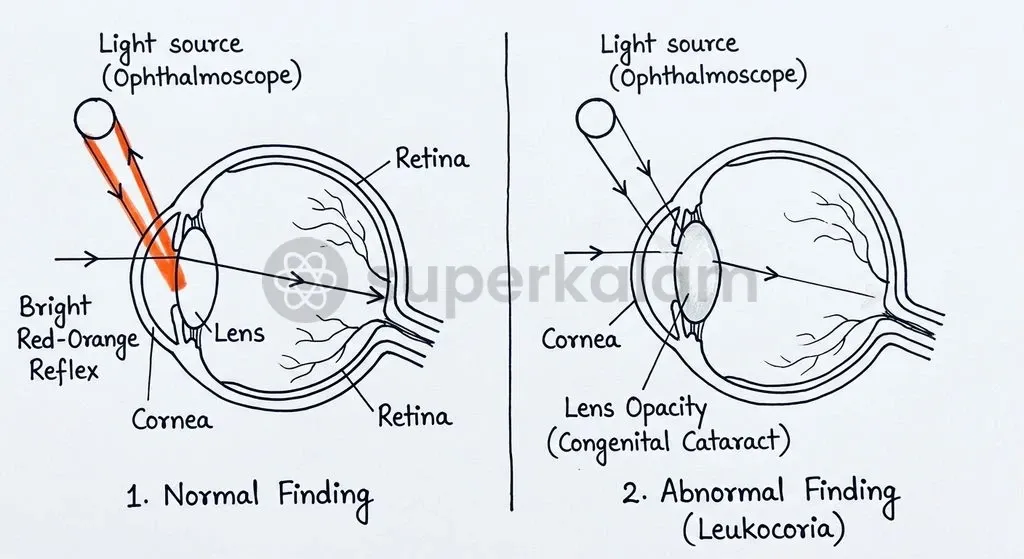
The Brückner red-reflex test provides an indispensable, non-invasive clinical evaluation designed to identify sight-threatening paediatric ocular anomalies before permanent sensory deprivation occurs. Performed using a direct ophthalmoscope at a distance of 0.5 to 1 metre in a dimly lit room, the test assesses the reflection produced when light travels through transparent ocular media onto the infant retina.
Recognising this urgency, the World Health Organization included universal newborn eye screening via external eye examination and red-reflex assessment within its global recommendations for maternal and newborn postnatal care. The test identifies critical diagnostic milestones:
- Normal Reflection: In a healthy neonate, light illuminates the fundus to produce an identical, bright red-orange glow across both pupils.
- Abnormal Reflection (Leukocoria): Any structural obstacle along the visual axis—such as a cloudy lens, vitreous haemorrhage, or intraocular tumour—scatters incoming light to create an abnormal white reflection.
- Narrow Intervention Window: Failure to remove a dense congenital cataract within the critical early visual development window of the first 6 to 8 weeks of life leads to permanent, irreversible stimulus-deprivation amblyopia.
Rashtriya Bal Swasthya Karyakram (RBSK): The Screening Framework
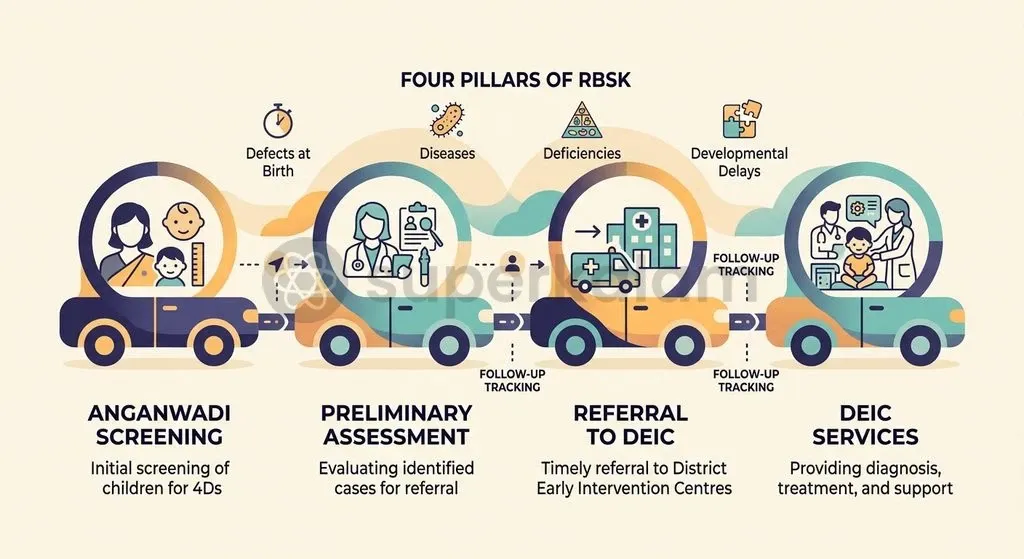
The Rashtriya Bal Swasthya Karyakram, operating under the National Health Mission, is India's primary institutional vehicle for systematic child health surveillance. The initiative structures universal child screening around the '4 Ds' framework: Defects at birth, Diseases, Deficiencies, and Developmental delays including disabilities.
Under the comprehensive RBSK 30-condition screening matrix, paediatric eye health conditions are catalogued systematically across categories:
- Defects at Birth: Congenital Cataract and Retinopathy of Prematurity.
- Deficiencies: Vitamin A deficiency (Bitot's spots, corneal xerosis).
- Developmental Delays: Vision Impairment and squints requiring specialist early intervention.
Field-level execution relies on Mobile Health Teams (MHTs) comprising two AYUSH doctors, one Auxiliary Nurse Midwife (ANM), and one pharmacist. These teams screen children aged 6 weeks to 6 years at Anganwadi Centres twice a year, and evaluate school students aged 6 to 18 years annually.
For high-risk neonates, India's National Operational Guidelines for Retinopathy of Prematurity mandate screening for all infants born at a gestational age of ≤34 weeks or a birth weight of ≤2,000 grams, as well as infants up to 36 weeks who experience an unstable clinical course. These protocols enforce the 'Tees Din Roshni Ke' (Day 30) rule, which requires retinal examinations to be completed before 30 days of life, and before 2 to 3 weeks for infants born before 28 weeks gestation or weighing under 1,200 grams.
Discuss with Superkalam
Explain the biological mechanism through which an unoperated dense congenital cataract during the first 6 to 8 weeks of life causes permanent amblyopia.
Ask NowBottlenecks in Newborn Eye Screening and Referral Pathways
Implementation hurdles across public health tiers limit the real-world impact of India's child health screening mandates. A comprehensive programme evaluation of RBSK child screening between 2014 and 2024 using the Tanahashi framework revealed that out of 11.90 crore children identified with health conditions, only 5.64 crore (47.4%) received completed care. This finding demonstrates an over 50% treatment gap, where children identified with defects drop out along the referral chain.
Severe infrastructure bottlenecks compound these dropouts at secondary care levels. As of 2024, only 430 District Early Intervention Centres (DEICs) were operational across India, covering approximately 53.75% of administrative districts despite the programme mandate prescribing a functional DEIC at every district hospital. Most public district hospitals also lack dedicated paediatric ophthalmologists capable of performing delicate infant lensectomies or laser photocoagulation.
Screening attrition accumulates along three primary failure points in the public referral pathway:
- Birth in Delivery Room / SNCU: The Brückner red-reflex examination is not institutionalised as a mandatory, documented discharge requirement on the newborn birth discharge slip across most public facilities.
- Frontline Diagnostic Constraints: Mobile Health Teams often operate without standardised visual acuity diagnostic tools or handheld ophthalmoscopes, leaving evaluators dependent on subjective gross inspection (as reported in the International Journal of Health Sciences and Research, March 2021).
- Delayed Initial Community Contact: Because MHTs first encounter infants at Anganwadis at six weeks of life, infants with dense congenital cataracts frequently miss the critical 6-to-8-week surgical window before an initial check occurs.
Discuss with Superkalam
If you were assigned as a District Magistrate in a district lacking a functional DEIC, how would you operationalise the 'Tees Din Roshni Ke' rule across local SNCUs?
Ask NowSocio-Economic Burdens and Health Equity Concerns
Paediatric visual impairment creates disproportionate, compounding hardships for rural and economically disadvantaged families. The repercussions span personal development, national income, and social justice:
- Disproportionate Life-Year Loss: Childhood blindness constitutes 4.8% of blind individuals in India, but represents nearly 30% of total 'blind-person-years' due to long remaining life expectancy. Affected infants face decades of diminished educational opportunities, compromised social integration, and reduced vocational potential.
- Macroeconomic Productivity Loss: A 2022 health economics assessment estimated that cumulative losses to India's Gross National Income attributable to childhood blindness and severe visual impairment over a 35-to-40 year productive horizon reach between $118 billion and $158 billion, according to an evaluation by Orbis International and the Vision Research Foundation (as reported in September 2022).
- Exacerbation of Health Inequities: Families in lower socio-economic deciles face catastrophic out-of-pocket expenses for tertiary surgical travel, leading to delayed treatment. When preventive eye screenings are omitted in rural secondary centres, structural exclusion is reinforced under Article 21.
Discuss with Superkalam
Analyse the primary factors that led to the epidemiological shift in childhood blindness from corneal scarring to Retinopathy of Prematurity and congenital cataracts.
Ask NowPolicy Lessons: Scaling Technological and Community Models
Public health innovations in low-resource settings show that decentralised, technology-enabled screening models overcome acute specialist shortages. Proven technological models include:
- Handheld Solar Diagnostic Tools: Deploying low-cost, solar-powered handheld direct ophthalmoscopes like the Arclight enables non-specialist primary healthcare providers to conduct reliable red-reflex screening in peripheral settings. Equipping auxiliary nurse midwives and medical officers with simplified tools removes the barrier of fragile optical hardware.
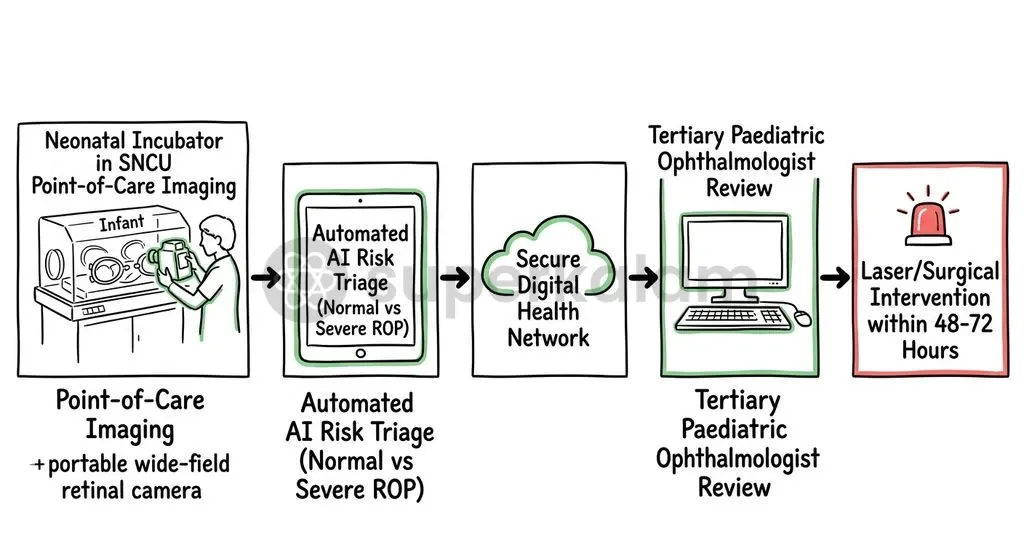
- Tele-Medicine Diagnostic Networks: The Karnataka Internet Assisted Diagnosis of Retinopathy of Prematurity (KIDROP) demonstrated that certified non-physician technicians using portable wide-field digital imaging achieve 95.7% sensitivity and 93.2% specificity in detecting treatment-requiring ROP.
- Indigenous AI Severity Grading: KIDROP and Remidio Innovative Solutions developed and validated an indigenously engineered artificial intelligence device, the Neubo 130, supported by the Department of Biotechnology, capable of automated offline ROP severity grading in rural neonatal units.
The Way Forward: Mandating Birth-Dose Screening and Closing Care Gaps
Eliminating avoidable childhood blindness in India requires transitioning from discretionary child screening toward mandatory, institutionalised neonatal protocols. State governments and the National Health Mission must enforce structural reforms across delivery points, diagnostic centres, and referral pathways.
- Institutionalise Mandatory Birth-Dose Eye Checks: State health departments should amend the standard institutional delivery discharge slip to make the Brückner red-reflex examination a compulsory recorded parameter, executed alongside routine birth vaccinations before maternal discharge. Equipping labour rooms and Special Newborn Care Units (SNCUs) with durable direct ophthalmoscopes like the Arclight ensures primary medical officers can identify congenital cataracts within the critical 6-to-8-week window.
- Fast-Track Full DEIC Operationalisation: The Ministry of Health and Family Welfare must bridge the infrastructure gap by establishing functional District Early Intervention Centres across all remaining administrative districts, ensuring adequate staffing of paediatric optometrists and trained ophthalmic technicians.
- Scale Tele-Ophthalmology and AI Diagnostics for ROP: Drawing on the validated KIDROP model, state health administrations should deploy portable wide-field imaging systems and automated artificial intelligence diagnostic tools, such as the Neubo 130, across all district-level SNCUs to sustain the 'Tees Din Roshni Ke' timeline.
- Close Referral Leakages via Digital Tracking: Health systems should implement tracking dashboards, as outlined in the revised operational framework of RBSK 2.0 (as reported by the Ministry of Health and Family Welfare, 2024), to digitally monitor children from initial primary screening through to tertiary surgical completion.
- Upskill Frontline Health Workers: Training modules for Accredited Social Health Activists (ASHAs) and Auxiliary Nurse Midwives (ANMs) should integrate basic external ocular inspection to spot corneal opacities, squint, and leukocoria during routine Home-Based Newborn Care (HBNC) home visits.
Discuss with Superkalam
Formulate a policy protocol to integrate mandatory red-reflex testing into standard newborn discharge checklists in rural primary healthcare centres.
Ask NowKey Takeaways
- The estimated national prevalence of childhood blindness in India stands at 0.80 per 1,000 children, with the primary burden shifting from nutritional corneal lesions to congenital cataracts and Retinopathy of Prematurity.
- Untreated dense congenital cataracts cause irreversible stimulus-deprivation amblyopia if surgical intervention is not performed within the critical development window of the first 6 to 8 weeks of life.
- The Brückner red-reflex test, performed with a direct ophthalmoscope at 0.5 to 1 metre in a dimly lit room, is the non-invasive gold standard for identifying leukocoria, congenital cataracts, and retinoblastoma.
- RBSK implementation faces major bottlenecks: only 430 District Early Intervention Centres were operational by 2024 (covering 53.75% of districts), and over 50% of children identified with conditions under the 4Ds fail to receive completed care.
- Childhood blindness accounts for nearly 30% of total blind-person-years in India due to long life expectancy, generating cumulative productivity losses estimated between $118 billion and $158 billion over 35 to 40 years.
- Policy comparisons with specific peer country screening systems remain limited in published domestic programmatic data .
Mains Question
"A programme evaluation of the Rashtriya Bal Swasthya Karyakram (RBSK) revealed that over 50% of children diagnosed with health conditions drop out before receiving completed treatment." Examine the systemic bottlenecks in the screening-to-treatment continuum for neonatal and infant eye care in India. (10 Marks)
Evaluate NowMains Question
"The epidemiological transition in childhood blindness from nutritional corneal scarring to congenital and preterm retinal pathologies demands a fundamental shift in India's public health strategy." Critically analyse this statement in light of India's constitutional and international child health obligations. (15 Marks)
Evaluate NowPractice MCQs
QUESTION 1
With reference to the etiology of childhood blindness in India, consider the following statements:
- The primary clinical burden of childhood blindness has transitioned over time from nutritional corneal scarring toward congenital cataracts and Retinopathy of Prematurity.
- In contemporary clinical practice, stimulus-deprivation amblyopia caused by congenital cataracts can be reversed if surgical intervention occurs anytime within the first six months of life.
- Population-based surveys have shown that treatable refractive errors account for approximately one-third of childhood blindness cases.
Which of the statements given above are correct?
QUESTION 2
Regarding the screening protocols for Retinopathy of Prematurity (ROP) under India's national guidelines, consider the following statements:
- Universal ROP screening is mandated for all infants born at or below 34 weeks of gestational age or having a birth weight of 2,000 grams or less.
- Under the 'Tees Din Roshni Ke' rule, retinal examinations for eligible infants must be completed before 30 days of life.
- For high-risk infants born before 28 weeks gestation or weighing under 1,200 grams, screening must occur earlier, within 2 to 3 weeks of birth.
Which of the statements given above is/are correct?
QUESTION 3
Consider the following statements regarding the Rashtriya Bal Swasthya Karyakram (RBSK):
- It operationalises universal child screening structured around the '4 Ds' framework: Defects at birth, Diseases, Deficiencies, and Developmental delays including disabilities.
- Mobile Health Teams (MHTs) under RBSK include paediatric ophthalmologists stationed at Anganwadi Centres for delivery-room evaluations.
- Congenital Cataract and Retinopathy of Prematurity are categorised as 'Defects at Birth' within the RBSK screening matrix.
Which of the statements given above is/are correct?
QUESTION 4
Which of the following clinical tests uses a direct ophthalmoscope at a distance of 0.5 to 1 metre in a dimly lit room to detect conditions such as congenital cataracts and retinoblastoma via the observation of leukocoria?
QUESTION 5
Consider the following statements concerning child health and legal entitlements in India:
- The Supreme Court of India recognised the right to health and medical care as an enforceable fundamental right under Article 21 in Consumer Education and Research Centre v. Union of India.
- Article 24 of the UN Convention on the Rights of the Child, ratified by India in 1992, obligates the State to diminish infant mortality and ensure essential preventive health care.
- According to a ten-year Tanahashi framework analysis of RBSK, more than 80% of children identified with health defects successfully received completed care.
Which of the statements given above is/are correct?