GST Council and Article 279A: UPSC Notes with the 57th Council Update
The 57th GST Council recommended reforms on arrest powers, refunds and ITC. Read Article 279A, Council voting and the Mohit Minerals ruling.
Oct, 2026
•8 min read
Overview
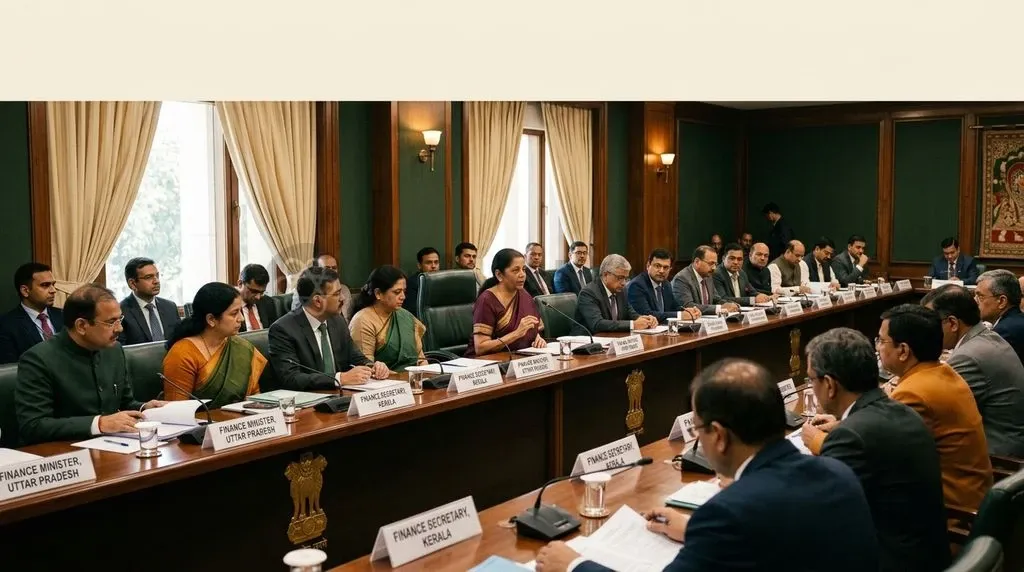
The Goods and Services Tax Council operates under Article 279A of the Constitution of India as a joint constitutional forum. It balances pooled national sovereignty against the fiscal autonomy of individual States through a weighted voting mechanism. Enacted via the Constitution (One Hundred and First Amendment) Act, 2016, this institutional architecture brings the Union Finance Minister and state finance ministers together to determine indirect tax rates, exemptions, and dispute procedures.
As of October 2026, the Council continues to shape inter-governmental fiscal relations across India. Its structural reliance on a central veto and non-binding recommendations turns cooperative federalism from an automatic legal guarantee into an active, continuous negotiation between New Delhi and the states.
Why in the News: The Context Behind the 57th GST Council Meeting
The 57th GST Council meeting was held in New Delhi on 8 October 2026 under the chairpersonship of the Union Finance Minister. Unlike the 56th meeting (September 2025), which dealt with rate rationalisation, the 57th made recommendations on process reforms covering registration, returns, refunds and adjudication. It changed no GST rates.
Key recommendations, as per the PIB release:
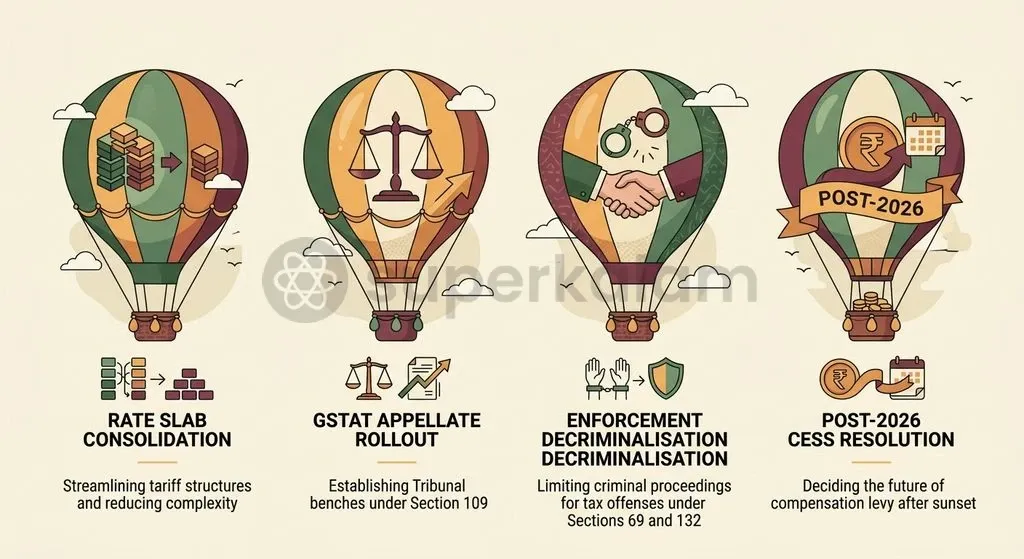
- Arrest powers: complete withdrawal of arrest powers under GST by omitting Section 69 of the CGST Act, 2017.
- Prosecution and penalty: prosecution threshold raised from ₹1 crore to ₹5 crore; general penalty under Section 125 reduced from ₹25,000 to ₹10,000; no show cause notice where the tax involved is below ₹10,000.
- Refunds: system-based processing of refunds, with the acknowledgement or deficiency memo window cut from 15 days to 10 days and 90% of zero-rated and inverted duty claims sanctioned provisionally by the system.
- Small taxpayers: late fee waiver for taxpayers with turnover up to ₹5 crore, and an in-principle optional Annual Return Quarterly Payment (ARQP) scheme.
These are recommendations of the Council. They need amendments to the CGST Act and Rules before they take effect, and the PIB release gives no single effective date. April 2027 is specified only for the new return-amendment mechanism (from the April 2027 return) and for the refund of ITC on capital goods (for ITC availed on or after 1 April 2027).
Discuss with Superkalam
What constitutional majority and meeting quorum are mandated under Article 279A for the GST Council to adopt a decision?
Ask NowConstitutional Roots: How Article 279A Created the GST Council
Article 279A was introduced into the Constitution of India by Section 12 of the Constitution (One Hundred and First Amendment) Act, 2016, taking effect on 12 September 2016. Under Article 279A(1), the President of India was mandated to constitute the Goods and Services Tax Council within sixty days of the amendment's commencement.
This constitutional amendment marked an unprecedented departure from traditional fiscal arrangements through two core structural pillars:
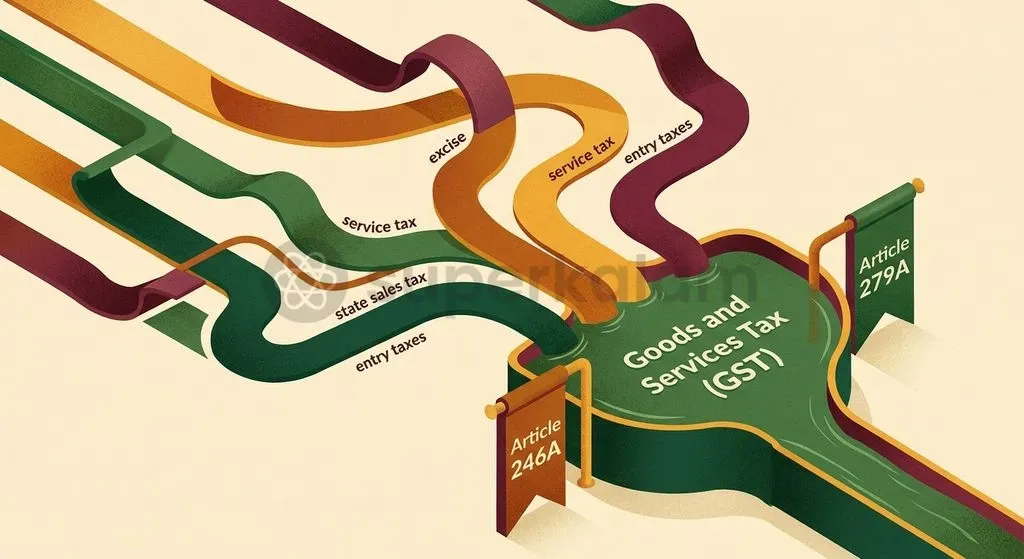
- Harmonised Tax Base: The reform unified seventeen distinct levies and thirteen cesses previously split between the Union and the States into a single tax base.
- Simultaneous Legislative Power: The 101st Amendment inserted Article 246A, which confers simultaneous legislative power upon Parliament and State Legislatures to enact indirect tax statutes.
This dual framework transformed the Seventh Schedule's traditional separation of tax powers into a shared, concurrent domain. That shift necessitates a permanent inter-governmental decision-making body.
Inside the Room: Composition and the 75% Voting Formula
The Goods and Services Tax Council derives its statutory authority and operational structure directly from Article 279A(2) of the Constitution of India.
The Council brings together three distinct categories of political leadership to deliberate on national tax policy:
- Chairperson: The Union Finance Minister heads the body.
- Union Member: The Union Minister of State in charge of Revenue or Finance represents the Centre.
- State Members: The Minister in charge of Finance or Taxation, or any other minister nominated by each State Government, represents their respective state.
Article 279A(7) stipulates that the quorum for conducting a formal meeting is one-half of total members. Decision-making within the body is governed by a strict arithmetic formula set out in Article 279A(9). Every decision requires a weighted majority of not less than three-fourths (75%) of the votes of members present and voting.
| Dimension | Central Government | State Governments (Collective) |
|---|---|---|
| Constitutional Provision | Article 279A(9)(a) | Article 279A(9)(b) |
| Assigned Voting Weight | Exactly one-third (33.33%) of total votes cast | Exactly two-thirds (66.67%) of total votes cast |
| Individual State Weight | Not applicable (single Union block) | Proportional division across all voting States |
| Veto Capability | Unilateral veto over any proposal | Collective veto (requires at least one-third of States) |
This arithmetic arrangement gives the Union an effective unilateral veto power over any statutory proposal. Because passing a resolution requires 75% of the weighted vote, the Centre's 33.33% share prevents any measure from passing without central approval. Conversely, the States collectively hold 66.67% of the voting power, meaning the Centre cannot carry a resolution alone without winning the support of a substantial majority of the States.
Discuss with Superkalam
How does the simultaneous legislative power conferred by Article 246A fundamentally depart from the Seventh Schedule's traditional distribution of tax powers?
Ask NowBinding or Persuasive? What the Supreme Court Ruled in the Mohit Minerals Case
The Supreme Court of India clarified the legal character of GST Council decisions in its landmark ruling in Union of India vs Mohit Minerals Pvt. Ltd. (2022 INSC 596).
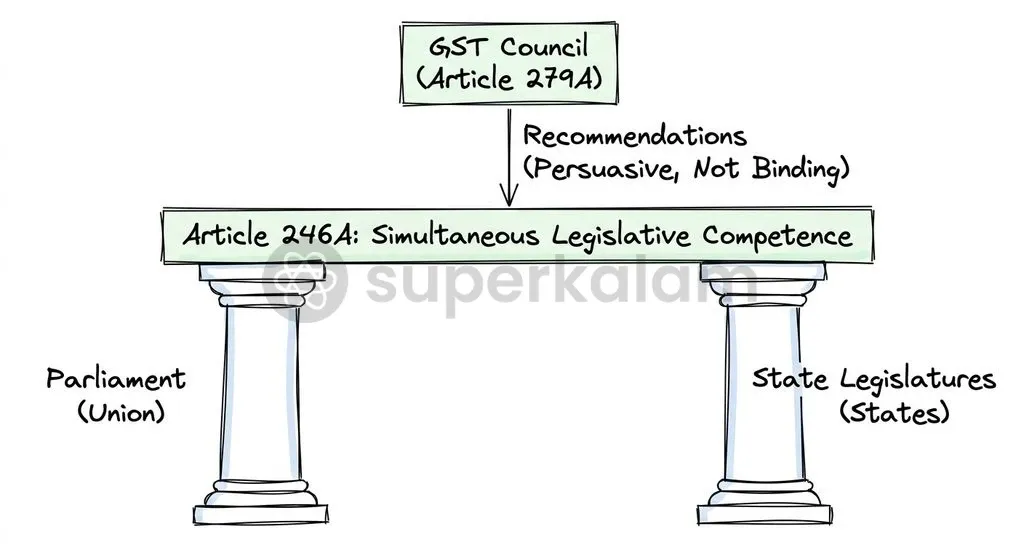
The bench established that recommendations issued by the GST Council possess persuasive value only and are not legally binding on Parliament or State Legislatures. The Court based this doctrine on two structural absences:
- No Non-Obstante Clause: Article 279A contains no non-obstante clause overriding statutory law.
- No Repugnancy Clause: Article 246A does not feature a repugnancy clause that would allow Council recommendations to override enactments passed by competent legislative bodies.
This judicial interpretation safeguards parliamentary supremacy and state legislative autonomy. The Court emphasised that Indian federalism constitutes a dialogue. Pooled sovereignty does not strip federating units of their constitutional right to debate, alter, or independently evaluate indirect tax policy.
56th vs 57th GST Council: Rates Then, Process Reforms Now
The 56th GST Council (September 2025) dealt with rates. It approved a two-rate structure with a 5% merit rate and an 18% standard rate, plus a 40% demerit slab, to reduce inverted duty structures and classification disputes. The 57th Council changed no rates. Its recommendations are about process and enforcement: registration, returns, refunds, adjudication and trade facilitation, as summarised above.
Discuss with Superkalam
Analyse why the 33.33% voting weight allocated to the Union Government functions as a unilateral constitutional veto in GST Council deliberations.
Ask NowOther recommendations in the PIB release:
- Input tax credit: remove the Section 17(5) restrictions on ITC for outdoor catering, health and life insurance, telecommunication towers, pipelines laid outside factory premises, free samples, and goods destroyed or written off on expiry of shelf life as required by law.
- Small taxpayers: waiver of late fee on delayed returns for taxpayers with turnover up to ₹5 crore, and an in-principle optional Annual Return Quarterly Payment (ARQP) scheme for turnover up to ₹5 crore.
- E-way bills: amendments to Sections 68, 129 and 130 of the CGST Act, with interception of goods based on intelligence and authorisation.
- Exports: measures to facilitate export of services.
States vs Centre: Strains on Fiscal Federalism Under the GST Regime
Fiscal federalism under the Goods and Services Tax framework experiences recurring structural strains rooted in unequal constitutional bargaining power.
States surrendered substantial independent revenue powers when they ceded their authority over sales taxes and local entry levies under the 101st Amendment. Today, state-level indirect tax autonomy is confined largely to Entry 54 of List II, which preserves exclusive state taxation over alcoholic liquor for human consumption and five petroleum products.
Key flashpoints continue to define inter-governmental negotiations:
- Petroleum Integration: Under Article 279A(5), bringing petroleum crude, high-speed diesel, petrol, natural gas, and aviation turbine fuel into the GST net requires a formal recommendation from the Council. State finance ministers remain cautious about yielding this remaining revenue anchor without concrete guarantees against baseline revenue erosion.
- Dispute Adjudication Deficit: While Article 279A(11) authorises the Council to create an internal dispute adjudication mechanism, operationalising an independent tribunal for state-centre tax grievances remains an unfinished task.
Discuss with Superkalam
Evaluate how the 57th GST Council recommendation to omit Section 69 and raise the prosecution threshold to ₹5 crore would change GST enforcement.
Ask NowThe Way Forward: Restoring True Consensus in India's Tax Architecture
The Goods and Services Tax Council must reinforce its collaborative foundations to maintain institutional legitimacy across diverse political cycles.
- Operationalise Dispute Tribunals: The Council should activate the formal dispute resolution mechanism contemplated under Article 279A(11). Establishing an independent, objective forum to hear state grievances will resolve structural conflicts before they escalate into protracted judicial battles, preserving mutual trust between the Centre and the states.
- Turn recommendations into law: The 57th Council's process reforms are recommendations. They need amendments to the CGST Act and Rules, so how quickly Parliament and State Legislatures act on them will decide how much of the package takes effect.
By pairing administrative decriminalisation with institutional safeguards for state autonomy, India can realise the true potential of cooperative fiscal federalism.
Key Takeaways
- Constitutional Architecture: Article 279A was introduced via the 101st Constitutional Amendment Act, 2016, empowering the President to constitute the GST Council as a joint constitutional body.
- Voting Distribution: Decisions mandate a 75% weighted majority, with the Central Government holding one-third (33.33%) of votes and States collectively holding two-thirds (66.67%).
- Persuasive Doctrine: The Supreme Court ruled in the Mohit Minerals (2022) case that GST Council recommendations are persuasive and non-binding on Parliament and State Legislatures.
- Administrative Reforms: The 57th Council recommended omitting Section 69 arrest powers and raising the Section 132 prosecution floor to ₹5 crore to improve the ease of doing business.
- Fiscal Friction: States retain independent indirect taxation solely under Entry 54 of List II over alcohol and five specified petroleum items, keeping petroleum integration under Article 279A(5) contested.
Mains Question
"Recommendations of the GST Council possess persuasive value only and are not unyielding mandates on competent legislatures." In light of the Supreme Court's ruling in the Mohit Minerals case, elucidate how the constitutional architecture of Article 246A and Article 279A balances pooled sovereignty with legislative autonomy. (10 Marks)
Evaluate NowMains Question
The weighted voting matrix under Article 279A(9) and the 57th Council recommendations on arrest powers and prosecution show how the Council balances Union and State roles. Critically examine the structural strains in fiscal federalism under the GST regime. (15 Marks)
Evaluate NowPractice MCQs
QUESTION 1
With reference to the decision-making mechanism of the Goods and Services Tax (GST) Council under Article 279A of the Constitution of India, consider the following statements:
- The quorum required to conduct a formal meeting of the GST Council is one-half of the total number of its members.
- Every decision of the Council is taken by a majority of not less than two-thirds of the weighted votes of members present and voting.
- The vote of the Central Government has a weightage of one-third of the total votes cast in the meeting.
Which of the statements given above are correct?
QUESTION 2
Regarding the Supreme Court's judgment in Union of India vs Mohit Minerals Pvt. Ltd. (2022), consider the following statements:
- The Supreme Court held that the recommendations of the GST Council are legally binding on both Parliament and State Legislatures.
- The ruling observed that Article 279A does not contain a non-obstante clause that overrides statutory law.
- The bench highlighted that Article 246A lacks a repugnancy clause that would allow Council recommendations to supersede legislative enactments.
Which of the statements given above is/are correct?
QUESTION 3
Consider the following statements regarding the enforcement and institutional reforms under the Central Goods and Services Tax (CGST) Act, 2017:
- The 57th GST Council recommended omission of statutory arrest powers under Section 69 of the CGST Act.
- The Council proposed enhancing the statutory prosecution floor under Section 132 from ₹1 crore to ₹5 crore.
- The Goods and Services Tax Appellate Tribunal (GSTAT) is established under Section 109 of the CGST Act with a Principal Bench in New Delhi.
Which of the statements given above is/are correct?
QUESTION 4
With reference to the constitutional framework established by the Constitution (One Hundred and First Amendment) Act, 2016, consider the following statements:
- Article 246A grants simultaneous legislative power to Parliament and State Legislatures to enact indirect tax laws.
- Article 279A mandated the President to constitute the GST Council within sixty days of its commencement.
- Entry 54 of List II was completely repealed to eliminate state taxation on all goods.
Which of the statements given above is/are correct?