CAPF Act 2026: Key Provisions and Supreme Court Challenge
Read the CAPF Act 2026's rules on senior appointments, IPS deputation and force administration, and the issues raised in the Supreme Court challenge.
Oct, 2026
•12 min read
Context
The Central Armed Police Forces (General Administration) Act, 2026 unifies governance across five major paramilitary forces. However, its statutory entrenchment of Indian Police Service deputation quotas has provoked an urgent constitutional challenge before the Supreme Court of India.
Brought into force on 8 October 2026, the legislation adds a common general-administration framework for five forces covering over 10 lakh personnel across border and internal security commands. Statutory provisions grant up to 100 percent of apex leadership ranks to police deputationists. This clashes directly with binding Supreme Court verdicts that granted Organised Group 'A' Service status to cadre officers. It does not repeal the five force-specific Acts listed in its First Schedule. Existing recruitment rules in the Second Schedule continue until modified, amended, rescinded or superseded.
This confrontation tests whether legislative supremacy under Article 33 can override judicial mandates establishing cadre parity and career progression under Part III of the Constitution.
Why in the News: The Constitutional Challenge to the CAPF Act 2026
The Supreme Court of India issued notice on 4 August 2026 on a batch of writ petitions challenging the constitutional validity of the CAPF Act, 2026. A special bench comprising Justices Manoj Misra and Ujjal Bhuyan scheduled joint hearings on 15 October 2026 to hear the constitutional challenge alongside pending contempt petitions.
The lead petitioner in this litigation is CRPF Assistant Commandant Bibhor Kumar Singh, a Shaurya Chakra gallantry awardee who lost both legs during an anti-Maoist combat operation in 2022. The petitioners argue that the statute invalidates successive judicial protections earned by combat officers over decades of litigation.
The challenge addresses two interrelated legal disputes:
- Constitutional validity: Petitions testing whether statutory command reservations breach fundamental rights under Articles 14 and 16.
- Executive contempt: Petitions alleging deliberate non-compliance with earlier Supreme Court orders mandating phased cadre restructuring.
The core analytical tension lies in whether Parliament can use exceptional powers under Article 33 of the Constitution to curtail service rights while insulating external deputation quotas from judicial review. As of October 2026, the Ministry of Home Affairs maintains that national security imperatives demand unified police-led leadership across all paramilitary organisations.
How the CAPF Act Relates to Existing Force-Specific Acts
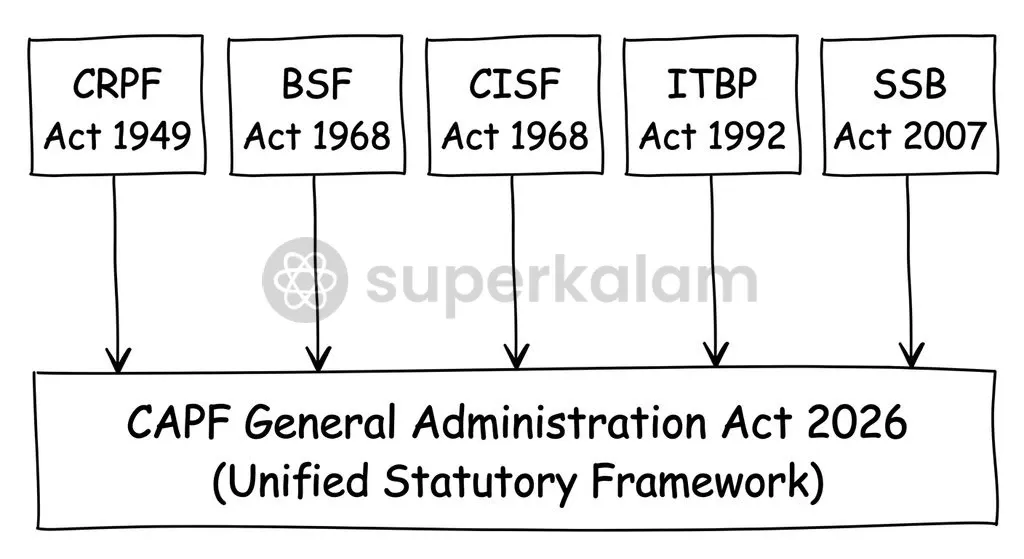
Parliament enacted the CAPF Act, 2026 to provide a common framework for recruitment and service conditions across five central armed police forces. It does not repeal their force-specific Acts. The First Schedule lists:
- The Central Reserve Police Force Act, 1949
- The Border Security Force Act, 1968
- The Central Industrial Security Force Act, 1968
- The Indo-Tibetan Border Police Force Act, 1992
- The Sashastra Seema Bal Act, 2007
Section 3 continues the recruitment rules listed in the Second Schedule until they are modified, amended, rescinded or superseded. The new Act adds rule-making powers and senior-rank deputation requirements; it is not a repeal-and-replacement law.
The Ministry of Home Affairs argued during parliamentary debates that separate statutory regimes caused severe regulatory fragmentation across recruitment standards, disciplinary codes, inter-force transfers, and operational deployments. Managing 10 lakh personnel across diverse operational roles under legacy rules generated chronic administrative friction between operational headquarters and central administrative ministries.
| Dimension | Legacy Force Framework (Pre-2026) | CAPF Act, 2026 Architecture |
|---|---|---|
| Legislative Basis | Five discrete Acts passed between 1949 and 2007 | Common general-administration law (Act No. 9 of 2026), alongside the five force-specific Acts |
| Command Structure | Disparate force-specific rules and ad-hoc deputations | Standardised statutory command ratios across all five forces |
| Service Status | Judicial recognition as Organised Group 'A' Services | Statutory terms subject to unilateral Union rule-making |
| Judicial Insulation | Subject to regular High Court and Supreme Court review | Section 3 contains an explicit non-obstante override |
| Inter-force Mobility | Restricted by individual force service regulations | Centralised deployment under Union List Entry 2A |
The legislative passage occurred rapidly in the budget session of 2026. The Central Armed Police Forces (General Administration) Bill, 2026 was introduced in the Rajya Sabha on 25 March 2026 and passed on 1 April 2026. It was cleared by the Lok Sabha on 2 April 2026 and received Presidential assent on 9 April 2026. Official implementation began on 8 October 2026 under Section 1(2) notifications.
Discuss with Superkalam
How does the CAPF Act, 2026 relate to the five force-specific Acts listed in its First Schedule?
Ask NowKey Provisions: Uniform Command, Dispute Rules, and Article 33 Restrictions
The CAPF Act, 2026 establishes uniform administrative control across five border and internal security forces while introducing statutory quotas for deputationists in apex command posts. The statute applies directly to Group 'A' General Duty officers across the CRPF, BSF, CISF, ITBP, and SSB.
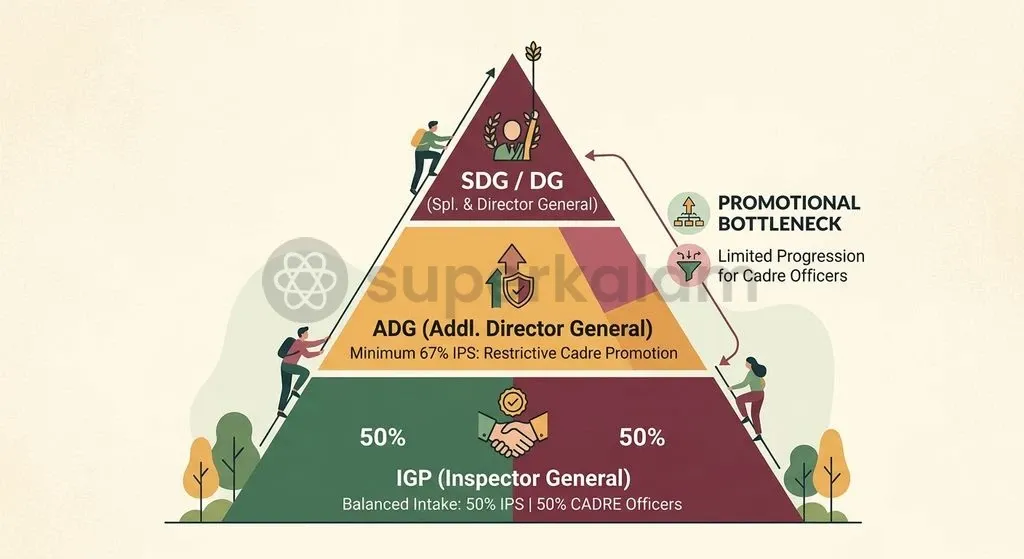
Specific statutory tiers institutionalise IPS deputation quotas across senior command ranks:
- Inspector General (IG): Exactly 50 percent of all posts must be reserved for IPS officers on deputation.
- Additional Director General (ADG): A statutory minimum of 67 percent of all vacancies must be allocated to IPS deputationists.
- Special Director General (SDG) and Director General (DG): Exactly 100 percent of apex leadership posts are statutory preserves for deputationists, completely excluding internal cadre officers from top command.
Section 3 of the Act contains an expansive non-obstante clause empowering the Union Government to frame service, promotion, and deputation rules notwithstanding any contrary judgment, decree, or order of any court. Complementing this provision, Section 7 of the Act establishes that the statute exercises an overriding effect over anything inconsistent contained in any other law for the time being in force.
The legislation simultaneously invokes parliamentary authority under Article 33 of the Constitution to limit collective bargaining, public speech, and association rights. Article 33 allows Parliament to restrict Fundamental Rights for forces charged with public order to ensure proper discharge of duties and maintenance of discipline.
The Cadre Dilemma: How the Act Reopens the Battle Over IPS Deputation
The CAPF Act, 2026 reignites a decade-long administrative confrontation between directly recruited cadre officers and the Indian Police Service over senior command appointments. The conflict centres on career mobility and leadership authority within specialised paramilitary forces.
In Union of India v. Harananda (2019), the Supreme Court affirmed that central armed police forces constitute Organised Group 'A' Services (OGAS). This classification entitled cadre officers to Non-Functional Financial Upgradation (NFFU) and mandated regular cadre reviews designed to minimise external deputation quotas.
The legal position was reinforced on 23 May 2025, when the Supreme Court ruled in Sanjay Prakash & Ors. v. Union of India. The Court ordered the Union Government to progressively reduce IPS deputation quotas up to the rank of Inspector General within two years to clear promotional bottlenecks. The Supreme Court subsequently dismissed the Home Ministry's review petition on 28 October 2025.
| Paramilitary Rank | Statutory Deputation Quota | Cadre Progression Impact |
|---|---|---|
| Director General (DG) / SDG | Exactly 100% reserved for deputationists | Cadre officers barred from apex command |
| Additional Director General (ADG) | Minimum 67% statutory reservation | Promotional advancement severely curtailed |
| Inspector General (IG) | Exactly 50% reserved for deputationists | Directly counters May 2025 judicial mandate |
The Union Executive defended these ratios through an affidavit filed by Union Home Secretary Govind Mohan. The affidavit justified posting 46 IPS officers across the five forces by arguing that the 2025 judicial directions did not impose an absolute ban on deputation. Cadre officers contend that statutory caps lock them out of leadership roles in organisations where they spend entire careers.
Directly recruited officers face prolonged promotion delays due to these reserved quotas. Cadre petitioners submitted to the Supreme Court that officers often endure stagnation of 15 to 18 years before attaining their first substantive promotion per submissions in Bibhor Kumar Singh & Ors. v. Union of India / The Hindu (as reported, 5 August 2026).
Discuss with Superkalam
How does the non-obstante clause in Section 3 of the CAPF Act, 2026 aim to neutralize previous Supreme Court rulings on cadre progression?
Ask NowConstitutional Grounds: Free Speech, Service Parity, and Federal Lines
Writ petitions before the Supreme Court challenge the CAPF Act, 2026 on grounds of judicial nullification, unequal service treatment, and the overextension of Article 33 restrictions. The litigation raises foundational questions of administrative law and constitutional balance.
Direct Judicial Invalidation and Separation of Powers
The foremost constitutional challenge targets Section 3 of the Act. The petitioners rely on the established doctrine articulated in Indian Aluminium Co. v. State of Kerala (1996) and Madras Bar Association v. Union of India (2021). These rulings establish that the legislature cannot simply overrule a binding judicial verdict without removing the underlying legal defect identified by the court.
By statutorily freezing deputation quotas at 50 to 100 percent after the Supreme Court ordered their phased reduction, Parliament is accused of encroaching upon judicial review. Judicial review forms an unalterable facet of the basic structure of the Constitution.
Fundamental Rights Under Articles 14, 16, and 33
The petitions challenge the deployment of Article 33 to suppress legitimate grievances regarding service conditions. While Article 33 permits Parliament to modify Part III rights for armed forces personnel to preserve operational discipline, the petitioners argue this power cannot be used as an instrument to enforce systemic career discrimination under Articles 14 and 16.
The challenge asserts that denying promotional parity to officers who perform frontline combat duties while granting administrative monopolies to civil policing cadres violates the constitutional test of reasonable classification and proportionality.
| Constitutional Pillar | Statutory Mechanism in Act | Constitutional Challenge Raised |
|---|---|---|
| Articles 14 and 16 | 50% to 100% statutory quotas for IPS officers | Breaches equality of opportunity in public employment |
| Article 33 Restrictions | Statutory curbs on speech and grievance forums | Misapplies disciplinary curbs to suppress career rights |
| Separation of Powers | Section 3 non-obstante legislative override clause | Encroaches on judicial review powers without curing defects |
| Seventh Schedule Balance | Entry 2A of List I centralised deployment | Creates operational friction with State policing powers under List II |
Federal Deployment Dynamics
The statutory consolidation also interfaces with Seventh Schedule demarcations between Union and State powers. The Union Government justified IPS-led command under Entry 2A of List I (deployment of armed forces of the Union in aid of civil power) and Article 312, contending that All India Service officers ensure seamless liaison with state administrations during emergencies.
State administrations frequently note that 'Public order' and 'Police' remain exclusive State subjects under Entries 1 and 2 of List II. Deploying centrally commanded paramilitary forces without flexible local coordination risks altering real-world cooperative federalism.
Discuss with Superkalam
If you were advising the Ministry of Home Affairs, how would you structure apex command ratios to balance combat expertise with inter-agency policing coordination?
Ask NowInternal Security Impact: Force Morale and Operational Readiness
Operational efficacy across the Central Armed Police Forces depends heavily on personnel morale, command trust, and sustainable career mobility during prolonged counter-insurgency duties. Structural alienation between frontline personnel and external leadership presents significant institutional consequences.
Data presented by the Ministry of Home Affairs in Parliament reveals that over 700 personnel across the CAPFs and Assam Rifles died by suicide over a five-year period. During that same window, more than 50,000 personnel voluntarily resigned or took early retirement from service.
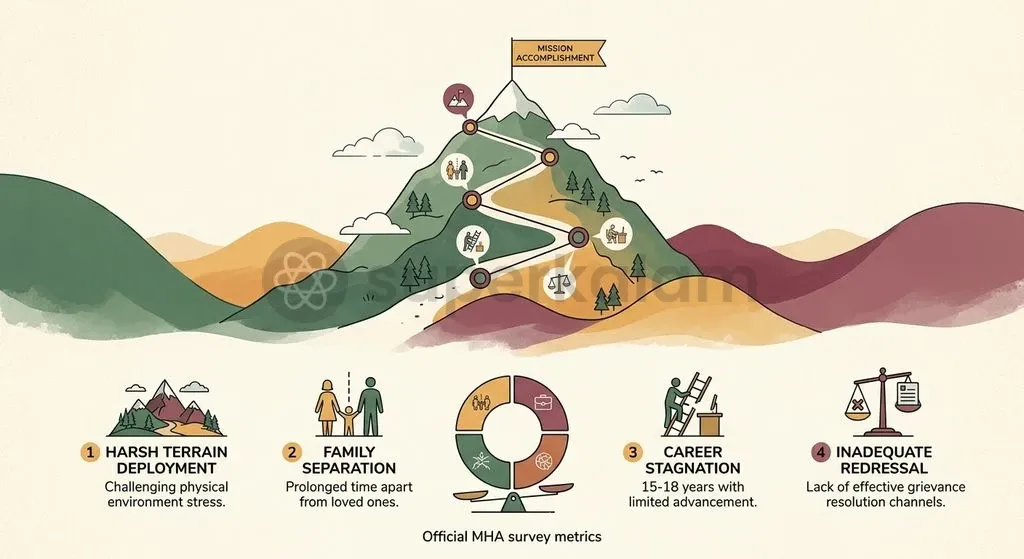
Four institutional pressures drive paramilitary attrition and severe operational stress:
- Continuous operational deployment: Protracted tours in harsh terrain and active counter-insurgency sectors without adequate recuperation.
- Family disruption: Acute absence of rotational peace postings and frequent cancellation of sanctioned leaves.
- Career stagnation: Extended delays spanning 15 to 18 years before directly recruited officers attain substantive promotions.
- Command alienation: Complete allocation of apex leadership posts to transient external deputationists.
A dedicated task force report by the Ministry of Home Affairs on mental health and suicides in CAPFs identified several key drivers of personnel distress:
- Workplace bullying and harsh internal administrative measures.
- Pervasive fear of punitive disciplinary proceedings when raising genuine field hardships.
- The absence of an objective, responsive grievance redressal mechanism across remote operating bases.
The Parliamentary Standing Committee on Home Affairs highlighted that extreme attrition stems from continuous deployment without rotational rest, prolonged separation from families, and inflexible leave policies. When senior command positions are occupied by deputationists who rotate back to state cadres, cadre officers argue that long-term institutional welfare and personnel empathy suffer.
The Way Forward: Balancing Combat Discipline with Officer Rights
Reforming paramilitary administration requires aligning statutory governance under the CAPF Act, 2026 with constitutional service guarantees and structured operational decentralisation. The Union Government must reconcile combat discipline with fair cadre mobility.
Compliance with Organised Group 'A' Service Norms
The Union Ministry of Home Affairs should implement the Supreme Court's mandate in Sanjay Prakash (2025) rather than using legislative override clauses to stall compliance. Progressively opening Additional Director General and Special Director General ranks to internal cadre officers will reward field experience and resolve severe promotional stagnation.
Cadre reviews must occur every five years as mandated by Department of Personnel and Training guidelines for Organised Group 'A' Services. Structured cadre expansion ensures predictable career milestones for directly recruited officers.
Institutionalising Independent Grievance Redressal
Parliamentary restrictions imposed under Article 33 must be counterbalanced by independent internal dispute forums. Establishing a specialised Paramilitary Administrative Tribunal—operating outside the immediate operational chain of command—would provide personnel a credible forum to resolve service grievances without facing disciplinary retaliation.
Transparent grievance channels directly mitigate the feelings of helplessness highlighted by the Ministry of Home Affairs task force report on operational stress and attrition.
Implementing Rotational Deployment and Welfare Architecture
The operational readiness of the CAPFs requires an enforceable institutional policy guaranteeing rotational postings between high-intensity operational zones and peace stations. The recommendations of the Parliamentary Standing Committee on Home Affairs must be translated into operational reality:
- Mandate statutory minimum annual leave allowances that field commanders cannot casually cancel except during national emergencies.
- Expand family accommodation infrastructure in regional transit hubs to alleviate long-term domestic separation.
- Institute mental health support systems with confidential counselling across company operating bases in counter-insurgency sectors.
Addressing these foundational welfare and leadership deficits is vital to ensure that legislative unification strengthens, rather than degrades, national security capabilities.
Discuss with Superkalam
Compare the constitutional justifications for invoking Article 33 with the equality protections guaranteed under Articles 14 and 16 in the context of paramilitary service.
Ask NowKey Takeaways
- The Central Armed Police Forces (General Administration) Act, 2026 unifies governance across CRPF, BSF, CISF, ITBP, and SSB, but faces a Supreme Court constitutional challenge heard by a bench of Justices Manoj Misra and Ujjal Bhuyan.
- The statute statutorily mandates high IPS deputation quotas—50 percent for Inspector General, minimum 67 percent for ADG, and 100 percent for SDG and DG posts—directly clashing with the Supreme Court's 2025 Sanjay Prakash judgment ordering their reduction.
- Section 3 of the Act contains a controversial non-obstante clause seeking to override court orders, raising basic structure questions regarding legislative overreach and judicial review under Madras Bar Association (2021).
- Article 33 of the Constitution is invoked to restrict fundamental rights and collective bargaining for paramilitary personnel, which petitioners argue violates proportionality under Articles 14 and 16 when used to preserve unequal service conditions.
- Paramilitary welfare remains critical, with official data recording over 700 suicides and more than 50,000 voluntary resignations over five years, driven by operational stress, lack of rotation, and promotional stagnation.
Mains Question
"Statutory overrides of judicial pronouncements under the cover of Article 33 test the constitutional boundaries of separation of powers." In light of Section 3 of the CAPF Act, 2026, critically examine the balance between parliamentary supremacy and the service rights of combatant officers. (15 Marks)
Evaluate NowMains Question
Evaluate the administrative rationale for a common framework for recruitment and service conditions under the Central Armed Police Forces (General Administration) Act, 2026, alongside the existing force-specific Acts. Discuss the operational dilemmas it creates. (10 Marks)
Evaluate NowPractice MCQs
QUESTION 1
With reference to the Central Armed Police Forces (General Administration) Act, 2026, consider the following statements:
- It provides a common recruitment and service framework for five forces while retaining their force-specific Acts.
- It reserves exactly 50 percent of Inspector General posts for IPS officers on deputation.
- It allows directly recruited cadre officers to hold up to 33 percent of Special Director General and Director General posts. Which of the statements given above is/are correct?
QUESTION 2
Consider the following statements regarding the legal and constitutional status of Central Armed Police Forces (CAPF) cadre officers:
- The Supreme Court in Union of India v. Harananda (2019) recognised CAPFs as Organised Group 'A' Services.
- In Sanjay Prakash v. Union of India (2025), the Supreme Court directed the Union to progressively reduce IPS deputation quotas up to the rank of Inspector General.
- Article 33 of the Indian Constitution empowers Parliament to modify the application of Fundamental Rights to forces charged with the maintenance of public order.
Which of the statements given above are correct?
QUESTION 3
Regarding the statutory command reservations introduced under the CAPF Act, 2026, consider the following pairs:
- Inspector General (IG) : 50 percent reserved for IPS deputationists
- Additional Director General (ADG) : Minimum 67 percent reserved for IPS deputationists
- Director General (DG) : Exactly 100 percent reserved for IPS deputationists
How many of the above pairs are correctly matched?
QUESTION 4
Which provision of the CAPF Act, 2026 contains a non-obstante clause empowering the Union Government to frame service, promotion, and deputation rules notwithstanding any contrary judgment, decree, or order of any court?
QUESTION 5
Consider the following statements regarding the legislative timeline and scope of the CAPF Act, 2026:
- It covers personnel across the CRPF, BSF, CISF, ITBP, and SSB.
- It received Presidential assent in April 2026 and came into force in October 2026.
- The legislation governs over 10 lakh personnel across border and internal security commands.
Which of the statements given above are correct?