GST Refund New Rules After the 57th GST Council: Exporters and Anti-Fraud Checks
The 57th GST Council recommended faster refund processing with anti-fraud checks. See what changes for exporters and inverted duty claims.
Oct, 2026
•10 min read

Overview
The Goods and Services Tax Council introduced a two-phase automated refund architecture. This system accelerates liquidity for Indian exporters while curbing input tax credit fraud through backend risk-engine profiling.
The reform amends Section 54 of the Central Goods and Services Tax Act, 2017. It shifts manual tax officer scrutinies toward automated system disbursements. Exporters operating under zero-rated supplies and inverted duty structures receive automated provisional credits.
This systemic transition balances prompt working capital disbursals with rigorous data triangulation against customs and tax intelligence databases.
Why in the News: The Push to Overhaul GST Refunds
The Goods and Services Tax Council overhauled the indirect tax refund framework during its 57th GST Council meeting. The move addresses chronic export liquidity bottlenecks and systemic tax fraud. As of October 2026, the Council recommended sweeping procedural amendments to Section 54 of the Central Goods and Services Tax (CGST) Act, 2017 to dismantle manual scrutiny stages.
The statutory revision tackles structural frictions where domestic exporters wait months for administrative approvals. Concurrently, tax authorities face escalating invoice-routing syndicates.
Discuss with Superkalam
What are the two specific circumstances under Section 54(3) of the CGST Act where unutilised input tax credit can be claimed as a refund?
Ask NowIndia's indirect tax administration is shifting from discretionary officer appraisals toward automated algorithmic verification. The automated engine dispatches legitimate liquidity while isolating evasion networks.
How GST Refunds Work: Inverted Duties and Unutilized Credits
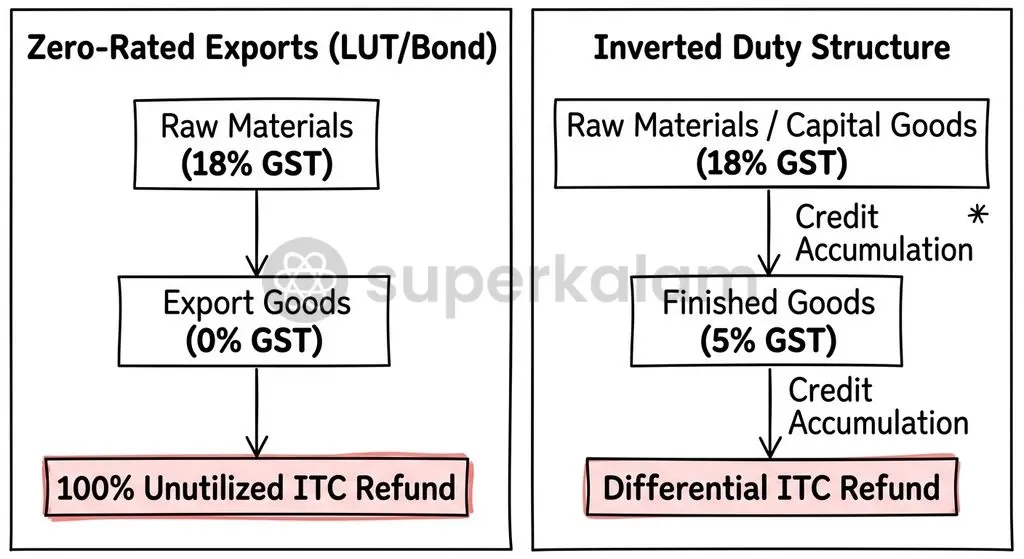
Section 54 of the CGST Act, 2017 governs refund claims, procedural timelines, provisional disbursements, and unjust enrichment safeguards. Section 54(3) strictly restricts refunds of unutilised input tax credit to two statutory categories:
- Zero-Rated Supplies: Exports of goods or services, or supplies made to Special Economic Zone (SEZ) developers or units, executed without paying integrated tax under a bond or Letter of Undertaking (LUT).
- Inverted Duty Structure (IDS): Manufacturing contexts where the tax rate on raw material inputs exceeds the indirect tax rate levied on finished output supplies.
Rule 89 of the CGST Rules, 2017 prescribes filing refund applications electronically using FORM GST RFD-01. It also details mathematical apportionment formulas for eligible Net ITC.
For exporters paying integrated tax directly, Rule 96 establishes that shipping bills filed with Customs act as deemed refund claims. These are processed automatically through the Indian Customs Electronic Gateway (ICEGATE) once export manifests match.
The Supreme Court of India examined Rule 89(5) formulas in Union of India v. VKC Footsteps India Pvt. Ltd. (September 2021). The Court upheld the validity of restricting inverted duty refunds strictly to input goods while excluding input services. However, it urged the GST Council to reconsider the formula as a matter of fiscal policy.
| Statutory Dimension | Zero-Rated Supplies (Exports/SEZ) | Inverted Duty Structure (IDS) |
|---|---|---|
| Governing Provision | Section 54(3)(i) of the CGST Act, 2017 | Section 54(3)(ii) of the CGST Act, 2017 |
| Core Operational Mechanism | Tax relief on goods or services dispatched overseas or to SEZs without tax under LUT | Accumulation of credit because input tax rate exceeds output tax rate |
| Application Mechanism | FORM GST RFD-01 or shipping bill under Rule 96 | FORM GST RFD-01 under Rule 89 |
| Input Services Eligibility | Allowed under the Net ITC export formula | Permitted for ITC availed on or after November 1, 2026 |
| Capital Goods Treatment | Eligible for ITC availed on or after April 1, 2027 (spread over 60 months) | Eligible for ITC availed on or after April 1, 2027 (spread over 60 months) |
The 57th GST Council also amended Rule 89(4)(C). It removed the artificial valuation cap that restricted zero-rated supply turnover to 1.5 times the domestic value of like goods.
The Council clarified that the minimum refund threshold of ₹1,000 under Section 54(14) applies to the combined aggregate of CGST, SGST/UTGST, and IGST.
In addition, the Council recommended omitting sub-clause (v) of Section 2(6) of the IGST Act, 2017. This change allows Indian service providers to claim export refunds when servicing their overseas branch establishments.
Discuss with Superkalam
How does an inverted duty structure create liquidity lock-ups for domestic manufacturers?
Ask NowPhase 1 and Phase 2 Rollout: Timelines, Process, and System Checks
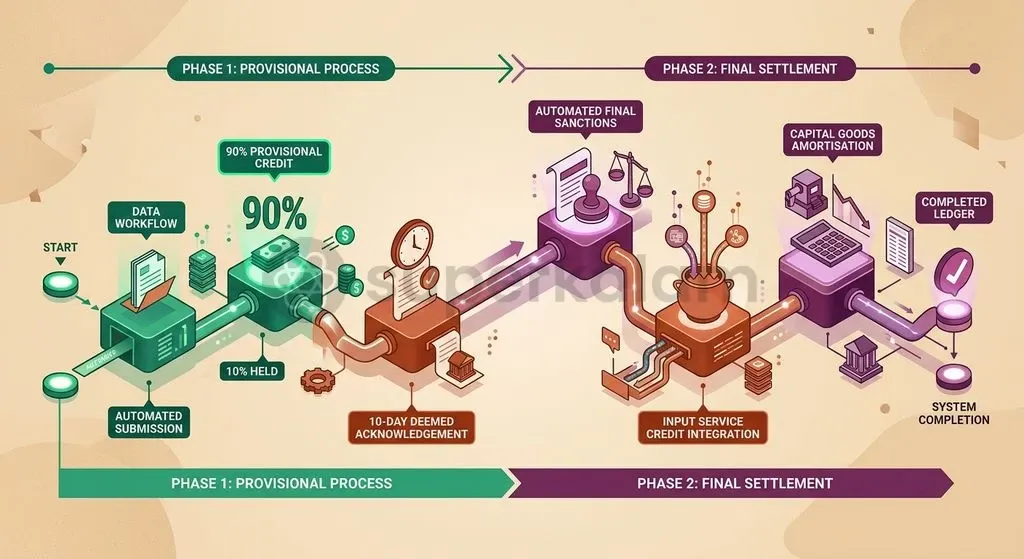
The recommendations of the 57th GST Council implement an operational two-phase architecture designed to phase out manual officer verification. This reform restructures both cash ledger claims and unutilised credit flows.
Phase 1: Rapid Provisional Relief and Ledger Automation
Phase 1 re-engineers baseline filing protocols through targeted system modifications:
- Automated Electronic Cash Ledger Refunds: Full refund claims for excess balances residing in the taxpayer's electronic cash ledger are sanctioned automatically by the GST Network without tax officer intervention.
- Shortened Deficiency Timelines: The statutory period for issuing a refund acknowledgement or deficiency memo drops from 15 days to 10 days, triggering a deemed system acknowledgement if administrative officers fail to act within that window.
- Automated 90% Provisional Sanction: Refund claims stemming from zero-rated supplies and inverted duty structures receive an automated provisional disbursal of 90% of the claimed amount directly via system logic based on algorithmic risk evaluation.
- Machine-Readable Documentation: FORM GST RFD-01 transitions into a structured, system-readable digital format, eliminating the requirement to upload scanned physical documents.
Phase 2: Full End-to-End System Processing
Phase 2 builds upon the initial rollout by completing end-to-end automation across verification, validation, and recovery stages:
- Automated Acknowledgement: System-based acknowledgement issues automatically upon digital verification without departmental review.
- Automated Final Sanctions: The GST system processes full refund claims for zero-rated supplies after adjusting outstanding tax demands via risk evaluation algorithms.
- Comprehensive Input Service Integration: Inverted duty structure claims encompass accumulated ITC on input services availed on or after November 1, 2026.
- Capital Goods Credit Inclusion: Accumulated ITC on capital goods becomes refundable for zero-rated supplies and inverted duty structures for credits availed on or after April 1, 2027, disbursed over 60 monthly installments.
Discuss with Superkalam
If a manufacturing exporter purchases capital equipment in May 2027, how will their unutilised input tax credit be refunded under the Phase 2 system rules?
Ask NowThe Core Trade-Off: Unlocking Exporter Cash Flow vs Stopping ITC Fraud
The central administrative challenge of indirect taxation is balancing export liquidity against systemic fraud control. Releasing liquidity requires fast disbursements. Conversely, curbing fraudulent input tax credits demands deep verification across supply tiers.
Enforcement findings by the Central Board of Indirect Taxes and Customs (CBIC) and the DGGI highlight several persistent fraud patterns:
- Circular Trading Syndicates: Networks of non-operating entities generate accommodation invoices without physical cargo movement to artificially inflate enterprise turnover. These entities siphon liquid cash out of the public exchequer via zero-rated refund filings.
- Identity Theft and Shell Formations: Syndicates harvest PAN and Aadhaar credentials from vulnerable economic groups to establish paper firms. These dummy enterprises pass ineligible ITC along multi-layered networks before vanishing.
- Valuation Inflation on Zero-Rated Cargo: Exporters report exaggerated free-on-board export values on low-grade goods to encash unearned tax refunds.
| Pipeline Stage | Data Source / System | Verification Function |
|---|---|---|
| Stage 1: Outward Returns | GSTN (GSTR-1 & GSTR-3B) | Evaluates declared export turnover and domestic tax payments |
| Stage 2: Customs Verification | ICEGATE (Shipping Bills) | Matches physical export cargo manifests against tax filings |
| Stage 3: Banking Remittance | DGFT (eBRC Platform) | Confirms realization of foreign inward remittances |
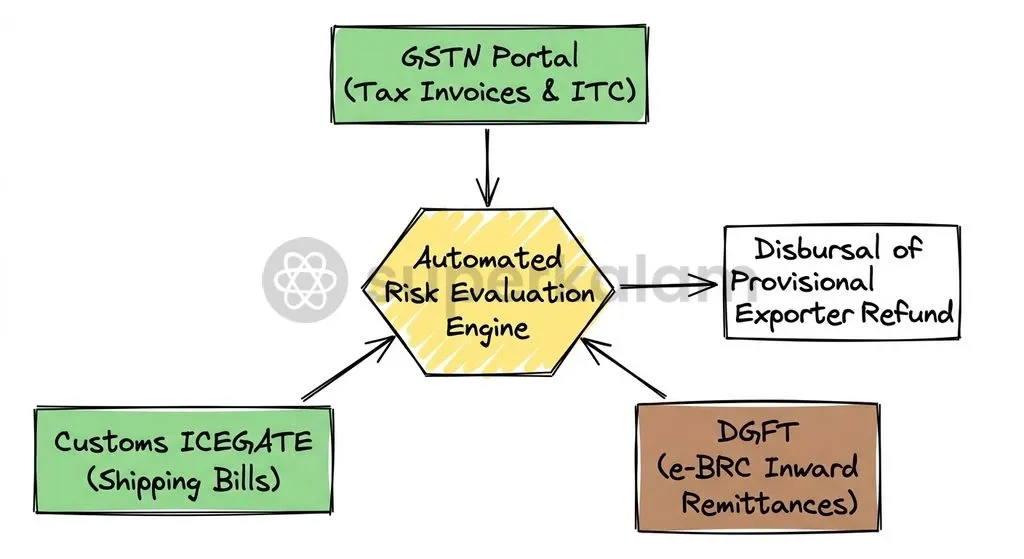
| Stage 4: Risk Evaluation | Central Risk Engine | Routes low-risk files to automated disbursal and flags suspicious claims for audit |
To resolve this friction without causing arbitrary claim delays, the automated architecture deploys tri-party data triangulation. The GST Network integrates outward declarations in GSTR-1 and GSTR-3B with real-time export logs inside ICEGATE.
Concurrently, the Directorate General of Foreign Trade (DGFT) electronic Bank Realisation Certificate (eBRC) system matches foreign inward remittances against declared shipping bills.
Discuss with Superkalam
Compare the risks of circular invoice trading with the procedural delays created by manual deficiency memos in indirect tax administration.
Ask NowWinners and Vulnerabilities: Who Gains and What Gaps Remain
The revised refund architecture alters commercial dynamics across manufacturing and exporting sectors, though transitional hurdles remain.
Key Beneficiaries
Manufacturing sectors constrained by inverted duty rates—specifically textiles, footwear, and fertilisers—gain substantial working capital relief. In synthetic textiles, raw inputs such as polyester yarn face an 18% tax rate, while output fabric incurs 5% tax, locking up domestic capital. Extending refunds to input services starting November 2026, and to capital goods starting April 2027, addresses long-standing liquidity constraints.
Exporters utilising the Advance Authorisation and Export Promotion Capital Goods (EPCG) frameworks benefit from the retrospective omission of Rule 96(10) of the CGST Rules back to October 23, 2017. This retrospective deletion resolves years of show-cause notices and legal disputes over zero-rated export refunds.
Service exporters also secure relief through the removal of Section 2(6)(v) export restrictions under the IGST Act. This reform allows cross-border support to foreign branch offices without trapped taxes.
Operational Vulnerabilities
While the automated 90% provisional refund provides immediate working capital relief to MSMEs, transitioning to structured system-readable RFD-01 schedules increases frontend accounting obligations. Small enterprises lacking enterprise-grade enterprise resource planning software face higher initial compliance hurdles.
| Beneficiary / Stakeholder Segment | Immediate Policy Benefit | Lingering Administrative Risk |
|---|---|---|
| Inverted Duty Sectors (Textiles, Footwear) | Inclusion of input services (Nov 2026) and capital goods (Apr 2027) | Capital goods refunds remain deferred across 60 monthly installments |
| Export Houses using Advance Authorisation / EPCG | Retrospective omission of Rule 96(10) back to October 2017 drops litigation | Historical audit reconciliations required to vacate pending demands |
| MSME Exporters | Automated 90% provisional sanction of zero-rated and inverted duty claims | Transition to system-readable RFD-01 tables increases compliance costs |
| Service Exporters with Overseas Branches | Section 2(6)(v) IGST Act omission allows refunds on intra-entity exports | Upstream credit validation across foreign banking remittances persists |
Way Forward: Fast Disbursals Without Tax Harassment
To modernise indirect tax governance, the automated refund architecture must pair digital processing with clear institutional safeguards. Achieving this efficiency requires several targeted policy measures:
- Institutional Redress Against Arbitrary Blocks: System risk algorithms can inadvertently freeze legitimate claims due to minor vendor-side clerical errors. State and central administrations must introduce time-bound grievance portals where algorithmic blocks are reviewed within seven working days.
- Deepening Triangulated Data Verification: Tax authorities should expand automated cross-checks between GSTN, ICEGATE, and the DGFT revamped eBRC platform. Verifying foreign exchange receipts alongside customs filings isolates phantom invoice routing without delaying compliant manufacturers.
- Support for MSME Digital Integration: Small-scale enterprises require accessible reconciliation utilities to transition smoothly to system-readable RFD-01 schedules. Providing standardised compliance software prevents small firms from suffering avoidable filing delays.
Discuss with Superkalam
Weigh the trade-off between providing immediate 90% provisional refund liquidity to exporters and the risk of exchequer loss from fly-by-night fraudulent firms.
Ask NowKey Takeaways
- Section 54 of the CGST Act and Rule 89 restrict unutilised ITC refunds to zero-rated exports under bond/LUT and inverted duty structures.
- The 57th GST Council approved a two-phase automated refund framework, cutting deficiency memo timelines from 15 to 10 days with deemed system acknowledgement.
- Phase 1 grants an automated 90% provisional refund on zero-rated supplies and inverted duties, alongside automated cash ledger disbursements.
- Inverted duty refunds expand to input services availed on or after November 1, 2026, and to capital goods availed on or after April 1, 2027 (spread over 60 months).
- The retrospective deletion of Rule 96(10) w.e.f. October 23, 2017 settles litigation for exporters using Advance Authorisation and EPCG schemes.
- Fraud countermeasures counter circular trading and identity theft by triangulating GSTN returns, ICEGATE shipping bills, and DGFT eBRC banking records.
Mains Question
"The transition from discretionary officer appraisals to automated algorithmic verification represents a fundamental paradigm shift in indirect tax governance." In light of the recent amendments to Section 54 of the CGST Act, elucidate how the two-phase automated refund architecture balances exporter liquidity with fraud prevention. (15 Marks)
Evaluate NowMains Question
Enforcement disclosures reveal escalating challenges of invoice-routing syndicates and fraudulent input tax credit under GST. Critically examine the efficacy of system-driven reconciliations in combating tax evasion without causing procedural harassment to genuine taxpayers. (10 Marks)
Evaluate NowPractice MCQs
QUESTION 1
Regarding the statutory framework for Goods and Services Tax (GST) refunds under Section 54 of the CGST Act, 2017, consider the following statements:
- Section 54(3) permits refund of unutilised input tax credit only in cases of zero-rated supplies made without payment of tax and inverted duty structures.
- The minimum refund threshold of ₹1,000 applies separately to CGST, SGST, and IGST components rather than their combined aggregate.
- The valuation cap restricting zero-rated supply export turnover to 1.5 times the domestic value of like goods was eliminated under Rule 89(4)(C). Which of the statements given above are correct?
QUESTION 2
With reference to the Supreme Court ruling in Union of India v. VKC Footsteps India Pvt. Ltd. (2021) and subsequent refund reforms, consider the following statements:
- The Supreme Court upheld the constitutional validity of restricting inverted duty structure refunds strictly to input goods while excluding input services.
- Inverted duty structure refund claims are permitted to incorporate input services for input tax credit availed on or after November 1, 2026.
- Unutilised credit on capital goods under inverted duty structures remains permanently excluded from refund claims under all phases of the reform. Which of the statements given above is/are correct?
QUESTION 3
Consider the following statements regarding the two-phase automated refund architecture recommended by the 57th GST Council:
- In Phase 1, the statutory timeline for issuing a deficiency memo was reduced from 15 days to 10 days, after which deemed acknowledgement is triggered.
- Phase 1 provides an automated provisional refund sanction of 90% of the claimed amount based on algorithmic risk evaluation for eligible claims.
- Refunds of excess balances lying in the taxpayer's electronic cash ledger continue to mandate manual verification by jurisdictional tax officers. Which of the statements given above is/are correct?
QUESTION 4
Which of the following changes was recommended by the 57th GST Council regarding cross-border services and overseas establishments?
QUESTION 5
Under the Phase 2 GST refund architecture, how is accumulated input tax credit on capital goods treated for zero-rated supplies and inverted duty structures?