How Is a DGP Appointed? UPSC Role and Prakash Singh Rules
Understand how a state DGP is selected, the UPSC empanelment process, Prakash Singh police reforms and Supreme Court directions on tenure and appointments.
Oct, 2026
•9 min read

Overview
A state police chief needs operational freedom from partisan political pressure. To secure this autonomy, the Union Public Service Commission conducts a structured screening process, yet State Governments repeatedly bypass judicial directions by appointing acting police chiefs through executive fiat.
In 2006, the Supreme Court created mandatory procedural safeguards to eliminate political patronage. These included objective empanelment and a guaranteed two-year tenure. Even so, multiple administrations continue exploiting procedural ambiguities to maintain direct leverage over top police ranks.
This deliberate circumvention weakens both All India Services cadre governance and the institutional independence of state law enforcement command.
Why Police Leadership Appointments Are Under Scrutiny Today
In October 2026, the Supreme Court questioned Jharkhand's 2025 DGP appointment rules, including removal of the six-month residual-service requirement. The Court said the provision prima facie appeared to conflict with its Prakash Singh directions and issued notice to DGP Tadasha Mishra.
The Court also asked the amicus curiae to examine whether other States had adopted similar rules. This is scrutiny of the rules and appointment process, not a final judgment annulling the appointment.
Discuss with Superkalam
Which constitutional article did the Supreme Court invoke in Prakash Singh (2006) to issue binding directives for police appointments?
Ask NowThe Landmark Prakash Singh Ruling: Why the Supreme Court Stepped In
The baseline for modern police governance emerged two decades ago in Prakash Singh v. Union of India (2006). The Supreme Court observed that partisan interference crippled everyday policing and undermined democratic accountability.
To resolve this, the Court invoked its powers under Article 142 of the Constitution. It issued binding directives to fill a legislative vacuum until legislatures passed comprehensive statutes. This intervention built directly on the Second Report of the National Police Commission (1977–1981), which had recommended statutory selection systems and protected tenures.
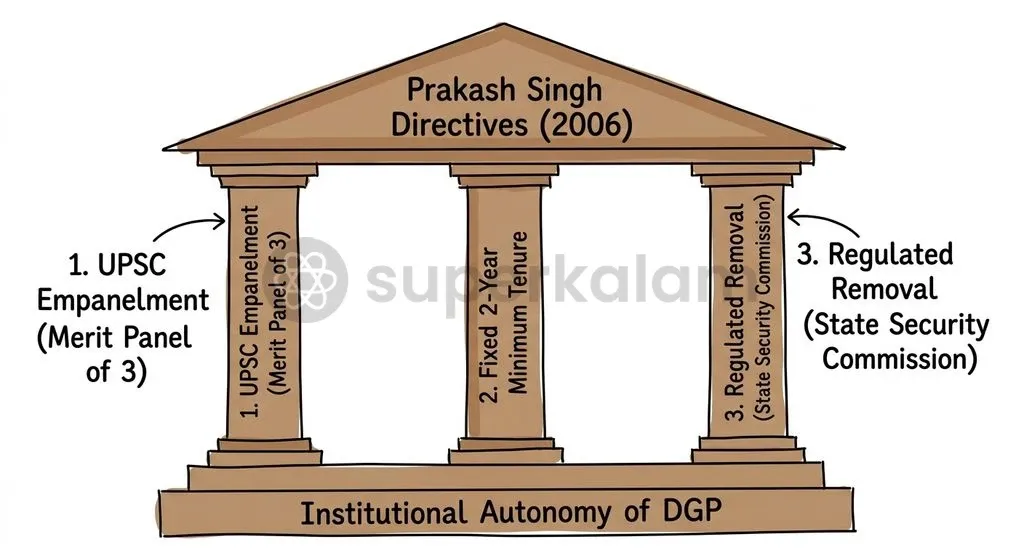
Under the 2006 ruling, State Governments must appoint the Director General of Police (DGP) exclusively from a panel of the three senior-most officers vetted by the UPSC. The Court instituted two structural tenure shields:
- Guaranteed two-year tenure: The selected DGP receives a minimum operational term of two years, regardless of their scheduled date of superannuation.
- Restricted premature removal: The State can remove an incumbent DGP prior to two years only under strict grounds. These include conviction in a criminal or corruption case, formal disciplinary proceedings, physical incapacitation, or following advice from an independent State Security Commission.
The Prescribed Path: How the UPSC and State Select a Police Chief
The formal appointment pathway divides responsibilities cleanly between the Centre and the States.
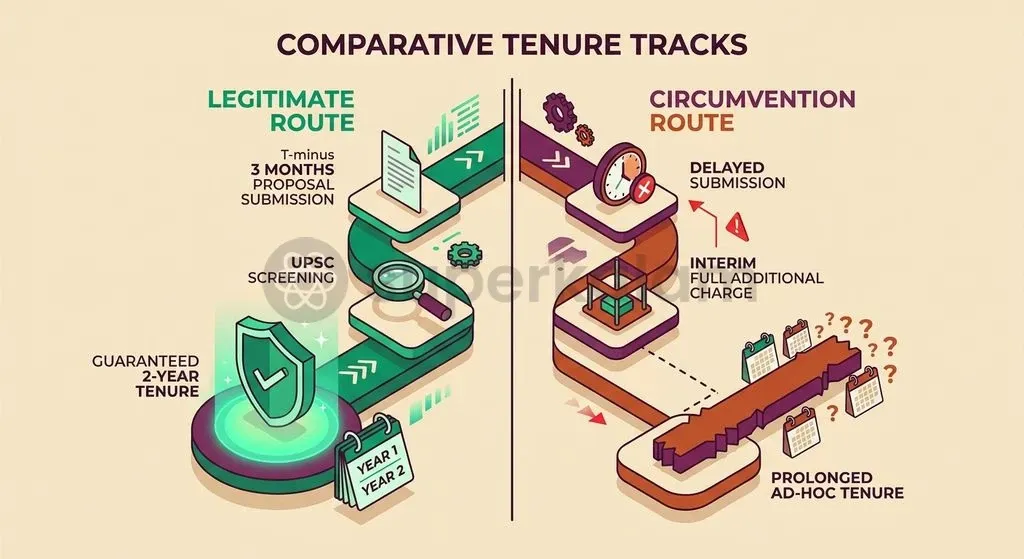
On July 3, 2018, the Supreme Court directed all States to send empanelment proposals to the UPSC at least three months before the incumbent's retirement. Later, on March 13, 2019, a three-judge Bench led by Chief Justice Ranjan Gogoi restricted eligibility. The Bench ruled that only Indian Police Service (IPS) officers holding a residual tenure of six months prior to superannuation can be empanelled.
The UPSC Empanelment Committee evaluates candidates through an independent five-member board. Per official UPSC guidelines, the committee includes:
- The UPSC Chairman or a designated UPSC Member presiding as Chair;
- The Union Home Secretary or an authorised nominee;
- The Chief Secretary of the concerned State;
- The incumbent State DGP (Head of Police Force);
- The head of a Central Armed Police Force nominated by the Union Government.
Institutional impartiality remains non-negotiable. On February 12, 2026, the Supreme Court ruled in a Tamil Nadu matter that an acting DGP who is an aspirant cannot sit on the screening committee. The State must substitute another senior officer, such as an Additional Chief Secretary.
Candidates must have completed at least 30 years of service. They also require 'Very Good' ratings in their Annual Performance Appraisal Reports across the preceding decade, evaluated across four core policing dimensions.
Officers on central deputation are excluded if the Ministry of Home Affairs confirms they cannot be spared. The committee shortlists three officers on merit and experience, leaving the State to choose any one officer from the final trio.
| Dimension | Mandated UPSC Selection Track | Ad-Hoc Executive Track |
|---|---|---|
| Legal Basis | Directives under Article 142; Prakash Singh (2006, 2018, 2019) | Discretionary executive orders; State Police Acts |
| Shortlisting Authority | Five-member UPSC Empanelment Committee | State cabinet or Chief Minister's office |
| Tenure Protection | Mandatory two-year minimum tenure | At the pleasure of the executive (unsecured) |
| Eligibility Filters | 30 years of service, 6 months residual tenure, APAR vetting | Variable; criteria frequently altered |
| Chain of Command | Operationally autonomous within statutory law | Functionally dependent on political patronage |
Discuss with Superkalam
How does the practice of appointing an 'acting DGP' compromise the ethical principles of impartiality and objectivity outlined by the Nolan Committee?
Ask NowThe Rise of 'Acting DGPs': How States Evade the Rules
State administrations often bypass regular appointments by assigning officers as 'acting', 'in-charge', or 'additional charge' DGPs.
The Supreme Court banned this practice outright on July 3, 2018. It held that no State may appoint an acting police chief because the law recognises no such post. Despite that order, executive branches continue to bypass regular empanelment.
States bypass the process through three familiar administrative tactics:
- Delaying formal proposals: States sit on proposals until an incumbent is about to retire. This creates an artificial emergency to justify an ad-hoc posting. As reported in legal proceedings, UPSC guidelines contain Paragraph 4(xii), requiring States to obtain explicit leave from the Supreme Court before belated proposals are considered.
- Full Additional Charge (FAC) mechanisms: Administrations post a favoured officer to run an allied department while assigning them Full Additional Charge as police chief. Such manoeuvres occurred in Uttar Pradesh, Punjab, and Telangana.
- Circumventing residual service limits: By avoiding the UPSC route, States promote favoured officers with under six months of service left, ignoring the March 2019 Supreme Court order.
State Police Acts vs Supreme Court Directives: The Federal Clash
Constitutional friction over police appointments arises directly from the division of powers under the Seventh Schedule.
Two competing constitutional domains collide in this dispute:
- State legislative domain: Under List II (State List), 'Public order' (Entry 1) and 'Police' (Entry 2) rest within the exclusive legislative powers of State Legislatures.
- Union cadre regulation: All India Services are governed under Article 312 and Entry 70 of List I (Union List), with service conditions directed centrally under the All India Services Act, 1951.
Several States have attempted to insulate appointments from UPSC oversight by passing separate State Police Acts. Enactments including the Punjab Police Act 2007, the Telangana Police Act 2018, and the Jharkhand 2025 Regulations established local search committees, bypassing the UPSC.
The Supreme Court tackled this friction on July 3, 2018. It ruled that state laws or executive rules conflicting with its directions remain in abeyance unless modified by the Court.
In October 2026 proceedings, a Bench headed by CJI Surya Kant observed that Jharkhand's 2025 regulations dispensing with the six-month service rule prima facie conflict with Prakash Singh. The judiciary views these state carve-outs as impermissible attempts to dilute cadre discipline.
Discuss with Superkalam
If a State Government passes a new Police Act that creates an internal search committee to bypass the UPSC, what legal standing does it hold against Supreme Court directives?
Ask NowWhat Compromised Leadership Means for Policing and Accountability
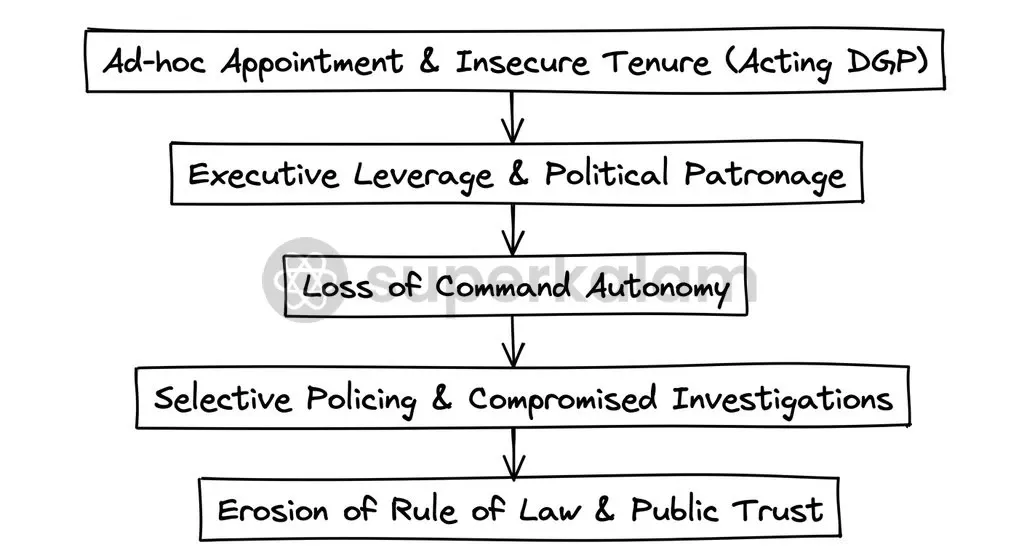
Ad-hoc leadership damages command discipline and constitutional governance.
According to the Second Administrative Reforms Commission (5th Report: Public Order), temporary police chiefs lack the Article 142 tenure shield. This leaves leadership exposed to executive patronage, political meddling, and sudden dismissals. An officer serving at the daily pleasure of the political executive cannot easily resist improper pressure.
This dependency undermines core ethical principles. The Nolan Committee standards of impartiality and objectivity require public officers to act without partisan bias or personal interest.
When a police chief depends on political patronage for tenure survival, governance suffers severe consequences:
- Operational autonomy collapses: Subordinate officers see that career survival favours political compliance over statutory duty.
- Biased investigation risks rise: Sensitive investigations into corruption or electoral disputes face immediate risks of political interference.
- Internal command frays: Ignoring merit disrupts seniority, sparking cadre factionalism and demoralising officers passed over for political picks.
Restoring Institutional Backbone: What Needs to Change
Repeated evasion shows that procedural guidelines require assertive judicial enforcement.
The Justice K.T. Thomas Committee, appointed by the apex court in 2008 to track compliance, observed in 2010 that most States remained unwilling to implement fundamental police reforms. Restoring operational autonomy demands concrete measures.
A viable reform path requires three coordinated interventions:
- Judicial contempt enforcement: The Supreme Court must use its contempt jurisdiction against bureaucratic stalling, holding Chief Secretaries personally liable if panels are not submitted three months prior to vacancies.
- Empowering proactive UPSC empanelment: Applying the ruling in UPSC v. T. Dhangopal Rao (2026), the UPSC must initiate empanelment meetings independently based on cadre data, stopping States from blocking the process.
- Implementing independent oversight bodies: State Legislatures should align with the Model Police Act, 2006, drafted by the Soli Sorabjee committee, which proposed statutory State Police Boards to manage leadership appointments, tenures, and transfers.
Discuss with Superkalam
Contrast the constitutional arguments supporting State control over policing under List II with those supporting Union-level UPSC empanelment under Article 312.
Ask NowKey Takeaways
- The Prakash Singh Baseline: The Supreme Court mandated in 2006 that State DGPs must be selected from a three-officer panel prepared by the UPSC, backed by a guaranteed two-year operational tenure.
- Empanelment Prerequisites: Under apex court rulings from 2018 and 2019, States must send proposals three months before a vacancy occurs, and only officers with at least six months of residual service are eligible.
- Absolute Bar on Acting Chiefs: The Supreme Court's July 2018 order prohibited acting DGPs, yet State Governments frequently bypass this through Full Additional Charge arrangements.
- Federal Legislative Friction: States rely on Seventh Schedule powers over Police (Entry 2, List II) to enact separate Police Acts, but the Supreme Court has placed conflicting state rules in abeyance.
- Reported Legal Challenges: The legal validity of delayed proposals requiring leave under UPSC Paragraph 4(xii), and the challenge to state regulations dispensing with residual service rules, remain under active judicial scrutiny.
Mains Question
"The practice of appointing 'acting DGPs' through executive fiat undermines the institutional safeguards established under Article 142 in Prakash Singh v. Union of India." Examine how procedural delays and state legislative enactments have been utilised to circumvent judicial directives on police leadership. (10 Marks)
Evaluate NowMains Question
According to the Second Administrative Reforms Commission (5th Report: Public Order), ad-hoc police leadership deprives the force of essential tenure protections, compromising institutional autonomy and ethical governance. Critically analyse the constitutional and administrative ramifications of compromised police command. (15 Marks)
Evaluate NowPractice MCQs
QUESTION 1
Regarding the selection process of the Director General of Police (DGP) mandated by the Supreme Court in Prakash Singh v. Union of India and subsequent orders, consider the following statements:
- State Governments are required to send empanelment proposals to the UPSC at least three months prior to the retirement of the incumbent.
- Only Indian Police Service officers having a residual tenure of at least one year before superannuation are eligible for empanelment.
- The UPSC Empanelment Committee shortlists a panel of three officers from which the State Government must choose the DGP.
Which of the statements given above are correct?
QUESTION 2
Consider the following statements regarding the composition and guidelines of the UPSC Empanelment Committee for the selection of a State DGP:
- The committee is chaired by the UPSC Chairman or a designated UPSC Member.
- The Union Home Secretary and the Chief Secretary of the concerned State are both members of the committee.
- An acting DGP who is an aspirant for the regular post is legally permitted to sit on the screening committee provided they recuse themselves during their personal assessment.
Which of the statements given above is/are correct?
QUESTION 3
With reference to the Supreme Court's directives on police leadership tenure and removal, consider the following statements:
- Under Article 142 directives, a regular DGP is entitled to a guaranteed minimum tenure of two years, irrespective of the date of superannuation.
- A State Government may prematurely remove an incumbent DGP following the advice of an independent State Security Commission.
- In July 2018, the Supreme Court explicitly prohibited State Governments from appointing acting police chiefs.
Which of the statements given above are correct?
QUESTION 4
In UPSC v. T. Dhangopal Rao & Ors. (2026), what specific mechanism was confirmed by the Supreme Court to check state-level delays in DGP appointments?
QUESTION 5
Consider the following statements regarding the eligibility conditions for empanelment as Director General of Police (DGP) as per UPSC guidelines:
- Officers must have completed at least 30 years of service.
- Officers require 'Very Good' ratings in their Annual Performance Appraisal Reports across the preceding decade.
- Officers on central deputation are automatically included irrespective of clearance from the Ministry of Home Affairs.
Which of the statements given above is/are correct?