Analyze the distinguishing features of the notion of Equality in the Constitutions of the USA and India.
Analyze the distinguishing features of the notion of Equality in the Constitutions of the USA and India.
The concepts of equality in the US and Indian Constitutions reflect their distinct historical experiences and social realities. Both constitutions share fundamental commitments to equality while adopting different approaches to achieve this ideal.
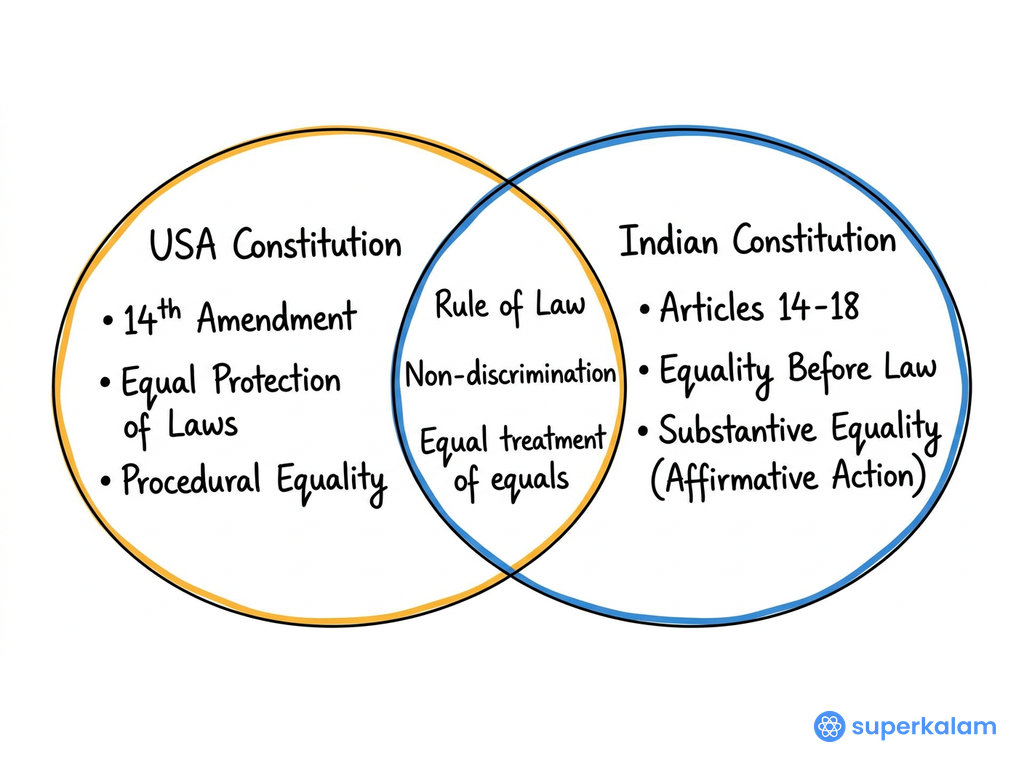
USA Constitution and the 14th Amendment
Constitutional Framework of Equality
US Constitution:
- Emphasizes equality through the 14th Amendment's Equal Protection Clause (1868)
- Follows negative equality approach - prohibiting state discrimination
- Uses three-tier scrutiny system: strict scrutiny for race/religion, intermediate for gender, rational basis for economic classifications
- Recent Students for Fair Admissions v. Harvard (2023) ended race-based affirmative action in college admissions
- Focuses primarily on procedural equality and equal treatment under law
Indian Constitution:
- Comprehensive equality framework through Articles 14-18
- Adopts both negative and positive equality principles
- Article 14: Right to equality before law and equal protection of laws
- Article 15(4) and 16(4): Enable special provisions for socially disadvantaged groups
- Recent Dr. Jaishri Laxmanrao Patil v. Chief Minister (2024) reaffirmed reasonable classification doctrine
Approach to Affirmative Action
| Aspect | USA | India |
|---|---|---|
| Philosophy | Color-blind constitution | Compensatory discrimination |
| Scope | Limited race/gender preferences | Comprehensive reservation system |
| Coverage | Education, employment (limited) | Education, employment, politics |
| Duration | Time-bound programs | Ongoing with periodic review |
Distinctive Features
Substantive vs. Formal Equality:
- USA: Emphasizes formal equality - same treatment for all
- India: Pursues substantive equality - unequal treatment to achieve equal outcomes
- Indian approach includes economic reservations through 103rd Amendment (2019)
- US focuses on individual merit while India considers group disadvantage
Social Context Integration:
- India's Constitution explicitly recognizes caste-based discrimination and untouchability
- USA's approach evolved from addressing racial segregation to broader civil rights
- India's Article 17 abolishes untouchability - unique provision absent in US Constitution
Both constitutions demonstrate evolving interpretations of equality. While the USA emphasizes individual rights and color-blind justice, India's approach balances formal equality with affirmative measures through initiatives like the Rights of Persons with Disabilities Act and ongoing reservation policies to achieve true social justice.
Answer Length
Model answers may exceed the word limit for better clarity and depth. Use them as a guide, but always frame your final answer within the exam’s prescribed limit.
Evaluate this PYQ now
Write your answer & evaluate in just 60 seconds




500+ students evaluated
Model Answers from
- 2021International Relations15 MarksView Answer
The newly tri-nation partnership AUKUS is aimed at countering China’s ambitions in the Indo-Pacific region. Is it going to supersede the existing partnerships in the region? Discuss the strength and impact of AUKUS in the present scenario.
- 2021International Relations15 MarksView Answer
Critically examine the aims and objectives of SCO. What importance does it hold for India?
- 2021International Relations10 MarksView Answer
“The USA is facing an existential threat in the form of China, that is much more challenging than the erstwhile Soviet Union.” Explain.
- 2021International Relations10 MarksView Answer
“If the last few decades were Asia's growth story, the next few are expected to be Africa's.” In the light of this statement, examine India’s influence in Africa in recent years.
Model Answers by Subject


Crack UPSC with your
Personal AI Mentor
An AI-powered ecosystem to learn, practice, and evaluate with discipline