The significance of the Gandhian movements lay in the masses they mobilized. Elucidate.
The significance of the Gandhian movements lay in the masses they mobilized. Elucidate.
The Gandhian Era (1917-1947) transformed the Indian National Movement from an elite constitutional struggle into a Mass Movement (Jan Andolan) by integrating diverse socio-economic groups through Satyagraha and Ahimsa.
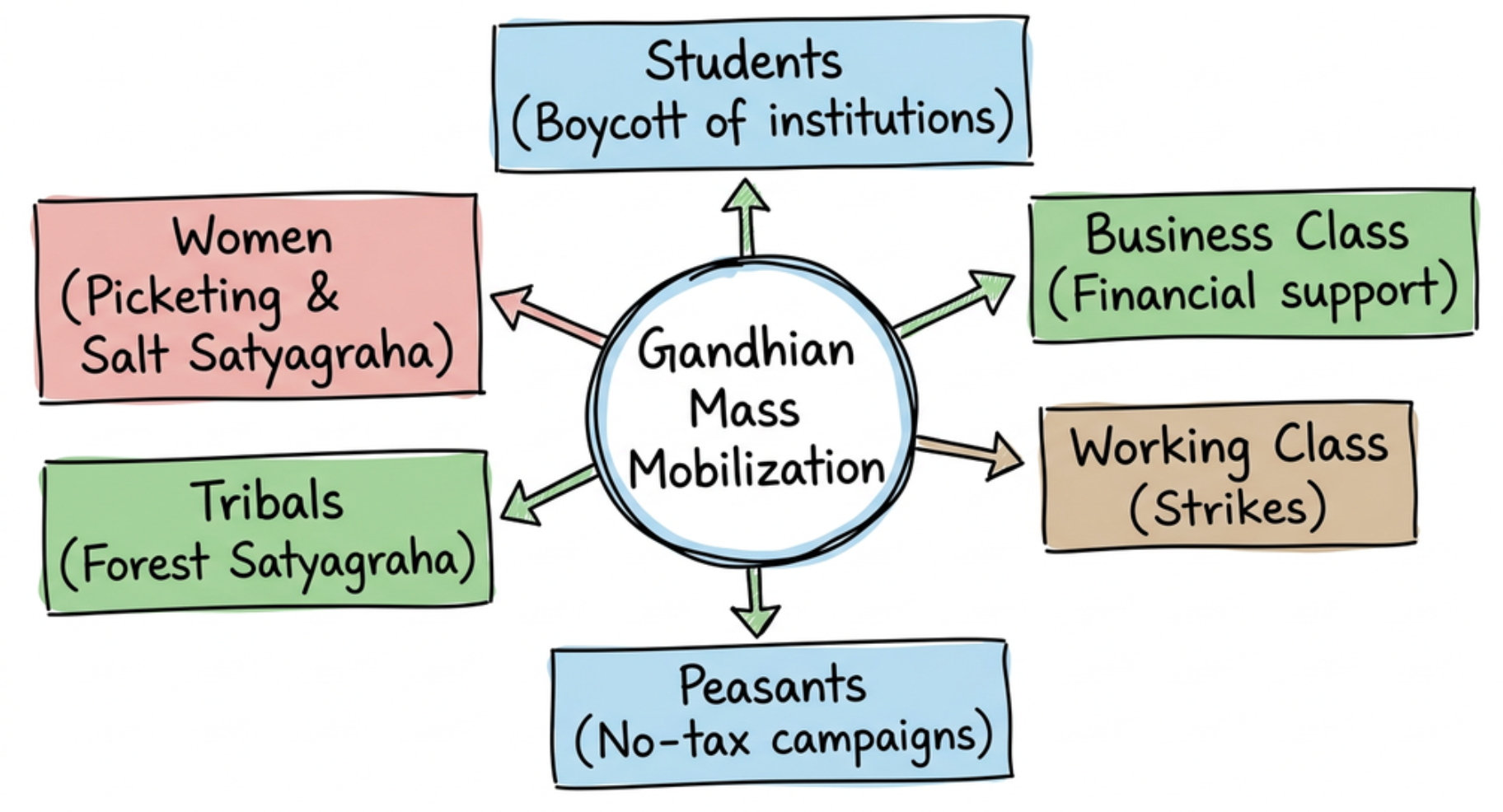
Gandhian Mass Mobilization Across Diverse Social Groups
Nature of Mass Mobilization
-
Peasantry Integration: Addressed agrarian distress, shifting the focus from urban councils to rural hinterlands.
- Eg: Champaran (1917) and Kheda Satyagraha (1918).
-
Women’s Participation: Mobilized women in the public sphere for picketing and salt manufacturing.
- Eg: Sarojini Naidu leading the Dharasana Salt Works protest.
-
Working Class Support: Linked industrial grievances with nationalistic goals.
- Eg: Ahmedabad Mill Strike (1918) using hunger strikes as a tool.
-
Youth and Students: Encouraged boycotts of colonial educational institutions.
- Eg: Thousands leaving government colleges during the Non-Cooperation Movement (NCM).
Significance of Mass Mobilization
-
Psychological Empowerment: Replaced colonial fear with self-reliance and Abhaya (fearlessness).
- Eg: Open defiance of laws during the Civil Disobedience Movement.
-
Structural Transformation: Converted the Congress into a tiered, mass-based political organization.
- Eg: Formation of Provincial Congress Committees based on linguistic lines.
-
Social Reform Linkage: Combined political freedom with the eradication of social evils.
- Eg: Formation of Harijan Sevak Sangh for the upliftment of Dalits.
-
Communal Unity: Attempted to bridge religious divides through common political platforms.
- Eg: Integration of the Khilafat issue with the NCM (1920).
-
Economic Self-Reliance: Promoted indigenous industry to erode the British economic base.
- Eg: The Khadi movement and boycott of foreign cloth.
-
Global Moral Pressure: Large-scale non-violent mobilization delegitimized British moral authority internationally.
- Eg: Global media coverage of the Dandi March (1930).
This mass mobilization fostered a democratic consciousness and a sense of "Indianness," providing the necessary social capital for the successful adoption of Universal Adult Franchise in the Indian Constitution.
Answer Length
Model answers may exceed the word limit for better clarity and depth. Use them as a guide, but always frame your final answer within the exam’s prescribed limit.
Evaluate this PYQ now
Write your answer & evaluate in just 60 seconds




500+ students evaluated
Model Answers by Subject


Crack UPSC with your
Personal AI Mentor
An AI-powered ecosystem to learn, practice, and evaluate with discipline



