What are the major teachings of Mahavir? Explain their relevance in the contemporary world.
What are the major teachings of Mahavir? Explain their relevance in the contemporary world.
Lord Mahavir, the 24th Tirthankara of Jainism (6th century BCE), was a contemporary of the Buddha and a pivotal figure in Indian philosophical thought.
His teachings form the foundation of Jain ethics, centered on non-violence, self-restraint, and truth. Though ancient, these principles remain profoundly relevant in today’s complex, conflict-ridden world.
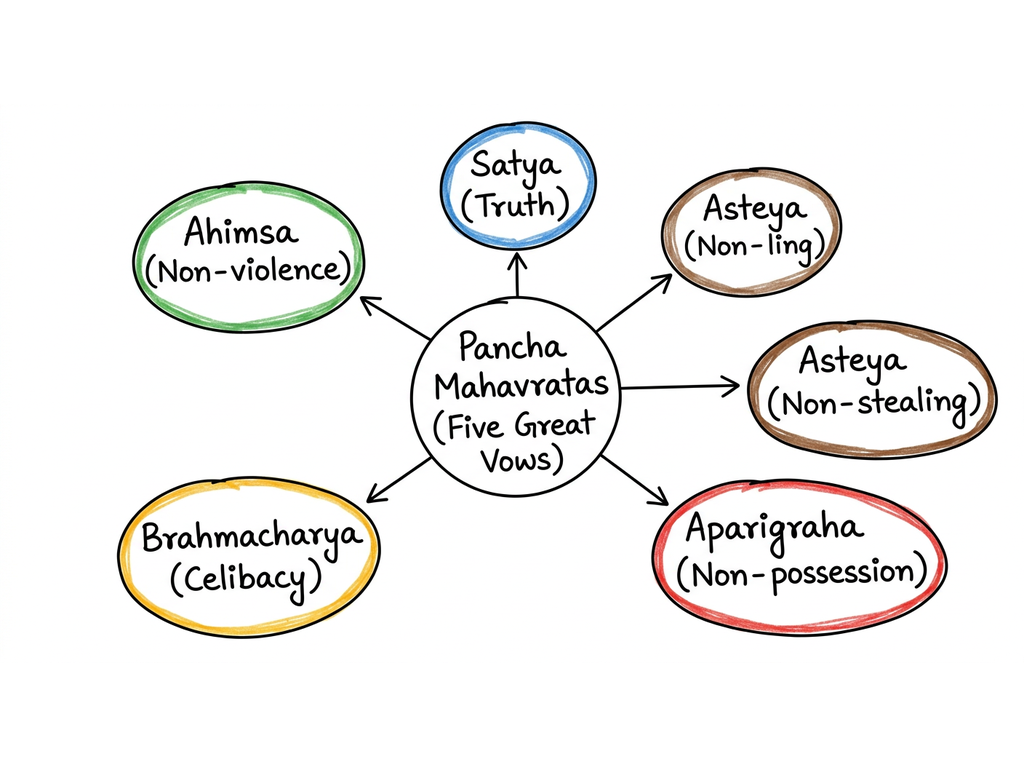
Pancha Mahavratas The Five Great Vows
Major Teachings of Mahavir
-
Ahimsa (Non-violence): Complete abstinence from harming any living being through thought, word, or action, extending beyond physical violence to mental and emotional harm.
-
Satya (Truthfulness): Speaking and living truth while ensuring it doesn't harm others, emphasizing anekantavada (multiple perspectives) to understand reality comprehensively.
-
Asteya (Non-stealing): Refraining from taking what is not given, including misuse of resources, time, or trust in personal and professional relationships.
-
Brahmacharya (Celibacy/Chastity): Controlling desires and maintaining purity in relationships, promoting self-discipline and spiritual focus.
-
Aparigraha (Non-attachment): Limiting material possessions and avoiding excessive accumulation, emphasizing contentment and simple living.
-
Anekantavada (Multiplicity of Views): Recognizing multiple perspectives on truth, promoting tolerance and understanding different viewpoints without dogmatism.
Relevance in Contemporary World
-
Environmental Conservation: Aparigraha principles directly support sustainable development goals. Ahimsa promotes biodiversity conservation and climate action by abstinence from harming all forms of life.
-
Corporate Ethics: Aparigraha teachings guide Corporate Social Responsibility (CSR) initiatives, encouraging businesses to balance profit with social welfare and environmental protection.
-
Conflict Resolution: Anekantavada provides framework for diplomatic negotiations and restorative justice systems, as demonstrated in Truth and Reconciliation Commissions.
-
Administrative Integrity: Satya and Asteya principles guide civil servants like Ashok Khemka in maintaining transparency and preventing corruption in governance.
-
Digital Ethics: Ahimsa extends to preventing cyberbullying and promoting responsible social media usage, while Satya combats misinformation and fake news.
-
Global Peace: Non-violence philosophy influences international peacekeeping efforts and Gandhi's Satyagraha movements, inspiring modern civil rights activism worldwide.
Mahavir's teachings offer practical ethical frameworks for addressing contemporary challenges from climate change to social justice, providing timeless wisdom for building a more compassionate and sustainable society.
Answer Length
Model answers may exceed the word limit for better clarity and depth. Use them as a guide, but always frame your final answer within the exam’s prescribed limit.
Evaluate this PYQ now
Write your answer & evaluate in just 60 seconds




500+ students evaluated
Model Answers from
- 2025Ethics: Theory10 MarksView Answer
India is an emerging economic power of the world as it has recently secured the status of fourth largest economy of the world as per IMF projection. However, it has been observed that in some sectors, allocated funds remain either under-utilised or misutilised. What specific measures would you recommend for ensuring accountability in this regard to stop leakages and gaining the status of third largest economy of the world in near future?
- 2025Ethics: Theory10 MarksView Answer
It is said that for an ethical work culture, there must be code of ethics in place in every organisation. To ensure value-based and compliance-based work culture, what suitable measures would you adopt in your work place?
- 2025Ethics: Theory10 MarksView Answer
To achieve holistic development goal, a civil servant acts as an enabler and active facilitator of growth rather than a regulator. What specific measures will you suggest to achieve this goal?
- 2025Ethics: Theory10 MarksView Answer
"One who is devoted to one's duty attains highest perfection in life." Analyse this statement with reference to sense of responsibility and personal fulfilment as a civil servant.
- 2025Ethics: Theory10 MarksView Answer
"For any kind of social re-engineering by successfully implementing welfare schemes, a civil servant must use reason and critical thinking in an ethical framework." Justify this statement with suitable examples.
- 2025Ethics: Theory10 MarksView Answer
Given below is the quotation of a great thinker. What does this quotations convey to you in the present context?
"The strength of a society is not in its laws, but in the morality of its people." – Swami Vivekananda
Model Answers by Subject


Crack UPSC with your
Personal AI Mentor
An AI-powered ecosystem to learn, practice, and evaluate with discipline



