Poverty and malnutrition create a vicious cycle, adversely affecting human capital formation. What steps can be taken to break the cycle?
Poverty and malnutrition create a vicious cycle, adversely affecting human capital formation. What steps can be taken to break the cycle?
Subject: Social Justice
The The State of Food Security and Nutrition in the World (SOFI) Report 2024 shows 55.6% of Indians cannot afford a healthy diet. This fuels a vicious cycle with poverty, heavily impeding human capital formation.
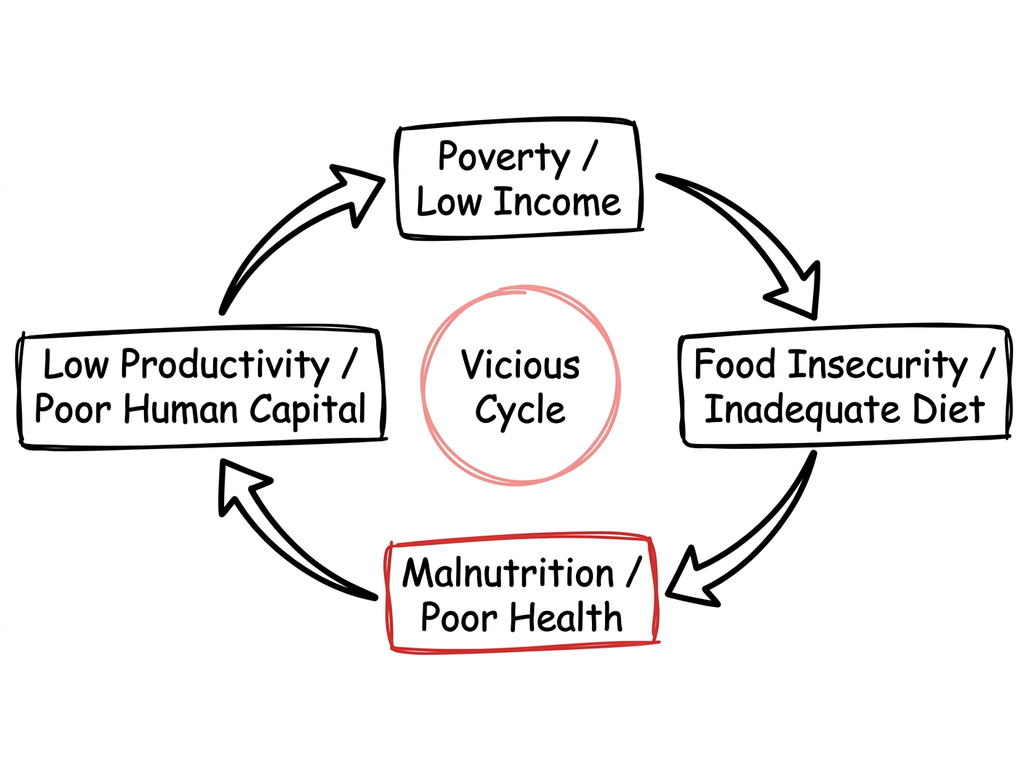
Poverty: the Cycle of Malnutrition and Insecurity
Impact of the Vicious Cycle on Human Capital
- Cognitive impairment: Malnutrition in the first 1000 days restricts brain development, leading to poor learning outcomes and lower employability for poor children.
- Intergenerational trap: Poor, undernourished mothers face higher maternal mortality and give birth to low-birth-weight infants, perpetuating generational poverty.
- Macroeconomic productivity loss: An unhealthy workforce reduces national GDP; effectively averting malnutrition can save 16.6 million DALYs and ₹49,800 crore annually.
- Health expenditure drain: Frequent illnesses stemming from poor immunity force vulnerable households into high out-of-pocket health expenditures, deepening their destitution.
Steps to Break the Poverty-Malnutrition Cycle
- Shift to nutritional security: Scale up the Fortified Rice Initiative (extended till 2028) across PMGKAY and ICDS to deliver iron and Vitamin B12 directly to the poorest.
- Institutionalizing safety nets: Implement the Supreme Court’s 2024 directive (Anun Dhawan v. Union of India) to establish state-funded Community Kitchens, fulfilling the Article 21 Right to Food.
- Supply chain modernization: Capitalize on 100% digitized ration cards and ePoS devices at Fair Price Shops to eliminate NFSA leakages and execute One Nation One Ration Card seamlessly.
- Unorganized sector inclusion: Expedite Supreme Court-mandated e-Shram portal registrations so migrant workers receive portable ration benefits regardless of documentation gaps.
- Health-nutrition convergence: Integrate nutrition schemes directly with the National Health Mission (NHM) to holistically treat disease-induced malnutrition and improve WASH parameters.
- Targeting gender parity: Counter the "eat last and least" norm by expanding PM Matru Vandana Yojana cash transfers for pregnant women and adolescent girls.
- Livelihood generation: Expand DAY-NRLM Self-Help Groups to increase household purchasing power, enabling families to afford diverse diets beyond PDS staples.
As the NITI Aayog National MPI Review notes, 13.5 crore Indians have recently escaped multidimensional poverty. Sustaining this momentum through targeted nutritional interventions is vital to leverage India's demographic dividend and meet SDG Target 2.2 by 2030.
Answer Length
Model answers may exceed the word limit for better clarity and depth. Use them as a guide, but always frame your final answer within the exam’s prescribed limit.
Evaluate this PYQ now
Write your answer & evaluate in just 60 seconds




500+ students evaluated
Model Answers from
Model Answers by Subject


Crack UPSC with your
Personal AI Mentor
An AI-powered ecosystem to learn, practice, and evaluate with discipline



