Explain and distinguish between Lok Adalats and Arbitration Tribunals. Whether they entertain civil as well as criminal cases?
Explain and distinguish between Lok Adalats and Arbitration Tribunals. Whether they entertain civil as well as criminal cases?
Subject: Indian Polity
Alternative Dispute Resolution (ADR) mechanisms operationalize Article 39A (equal justice and free legal aid). Their effectiveness is evident as National Lok Adalats disposed of a staggering 14.84 crore cases in 2025-26, drastically reducing judicial pendency.
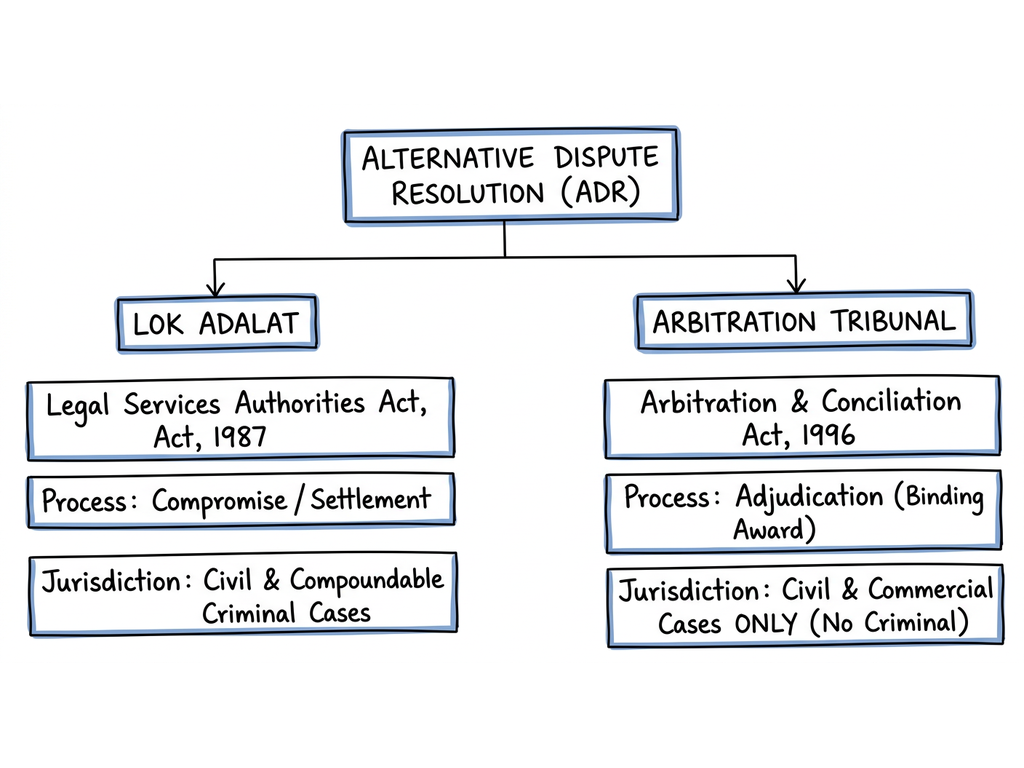
Alternative Dispute Resolution
Explaining and Distinguishing Lok Adalats and Arbitration Tribunals
- Statutory Basis: Lok Adalats are statutory bodies under the Legal Services Authorities (LSA) Act, 1987, whereas Arbitration Tribunals are governed by the Arbitration and Conciliation Act, 1996.
- Nature of Process: Lok Adalats rely on conciliation and amicable compromise, while arbitration is a quasi-judicial process where an arbitrator delivers a binding adjudicatory decision.
- Composition: A Lok Adalat bench comprises a judicial officer and social workers, whereas an Arbitral Tribunal consists of private experts mutually appointed by the disputing parties.
- Cost Dynamics: Lok Adalats charge zero court fees, serving the marginalized, whereas arbitration involves substantial professional fees, primarily serving commercial entities.
- Finality of Award: A Lok Adalat award is final and unappealable (equal to a civil court decree), while an arbitral award can be challenged in court under limited grounds (Section 34).
- Institutional Evolution: The Draft Arbitration Bill 2024 (based on the Dr. T.K. Viswanathan Committee) seeks to modernize arbitration with statutory timelines, whereas Lok Adalats are being modernized via NALSA's digital integration for pre-litigation.
Jurisdiction over Civil and Criminal Cases
- Civil Cases in Lok Adalats: They actively entertain widespread civil disputes, including matrimonial issues, land acquisition, and motor accident claims.
- Criminal Cases in Lok Adalats: Under Section 19(5) of the LSA Act, they can entertain only compoundable criminal offenses (like Section 138 Negotiable Instruments Act or traffic challans) and cannot hear non-compoundable crimes.
- Civil Cases in Arbitration: Arbitral tribunals exclusively handle civil, commercial, and contractual disputes, forming the backbone of India's "Ease of Doing Business" framework.
- Criminal Cases in Arbitration: Arbitration tribunals are strictly barred from entertaining criminal cases, as crimes are public wrongs (rights in rem) subject to sovereign prosecution.
Strengthening these mechanisms through seamless digital integration and the National Judicial Data Grid (NJDG) will ensure equitable justice at the grassroots while establishing India as a robust global arbitration hub.
Answer Length
Model answers may exceed the word limit for better clarity and depth. Use them as a guide, but always frame your final answer within the exam’s prescribed limit.
Evaluate this PYQ now
Write your answer & evaluate in just 60 seconds




500+ students evaluated
Model Answers from
- 2024Indian Polity15 MarksView Answer
Discuss India as a secular state and compare it with the secular principles of the US constitution.
- 2024Indian Polity15 MarksView Answer
Explain the reasons for the growth of PILs in India. As a result of it, has the India supreme court emerged as the most powerful judiciary?
- 2024Indian Polity15 MarksView Answer
What changes has the union government recently introduced in the domain of center- state relations ? Suggest measures to be adopted to build the trust between the center and the states and for strengthening federalism.
- 2024Indian Polity15 MarksView Answer
Right to privacy is intrinsic to life and personal liberty and is inherently protected under Article 21 of the constitution. Explain. In this reference discuss the law relating to D.N.A. testing of a child in the womb to establish its paternity.
- 2024Indian Polity10 MarksView Answer
Analyze the role of local bodies in providing good governance at local level and bring out the pros and cons of merging the rural local bodies with the urban local bodies.
- 2024Indian Polity10 MarksView Answer
"The duty of the Comptroller and Auditor General is not merely to ensure the legality of expenditure but also its propriety." Comment.
Model Answers by Subject


Crack UPSC with your
Personal AI Mentor
An AI-powered ecosystem to learn, practice, and evaluate with discipline