Wisdom lies in knowing what to reckon with and what to overlook. An officer being engrossed with the periphery, ignoring the core issues before him, is no rare in the bureaucracy. Do you agree that such preoccupation of an administrator leads to travesty of justice to the cause of effective service delivery and good governance? Critically evaluate.
Wisdom lies in knowing what to reckon with and what to overlook. An officer being engrossed with the periphery, ignoring the core issues before him, is no rare in the bureaucracy. Do you agree that such preoccupation of an administrator leads to travesty of justice to the cause of effective service delivery and good governance? Critically evaluate.
Wisdom, particularly in governance, lies not just in knowledge but in discernment—the ability to focus on what truly matters. Bureaucrats often find themselves engaged in procedural, cosmetic, or symbolic tasks, neglecting structural or core issues that affect the common citizen. Such misplaced priorities can have grave consequences for justice, service delivery, and governance outcomes.
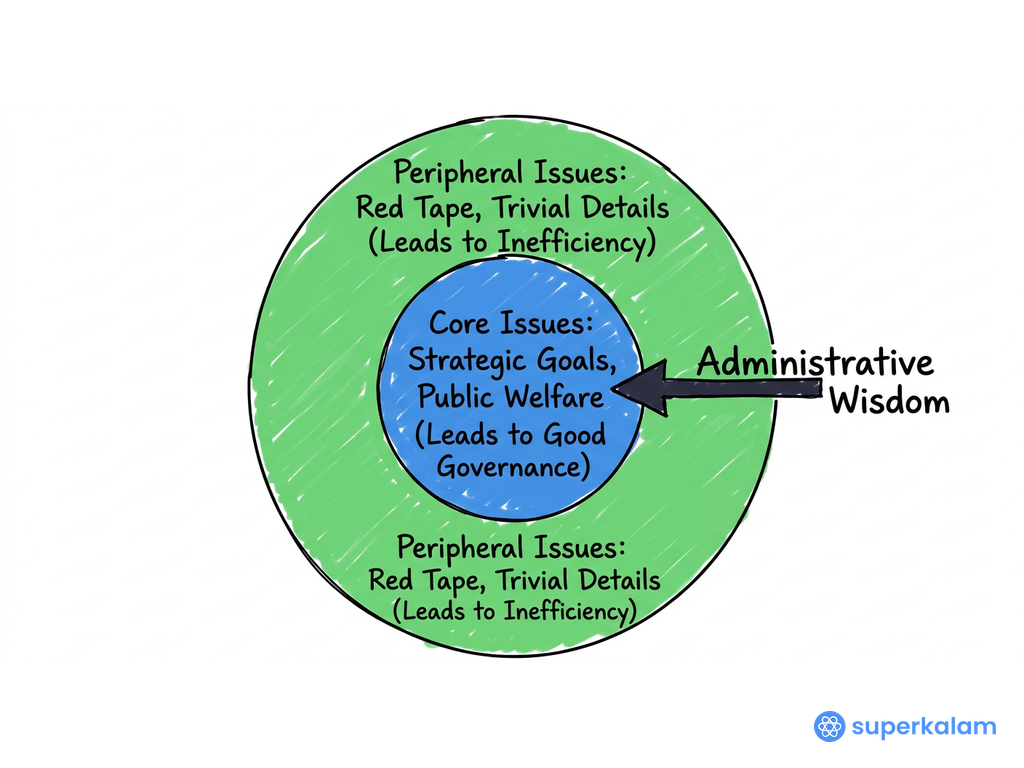
Core Issues Strategic Target Diagram Layers
Preoccupation with Peripheral Issues Undermines Governance
-
Dilution of Purpose and Policy Intent: The true spirit of a welfare scheme is compromised when energy is spent on superficial compliance or excessive paperwork.
Example: In Swachh Bharat Mission, overemphasis on building toilets without addressing behavioural change led to poor usage rates in some areas.
-
Citizen Disempowerment and Distrust: Citizens expect resolution of their core concerns (pensions, healthcare, education). Failure to deliver, while engaging in ceremonial tasks, alienates them.
Example: Delays in scholarship disbursal due to administrative layering erode faith in the education system.
-
Opportunity Cost of Administrative Time: Time spent on status reports, inspections, and VIP duties comes at the cost of field visits, grievance redressal, or disaster response.
Example: In rural districts, officers may spend disproportionate time on preparing for ministerial visits while ignoring developmental backlogs.
-
Prioritization of Optics over Outcomes: Schemes may be declared successful based on input metrics (number of forms filled, meetings held) rather than actual public benefit.
Example: Project deadlines met by compromising on quality (as seen in flyover collapses or infrastructure failures) like serial bridge collapses in Bihar.
-
Ethical Negligence: Such neglect of core responsibilities violates the ethical duty of care and public accountability vested in administrators.
-
Misdirected efforts: The focus on organizing elaborate events instead of addressing sanitation issues in a district diverts resources from essential services.
Example: Funds allocated for a Swachh Bharat Abhiyan awareness campaign were used for a celebrity appearance instead of procuring cleaning equipment.
-
Delayed projects: Obsessive attention to file work and bureaucratic procedures delays crucial infrastructure projects.
Example: The prolonged land acquisition process for the Mumbai-Ahmedabad High-Speed Rail project due to bureaucratic hurdles delayed its implementation.
Procedures and Peripheral Tasks Have Their Role
-
Due Process Ensures Rule of Law: Ignoring checks and balances in the name of efficiency can lead to arbitrary or illegal decisions, especially in land acquisition, environment, or public contracts.
Example: In the Vedanta mining case (Odisha), bypassing due environmental procedures led to public uproar and legal setbacks.
-
Peripheral Issues May Become Core in Context: In disaster management or public health, minute logistical issues (e.g., oxygen cylinder supply) are technically peripheral but become core in crisis.
Example: COVID-19 frontline officers had to manage bed availability, PPE supply, ambulance tracking—seemingly minor, yet life-saving.
-
Symbolism Matters in Public Administration: Ceremonial presence, community meetings, flag hoisting, or listening circles help build trust and public visibility of administration.
Example: Night inspections by officers have reduced absenteeism in schools and hospitals in many states.
-
Need for Holistic View: Governance involves multi-dimensional issues, and administrators must be able to zoom in and out appropriately.
The inability of an officer to focus on core issues can seriously undermine justice, equity, and efficiency. Public administration is not merely about managing events or producing reports, but about understanding people’s pain points and acting decisively to resolve them. True administrative wisdom lies in balancing the letter and spirit of governance. An ethical, effective public servant discerns what to act on and what to ignore—for the citizen is always at the core.
Answer Length
Model answers may exceed the word limit for better clarity and depth. Use them as a guide, but always frame your final answer within the exam’s prescribed limit.
Evaluate this PYQ now
Write your answer & evaluate in just 60 seconds




500+ students evaluated
Model Answers from
- 2022Ethics: Theory10 MarksView Answer
In contemporary world, corporate sector’s contribution in generating wealth and employment is increasing. In doing so, they are bringing in unprecedented onslaught on the climate, environmental sustainability and living conditions of human beings. In this background, do you Responsibility (CSR) is efficient and sufficient enough to fulfill the social roles and responsibilities needed in the corporate work mandated? Critically examine.
- 2022Ethics: Theory10 MarksView Answer
Whistle blower, who reports corruption and illegal activities, wrongdoing and misconduct to the concerned authorities, runs the risk of being exposed to grave danger, physical harm and victimization by the vested interests, accused persons and his team. What policy measures would you suggest to strengthen protection mechanism to safeguard the whistle blower?
- 2022Ethics: Theory10 MarksView Answer
Write short notes on the following in 30 words each :
(i) Constitutional morality
(ii) Conflict of interest
(iii) Probity in public life
(iv) Challenges of digitalization
(v) Devotion to duty - 2022Ethics: Theory10 MarksView Answer
The Russia and Ukraine war has been going on for the last seven months. Different countries have taken independent stands and actions keeping in view their own national interests. We are all aware that war has its own impact on the different aspects of society, including human tragedy. What are those ethical issues that are crucial to be considered while launching the war and its continuation so far? Illustrate with justification the ethical issues involved in the given state of affair.
- 2022Ethics: Theory10 MarksView Answer
Online methodology is being used for day-to-day meetings, institutional approvals in the administration and for teaching and learning in education sector to the extent telemedicine in the health sector is getting popular with the approvals of the competent authority. No doubt it has advantages and disadvantages for both the beneficiaries and system at large. Describe and discuss the ethical issues involved in the use of online method particularly to
vulnerable section of society. - 2022Ethics: Theory10 MarksView Answer
What do you understand by term ‘good governance’? How far recent initiatives in terms of e-Governance steps taken by the State have helped the beneficiaries? Discuss with suitable examples.
Model Answers by Subject


Crack UPSC with your
Personal AI Mentor
An AI-powered ecosystem to learn, practice, and evaluate with discipline



