It is believed that adherence to ethics in human actions would ensure in smooth functioning of an organization/system. If so, what does ethics seek to promote in human life? How do ethical values assist in the resolution of conflicts faced by him in his day-to-day functioning?
It is believed that adherence to ethics in human actions would ensure in smooth functioning of an organization/system. If so, what does ethics seek to promote in human life? How do ethical values assist in the resolution of conflicts faced by him in his day-to-day functioning?
Ethics refers to a set of moral principles that guide human behavior towards what is right, fair, and just. In both personal and professional spheres, ethics ensures that individuals act responsibly, fostering trust and harmony in society. In organizations, adherence to ethics promotes credibility, transparency, and effectiveness.
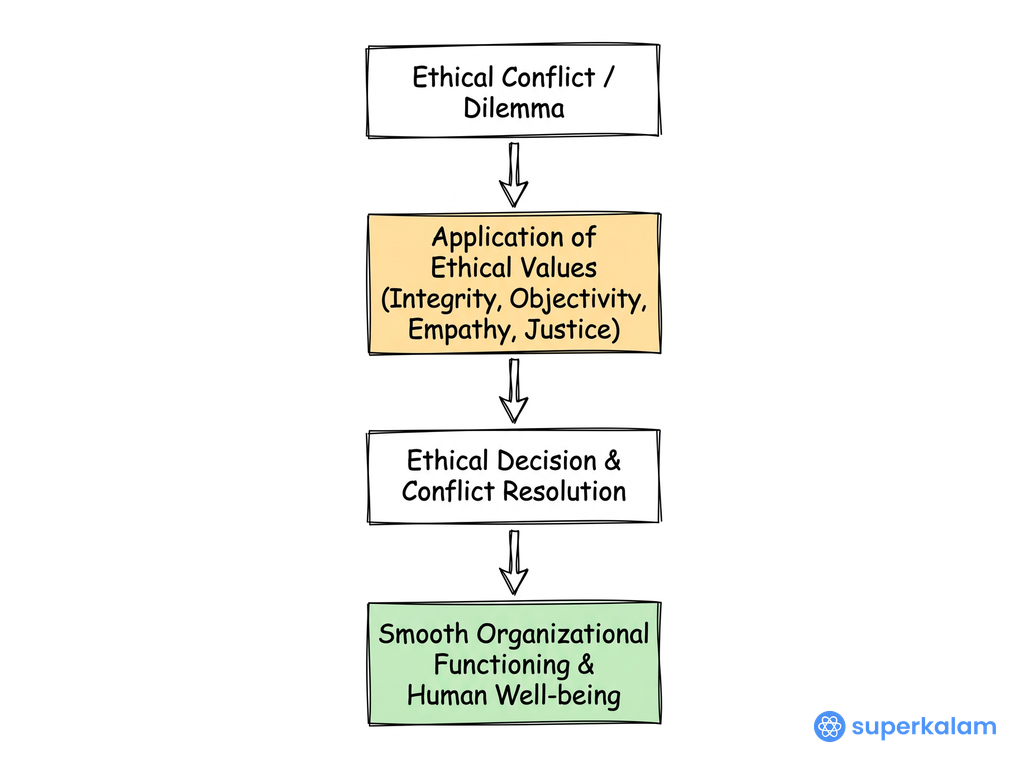
Ethical Conflict Resolution Process Flowchart
What Does Ethics Seek to Promote in Human Life?
-
Integrity and Self-Respect: Ethical conduct reinforces an individual’s inner integrity, aligning actions with personal values.
Example: E. Sreedharan, the “Metro Man of India,” maintained integrity throughout large infrastructure projects like Delhi Metro, avoiding cost overruns and corruption.
-
Justice and Fairness: Ethics ensures people act fairly, respecting the rights of others.
Example: The Supreme Court’s verdict in the Vishaka vs. State of Rajasthan (1997) laid ethical and legal guidelines for sexual harassment at workplaces, ensuring justice for women.
-
Social Cohesion and Harmony: Ethical behavior promotes mutual respect and peaceful coexistence.
Example: T.N. Seshan, former Chief Election Commissioner, enforced electoral ethics, contributing to fairer elections and reducing political polarization.
-
Trust in Institutions: Consistent ethical behavior by officials enhances public faith in governance.
Example: The Right to Information Act, 2005 promotes transparency and accountability, empowering citizens and making institutions more trustworthy.
-
Empathy and Compassion: Ethics nurtures concern for others, especially the marginalized.
Example: Armstrong Pame, an IAS officer, built a 100-km road in Manipur without government funds, mobilizing communities—reflecting compassionate leadership.
-
Sustainability and Responsibility: Ethics demands responsible use of resources and care for future generations.
Example: The Chipko Movement led by villagers in Uttarakhand, especially women, exemplified grassroots ethical resistance to deforestation for long-term ecological balance.
Role of Ethical Values in the Resolution of Day-to-Day Conflicts
-
Guiding Decision-Making in Dilemmas: Ethical values provide a moral compass during conflicting situations.
Example: Ashok Khemka, IAS officer, repeatedly transferred for canceling illegal land deals, chose ethical duty over personal comfort.
-
Reducing Bias and Ensuring Fairness: Ethics discourages favoritism and upholds impartiality.
Example: Election Commission’s neutrality in disqualifying candidates violating the Model Code of Conduct enhances public confidence in democratic processes.
-
Building Trust in Public Service: Ethical conduct builds credibility in officials’ actions and words.
Example: Narendra Modi government’s adoption of Aadhaar-enabled DBT (Direct Benefit Transfer) curbed leakages in welfare schemes like LPG subsidy and MNREGA.
-
Promoting Reconciliation Over Retaliation: Ethics enables dialogue and compromise instead of escalation.
Example: The Truth and Reconciliation Commission in South Africa, led by Desmond Tutu, promoted healing post-apartheid without vengeful justice.
-
Strengthening Teamwork and Leadership: Ethical leaders earn the trust and cooperation of subordinates.
Example: Vinod Rai, former CAG, maintained objectivity during the audit of the 2G spectrum allocation, sparking reform in public financial accountability.
-
Boosting Emotional Resilience and Role-Modelling: Ethical grounding prevents emotional burnout in high-pressure situations.
Example: Anand Kumar, founder of Super 30, despite poverty and adversity, continued to educate underprivileged children free of cost—demonstrating ethical conviction and resilience.
Ethics is more than an abstract virtue—it is a guiding force for justice, harmony, and human dignity. For civil servants and citizens alike, it offers not just direction in complex situations, but also safeguards individual and institutional integrity. Real-life examples demonstrate that ethical action, though challenging, leads to lasting impact and societal progress.
Answer Length
Model answers may exceed the word limit for better clarity and depth. Use them as a guide, but always frame your final answer within the exam’s prescribed limit.
Evaluate this PYQ now
Write your answer & evaluate in just 60 seconds




500+ students evaluated
Model Answers from
- 2022Ethics: Theory10 MarksView Answer
In contemporary world, corporate sector’s contribution in generating wealth and employment is increasing. In doing so, they are bringing in unprecedented onslaught on the climate, environmental sustainability and living conditions of human beings. In this background, do you Responsibility (CSR) is efficient and sufficient enough to fulfill the social roles and responsibilities needed in the corporate work mandated? Critically examine.
- 2022Ethics: Theory10 MarksView Answer
Whistle blower, who reports corruption and illegal activities, wrongdoing and misconduct to the concerned authorities, runs the risk of being exposed to grave danger, physical harm and victimization by the vested interests, accused persons and his team. What policy measures would you suggest to strengthen protection mechanism to safeguard the whistle blower?
- 2022Ethics: Theory10 MarksView Answer
Write short notes on the following in 30 words each :
(i) Constitutional morality
(ii) Conflict of interest
(iii) Probity in public life
(iv) Challenges of digitalization
(v) Devotion to duty - 2022Ethics: Theory10 MarksView Answer
The Russia and Ukraine war has been going on for the last seven months. Different countries have taken independent stands and actions keeping in view their own national interests. We are all aware that war has its own impact on the different aspects of society, including human tragedy. What are those ethical issues that are crucial to be considered while launching the war and its continuation so far? Illustrate with justification the ethical issues involved in the given state of affair.
- 2022Ethics: Theory10 MarksView Answer
Online methodology is being used for day-to-day meetings, institutional approvals in the administration and for teaching and learning in education sector to the extent telemedicine in the health sector is getting popular with the approvals of the competent authority. No doubt it has advantages and disadvantages for both the beneficiaries and system at large. Describe and discuss the ethical issues involved in the use of online method particularly to
vulnerable section of society. - 2022Ethics: Theory10 MarksView Answer
What do you understand by term ‘good governance’? How far recent initiatives in terms of e-Governance steps taken by the State have helped the beneficiaries? Discuss with suitable examples.
Model Answers by Subject


Crack UPSC with your
Personal AI Mentor
An AI-powered ecosystem to learn, practice, and evaluate with discipline