How will 12U2 (India, Israel, UAE and USA) grouping transform India’s position in global politics?
How will 12U2 (India, Israel, UAE and USA) grouping transform India’s position in global politics?
The formation of the I2U2 grouping in July 2022 (also termed the “West Asian Quad”) brings together India, Israel, the UAE, and the USA. It is aimed at promoting joint investments in infrastructure, technology, food security, and clean energy. Unlike traditional security alliances, it is an issue-based, geo-economic platform. For India, this grouping enhances both its strategic depth and global positioning.
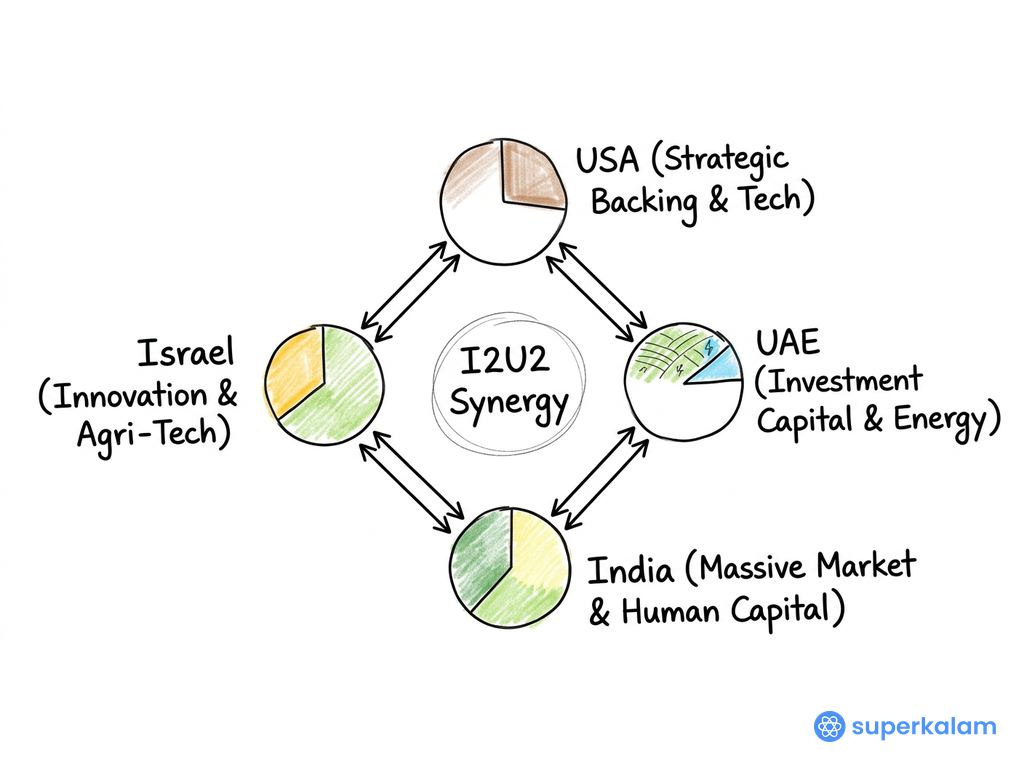
Interconnected Circular Nodes in Diamond Shape
Transformational Impact on India’s Position in Global Politics
-
Strategic Positioning in West Asia
-
India gains a stronger footprint in West Asia, a region critical for energy security (over 60% of India’s crude oil imports).
-
The grouping complements India’s deepening ties with UAE (Comprehensive Economic Partnership Agreement, 2022) and Israel (defence and agriculture cooperation).
-
It reduces India’s overdependence on traditional forums like OIC, where Pakistan often influences the agenda.
-
-
Boost to Food and Energy Security
-
First I2U2 project: $2 billion UAE investment in integrated food parks in India, with US and Israeli tech support.
-
Israel’s expertise in drip irrigation and agri-tech + US financing + UAE investment = enhanced India’s role as a regional agri-hub.
-
Helps India emerge as a “food basket” for West Asia and Africa, strengthening its global economic diplomacy.
-
-
Enhancing India’s Role as a Bridge between Global North & South
-
India, as part of I2U2, acts as a link between the developed West (USA, Israel) and the developing Global South (India, extended to Africa via UAE’s outreach).
-
Positions India as a mediator in issue-based coalitions, similar to its role in BRICS and Quad.
-
-
Synergy with Other Minilaterals
-
I2U2 complements India’s engagements in Quad (Indo-Pacific), BRICS, SCO, IBSA.
-
Unlike SAARC, which is often stalled by politics, I2U2 is functional and sector-specific.
-
Enhances India’s profile as a trusted partner in multiple coalitions, advancing its multi-alignment strategy.
-
-
Strengthening India–US Strategic Partnership
-
Provides another pillar to the Comprehensive Global Strategic Partnership with the USA.
-
Deepens India’s integration with US-led initiatives like Indo-Pacific Economic Framework (IPEF) and Clean Energy partnerships.
-
-
Countering China’s Influence
-
Offers an alternative model of development financing to China’s Belt and Road Initiative (BRI).
-
India can project itself as a responsible stakeholder offering transparent, sustainable projects in West Asia and Africa.
-
Enhances India’s role in shaping supply chains and critical technologies (renewables, green hydrogen).
-
-
Economic & Technological Gains
-
Access to US financing, Israeli innovation, and UAE capital creates a win-win for India.
-
Example: Collaboration on 6G research, renewable energy, space cooperation enhances India’s global tech profile.
-
-
Diplomatic Image Building
-
I2U2 was hailed by the US as the “Quad of West Asia”, giving India visibility as a global player beyond South Asia.
-
Adds to India’s image of being a “first responder” and a “developmental partner”, in sync with its G20 Presidency (2023) and Global South leadership.
-
Challenges and Limitations of I2U2
-
Regional volatility can stall projects
-
The Israel–Gaza war and Iran–Israel flare-ups have repeatedly disrupted West Asia’s connectivity agenda (shipping reroutes, risk premia in Red Sea).
-
Impact: Flagship I2U2 ideas—UAE’s ~$2 bn food parks in India and the ~300 MW hybrid renewable project in Gujarat — face execution risk if supply chains, capital flows or on-site collaboration are hit by conflict-driven restrictions.
-
-
Tightrope with Iran & strategic autonomy
-
I2U2 informally aligns India with a US–Israel–UAE axis, complicating ties with Iran (Chabahar port and energy access).
-
US secondary sanctions/ITAR rules can chill India’s tech, energy or shipping engagements with Tehran, narrowing room for classic multi-alignment.
-
-
No security pillar → limited deterrent value
-
I2U2 is geo-economic, not a security arrangement (unlike, say, AUKUS).
-
That caps India’s leverage in hard-security outcomes (sea-lane protection, missile/drone threats) that directly condition project delivery and energy prices.
-
-
Scale & financing gap vs. competing models
-
China’s BRI has mobilized $800bn–$1tn+ over a decade; I2U2’s pipeline so far is project-specific and modest, relying on private/DFI capital and complex PPPs.
-
Without a large, predictable finance window, India’s infrastructure brand in West Asia/Africa struggles to match BRI’s speed/scale.
-
-
Regulatory and export-control friction
-
US/Israeli export controls (ITAR, EAR) and stringent IP regimes can slow transfer in dual-use tech, drones, semiconductors, advanced agri-tech.
-
Add India’s data-localisation and procurement rules, and timelines stretch—undercutting the “quick-delivery” narrative.
-
-
Domestic political/economic sensitivities in partner states
-
Arab public opinion on Israel and domestic coalitions in Israel/US can buffet policy continuity; Emirati and Israeli risk appraisals may tighten during crises.
-
For India, 8–9 million Indian workers in GCC (remittances ~$40–50 bn/yr) make New Delhi cautious—over-identification with any bloc risks diaspora exposure.
-
-
Implementation frictions inside India
-
Land acquisition, state-level clearances, grid connectivity and logistics bottlenecks frequently delay renewables/food-park timelines.
-
Any slippage on ease of doing business at sub-national level weakens India’s value-proposition to I2U2 investors.
-
I2U2 represents a paradigm shift in India’s foreign policy—from being a regional player to a key stakeholder in shaping global economic and strategic frameworks. By integrating capital, technology, markets and talent, and finance/security guarantees (USA), I2U2 strengthens India’s global positioning as a bridge between the West and the Global South.
Answer Length
Model answers may exceed the word limit for better clarity and depth. Use them as a guide, but always frame your final answer within the exam’s prescribed limit.
Evaluate this PYQ now
Write your answer & evaluate in just 60 seconds




500+ students evaluated
Model Answers from
- 2022International Relations15 MarksView Answer
Clean energy is the order of the day.’ Describe briefly India’s changing policy towards climate change in various international fora in the context of geopolitics.
- 2022International Relations15 MarksView Answer
Critically examine the procedures through which the Presidents of India and France are elected.
- 2022International Relations10 MarksView Answer
Do you think that BIMSTEC is a parallel organisation like the SAARC ? What are the similarities and dissimilarities between the two ? How are Indian foreign policy objectives realized by forming this new organisation ?
- 2022International Relations10 MarksView Answer
India is an age-old friend of Sri Lanka.’ Discuss India’s role in the recent crisis in Sri Lanka in the light of the preceding statement.
Model Answers by Subject


Crack UPSC with your
Personal AI Mentor
An AI-powered ecosystem to learn, practice, and evaluate with discipline



