Briefly mention the alignment of major mountain ranges of the world and explain their impact on local weather conditions, with examples.
Briefly mention the alignment of major mountain ranges of the world and explain their impact on local weather conditions, with examples.
Recent climate studies show mountain ranges control over 60% of global precipitation patterns, making their alignment crucial for understanding weather systems worldwide.
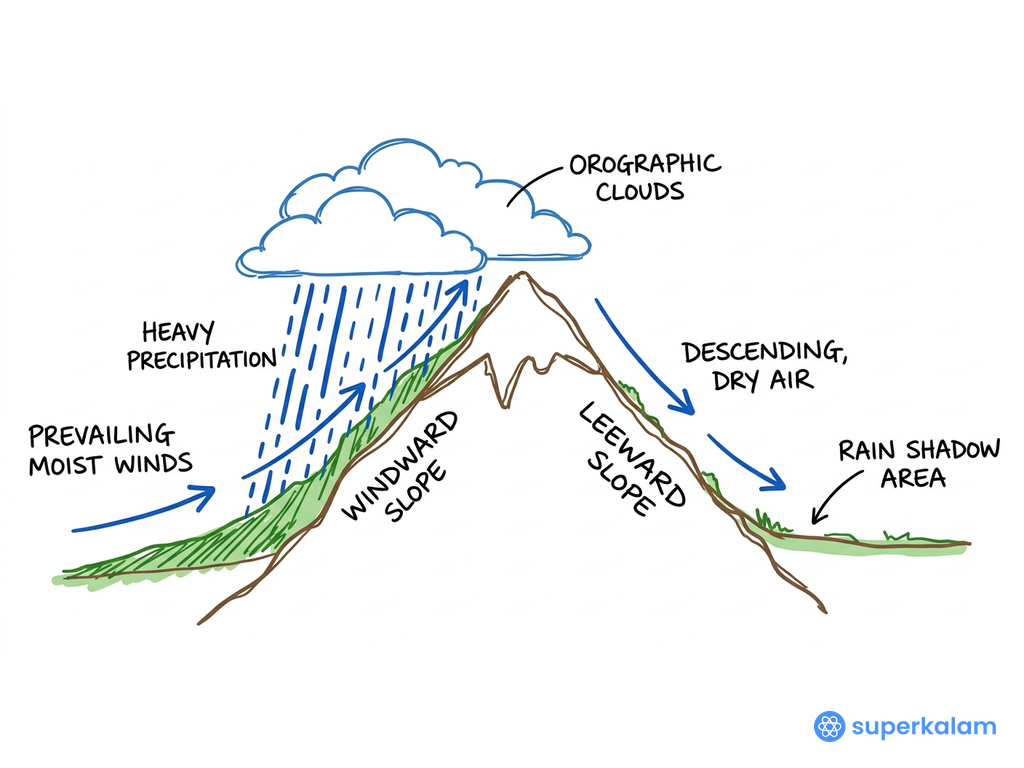
Orographic effect on a mountain cross section
Alignment of Major Mountain Ranges
East-West Aligned Ranges
- Himalayas: 2,400 km barrier from Pakistan to Myanmar, world's highest peaks
- Alps: European chain stretching 1,200 km across 8 countries
- Caucasus Mountains: 1,200 km between Black and Caspian Seas
- Atlas Mountains: 2,500 km across North Africa (Morocco to Tunisia)
- Kunlun Range: 3,000 km across Central Asia, separating Tibetan Plateau
North-South Aligned Ranges
- Andes: 7,000 km spine along South America's Pacific coast
- Rocky Mountains: 4,800 km from Canada to New Mexico
- Ural Mountains: 2,500 km dividing Europe and Asia
- Great Dividing Range: 3,500 km along Australia's eastern coast
- Western Ghats: 1,600 km parallel to India's west coast
Impact on Weather Conditions
| Weather Effect | Windward Side | Leeward Side | Example |
|---|---|---|---|
| Precipitation | Heavy rainfall (1,500-3,000mm) | Rain shadow (200-500mm) | Western Ghats vs Deccan Plateau |
| Temperature | Cooler, moderate | Warmer, extreme variations | Andes: Pacific vs Amazon sides |
| Humidity | High (80-90%) | Low (30-50%) | Rockies: Pacific Northwest vs Great Plains |
Specific Weather Phenomena
- Orographic Rainfall: Himalayas receive 2,500mm+ during monsoons, creating world's wettest regions like Cherrapunji
- Foehn Winds: Rocky Mountains create warm Chinook winds, raising temperatures by 20°C in hours
- Monsoon Blocking: East-west Himalayas trap monsoon moisture, preventing it from reaching Central Asia
- Desert Formation: Andes create Atacama Desert (0.1mm annual rainfall) through rain shadow effect
- Valley Winds: Daily thermal circulation in Alpine valleys affects local agriculture and settlement patterns
Mountain alignments fundamentally shape regional climates, with Climate Change intensifying these effects through altered precipitation patterns and extreme weather events.
Answer Length
Model answers may exceed the word limit for better clarity and depth. Use them as a guide, but always frame your final answer within the exam’s prescribed limit.
Evaluate this PYQ now
Write your answer & evaluate in just 60 seconds




500+ students evaluated
Model Answers from
- 2021Physical Geography15 MarksView Answer
Discuss the multi-dimensional implications of uneven distribution of mineral oil in the world
- 2021Physical Geography15 MarksView Answer
How do the melting of the Arctic ice and glaciers of the Antarctic differently affect the weather patterns and human activities on the earth?
- 2021Physical Geography10 MarksView Answer
Mention the global occurrence of volcanic eruptions in 2021 and their impact on regional environment
- 2021Physical Geography10 MarksView Answer
Despite India being one of the countries of Gondwanaland, its mining industry contributes much less to its Gross Domestic Product (GDP) in percentage. Discuss
Model Answers by Subject


Crack UPSC with your
Personal AI Mentor
An AI-powered ecosystem to learn, practice, and evaluate with discipline



