What does this quotation mean to you
“The best way to find yourself is to lose yourself in the service of others.” – Mahatma Gandhi
What does this quotation mean to you
“The best way to find yourself is to lose yourself in the service of others.” – Mahatma Gandhi
Gandhi's profound wisdom emphasizes self-realization through selfless service, reflecting the philosophical concept of seva where individual fulfillment emerges from dedicating oneself to collective welfare and societal betterment.
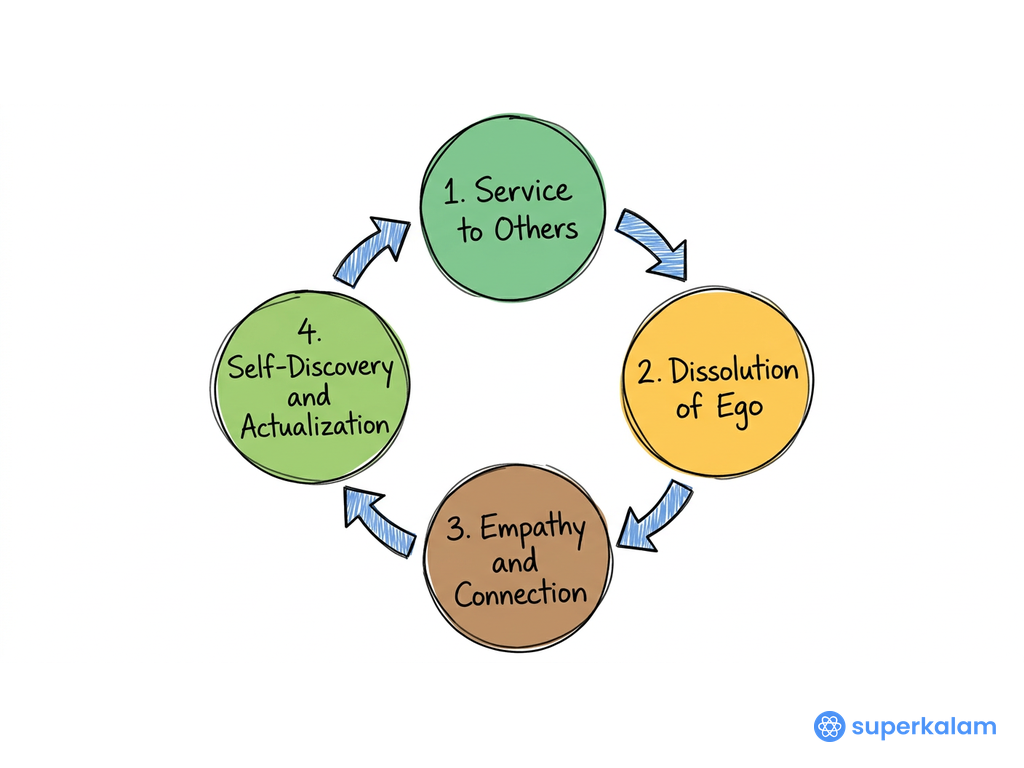
Four Step Circular Cycle Diagram
Meaning and Interpretation of Gandhi's Quote
• Transcendence of Ego: Service to others dissolves the boundaries of self-centeredness, enabling individuals to discover their authentic purpose beyond material pursuits, aligning with Kant's categorical imperative of treating humanity as an end.
• Dharmic Self-Discovery: The quote embodies Vedantic philosophy where atman (individual soul) realizes its connection with paramatman (universal soul) through nishkama karma (desireless action), as advocated in the Bhagavad Gita.
• Moral Development Through Practice: Aristotelian virtue ethics suggests that moral character develops through repeated virtuous actions, where service becomes the pathway to cultivating compassion, empathy, and righteousness.
• Utilitarian Fulfillment: Following Mill's greatest happiness principle, serving others creates broader societal welfare while simultaneously generating personal satisfaction and meaning, creating a virtuous cycle of well-being.
• Existential Purpose: Viktor Frankl's logotherapy demonstrates that meaning emerges from contributing to something greater than oneself, transforming personal suffering into purposeful action for collective benefit.
Applications in Civil Service and Governance
• Administrative Excellence: Civil servants like E. Sreedharan exemplified this philosophy by dedicating themselves to infrastructure development, finding personal fulfillment through transforming India's transportation landscape via Delhi Metro and Konkan Railway.
• Social Justice Advocacy: Aruna Roy's commitment to transparency through RTI movement demonstrates how losing oneself in public service leads to discovering one's role as a catalyst for democratic empowerment.
• Community Development: Armstrong Pame's road construction in Manipur without government funding showcases how self-sacrifice for community welfare reveals individual potential and societal impact.
• Educational Reform: A.P.J. Abdul Kalam's dedication to youth empowerment and scientific temper illustrates how service-oriented leadership creates lasting legacies while fulfilling personal aspirations.
• Anti-Corruption Efforts: Ashok Khemka's whistleblowing activities demonstrate how prioritizing public interest over personal security leads to discovering one's moral courage and ethical identity.
Gandhi's wisdom remains eternally relevant for civil servants, suggesting that true self-actualization emerges not through self-promotion but through dedicated public service, creating both personal fulfillment and societal transformation.
Answer Length
Model answers may exceed the word limit for better clarity and depth. Use them as a guide, but always frame your final answer within the exam’s prescribed limit.
Evaluate this PYQ now
Write your answer & evaluate in just 60 seconds




500+ students evaluated
Model Answers from
- 2020Ethics: Theory10 MarksView Answer
What does this quotation mean to you
“A system of morality which is based on relative emotional values is a mere illusion, a thoroughly vulgar conception which has nothing sound in it and nothing true.” – Socrates - 2020Ethics: Theory10 MarksView Answer
What does this quotation mean to you
“Condemn none: if you can stretch out a helping hand, do so. If not, fold your hands, bless your brothers, and let them go their own way.” – Swami Vivekanand - 2020Ethics: Theory10 MarksView Answer
“The current internet expansion has instilled a different set of cultural values which are often in conflict with traditional values.’ Discuss.
- 2020Ethics: Theory10 MarksView Answer
What are the main factors responsible for gender inequality in India? Discuss the contribution of Savitribai Phule in this regard.
- 2020Ethics: Theory10 MarksView Answer
A positive attitude is considered to be an essential characteristic of a civil servant who is often required to function under extreme stress. What contributes to a positive attitude in a person?
- 2020Ethics: Theory10 MarksView Answer
Distinguish between laws and rules. Discuss the role of ethics in formulating them
Model Answers by Subject


Crack UPSC with your
Personal AI Mentor
An AI-powered ecosystem to learn, practice, and evaluate with discipline



