What does this quotation mean to you
“Condemn none: if you can stretch out a helping hand, do so. If not, fold your hands, bless your brothers, and let them go their own way.” – Swami Vivekanand
What does this quotation mean to you
“Condemn none: if you can stretch out a helping hand, do so. If not, fold your hands, bless your brothers, and let them go their own way.” – Swami Vivekanand
Swami Vivekananda's quote embodies compassionate non-judgment and constructive engagement, reflecting the principle of ahimsa and seva in public service.
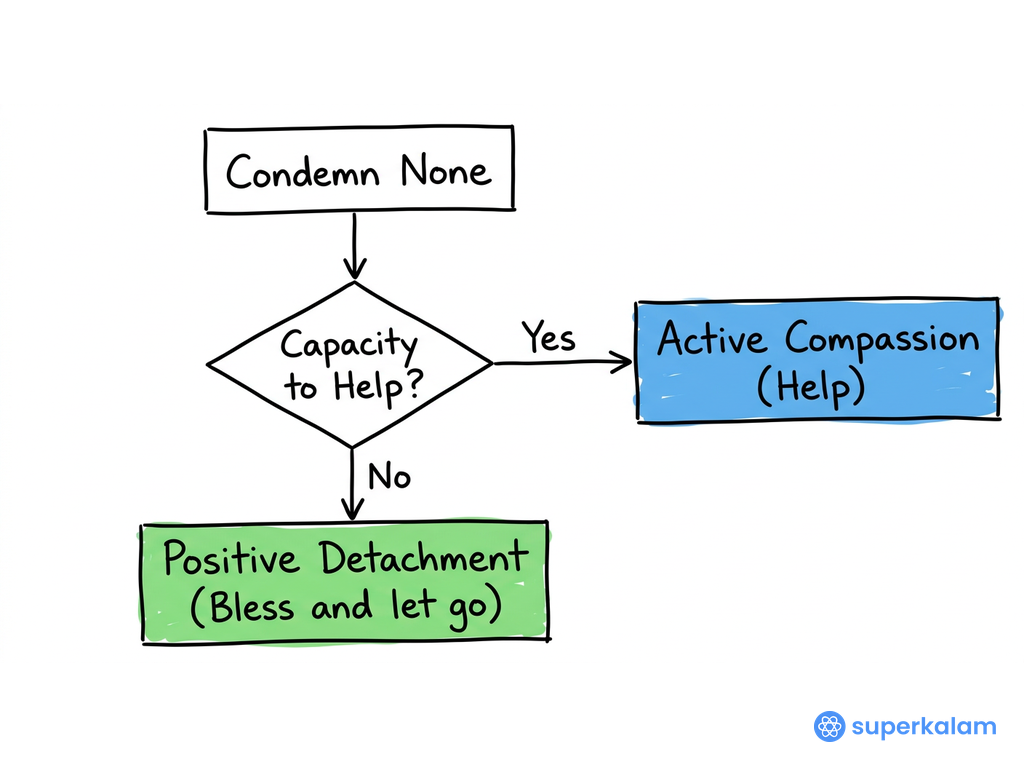
Condemn None Decision-Making Flowchart Process
Meaning and Interpretation of the Quotation
• Non-judgmental Approach: The quote advocates against moral condemnation of others, emphasizing empathy over criticism in human interactions, reflecting Kant's categorical imperative of treating people as ends in themselves.
• Active Compassion: "Stretch out a helping hand" signifies proactive assistance and constructive intervention, aligning with utilitarian principles of maximizing welfare and Gandhi's satyagraha philosophy.
• Respectful Withdrawal: When unable to help, "fold your hands and bless" demonstrates dignified restraint and respectful non-interference, embodying Aristotle's golden mean between harmful intervention and callous indifference.
• Individual Autonomy: "Let them go their own way" respects personal agency and freedom of choice, reflecting Mill's harm principle and democratic values of self-determination.
• Graduated Response: The quote presents a hierarchical approach - help first, bless if unable to help, but never condemn, demonstrating practical wisdom in ethical decision-making.
Relevance for Civil Servants
• Administrative Compassion: Civil servants should approach citizens with empathy rather than judgment, exemplified by E. Sreedharan's inclusive project management and Aruna Roy's grassroots engagement through RTI activism.
• Constructive Governance: Focus on solution-oriented approaches rather than punitive measures, as seen in restorative justice programs and community policing initiatives pioneered by Kiran Bedi.
• Policy Implementation: When direct intervention isn't possible, create enabling environments through supportive policies like MGNREGA and Jan Aushadhi Scheme that empower citizens.
• Stakeholder Relations: Maintain professional dignity even when disagreeing with policies or individuals, fostering collaborative governance and public trust.
• Ethical Leadership: Demonstrate moral courage in helping while respecting constitutional boundaries and procedural fairness, balancing dharma with administrative efficiency.
This philosophy guides civil servants toward compassionate governance that combines active service with respectful restraint, fostering both individual dignity and collective welfare in public administration.
Answer Length
Model answers may exceed the word limit for better clarity and depth. Use them as a guide, but always frame your final answer within the exam’s prescribed limit.
Evaluate this PYQ now
Write your answer & evaluate in just 60 seconds




500+ students evaluated
Model Answers from
- 2020Ethics: Theory10 MarksView Answer
What does this quotation mean to you
“A system of morality which is based on relative emotional values is a mere illusion, a thoroughly vulgar conception which has nothing sound in it and nothing true.” – Socrates - 2020Ethics: Theory10 MarksView Answer
What does this quotation mean to you
“The best way to find yourself is to lose yourself in the service of others.” – Mahatma Gandhi - 2020Ethics: Theory10 MarksView Answer
“The current internet expansion has instilled a different set of cultural values which are often in conflict with traditional values.’ Discuss.
- 2020Ethics: Theory10 MarksView Answer
What are the main factors responsible for gender inequality in India? Discuss the contribution of Savitribai Phule in this regard.
- 2020Ethics: Theory10 MarksView Answer
A positive attitude is considered to be an essential characteristic of a civil servant who is often required to function under extreme stress. What contributes to a positive attitude in a person?
- 2020Ethics: Theory10 MarksView Answer
Distinguish between laws and rules. Discuss the role of ethics in formulating them
Model Answers by Subject


Crack UPSC with your
Personal AI Mentor
An AI-powered ecosystem to learn, practice, and evaluate with discipline



