Comment on the important changes introduced in respect of the Long term Capital Gains Tax (LCGT) and Dividend Distribution Tax (DDT) in the Union Budget for 2018-2019.
Comment on the important changes introduced in respect of the Long term Capital Gains Tax (LCGT) and Dividend Distribution Tax (DDT) in the Union Budget for 2018-2019.
The Union Budget 2018-19 introduced landmark reforms in capital gains and dividend taxation, fundamentally reshaping India's investment tax landscape and aligning it with global practices.
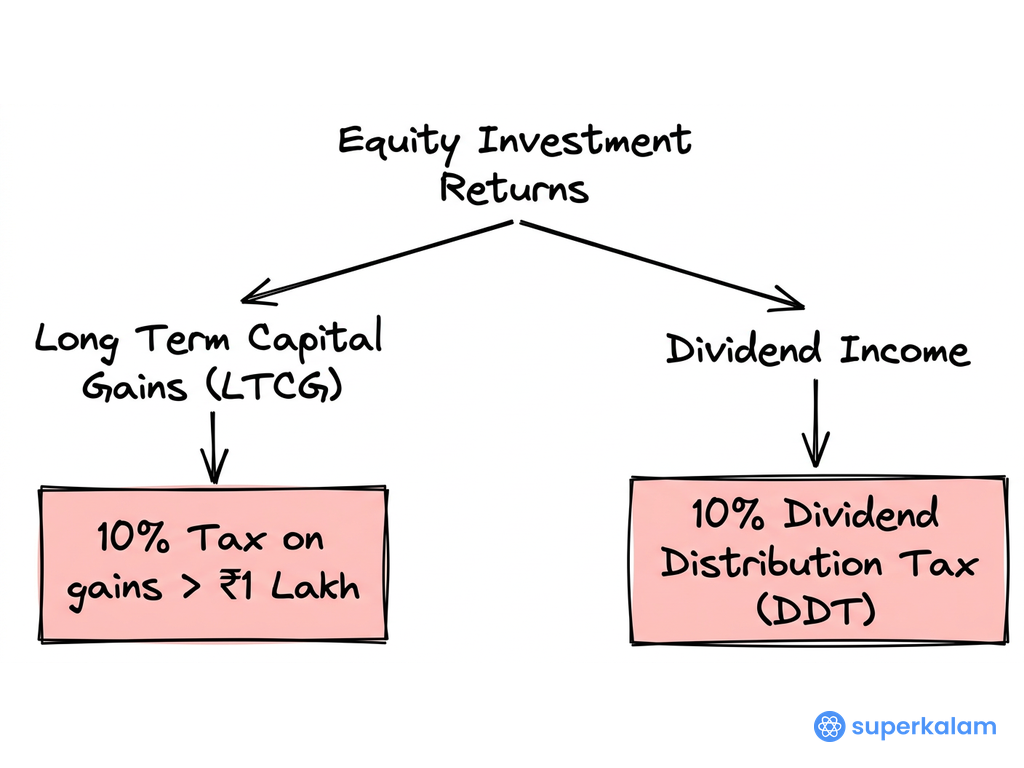
Equity Taxation Changes Budget 2018 19
Long-term Capital Gains Tax (LCGT) Changes
- Section 112A Introduction: Imposed 10% tax on LTCG exceeding ₹1 lakh from listed equity shares and equity-oriented mutual funds, ending the era of tax-free equity gains
- Grandfathering Provision: Protected all gains accumulated until January 31, 2018, from retrospective taxation, safeguarding existing investor interests
- Indexation Benefit Removal: Eliminated indexation benefits, simplifying tax calculations but potentially increasing effective tax burden for long-term investors
- Revenue Generation: Expected to generate approximately ₹20,000 crores annually while maintaining investment attractiveness
- Market Stability: Implementation with adequate transition period minimized market disruptions and investor panic
Dividend Distribution Tax (DDT) Reforms
- Classical Taxation System: Shifted from company-level DDT (approximately 20.56%) to individual-level taxation at applicable slab rates
- TDS Mechanism: Introduced 10% TDS on dividend payments exceeding ₹5,000 annually, enhancing tax compliance and collection efficiency
- Progressive Tax Structure: High-income investors now pay higher rates while lower-income investors benefit from reduced tax burden
- Foreign Investment Boost: Enabled foreign investors to claim tax credits in home countries, eliminating double taxation issues
- Corporate Benefit: Reduced compliance burden on companies while improving their cash flows by eliminating DDT payments
Impact and Implications
| Aspect | LCGT Changes | DDT Reforms |
|---|---|---|
| Revenue Impact | ₹20,000 crores additional | Neutral to positive |
| Investor Category | All equity investors | High vs. low income differential |
| Global Competitiveness | Maintained with exemption | Significantly improved |
| Compliance | Simplified | Enhanced through TDS |
These reforms represent a balanced approach between revenue generation and investment promotion, ensuring India's continued attractiveness as an investment destination while building a more equitable and transparent tax system aligned with international standards.
Answer Length
Model answers may exceed the word limit for better clarity and depth. Use them as a guide, but always frame your final answer within the exam’s prescribed limit.
Evaluate this PYQ now
Write your answer & evaluate in just 60 seconds




500+ students evaluated
Model Answers from
- 2018Economy15 MarksView Answer
With growing energy needs should India keep on expanding its nuclear energy programme? Discuss the facts and fears associated with nuclear energy.
- 2018Economy15 MarksView Answer
How has the emphasis on certain crops brought about changes in cropping patterns in the recent past? Elaborate the emphasis on millet production and consumption.
- 2018Economy15 MarksView Answer
Assess the role of the National Horticulture Mission (NHM) in boosting the production, productivity and income of horticulture farms. How far has it succeeded in increasing the income of farmers?
- 2018Economy15 MarksView Answer
How would the recent phenomena of protectionism and currency manipulations in world trade affect the macroeconomic stability of India?
- 2018Economy15 MarksView Answer
How are the principles followed by NITI Aayog different from those followed by the erstwhile planning commission in India?
- 2018Economy10 MarksView Answer
Sikkim is the first ‘Organic State’ in India. What are the ecological and economic benefits of an Organic State?
Model Answers by Subject


Crack UPSC with your
Personal AI Mentor
An AI-powered ecosystem to learn, practice, and evaluate with discipline



