What characteristics can be assigned to the monsoon climate that succeeds in feeding more than 50 percent of the world population residing in Monsoon Asia?
What characteristics can be assigned to the monsoon climate that succeeds in feeding more than 50 percent of the world population residing in Monsoon Asia?
Recent studies show that monsoon regions support over 3.8 billion people, making the monsoon climate system crucial for global food security and agricultural sustainability.
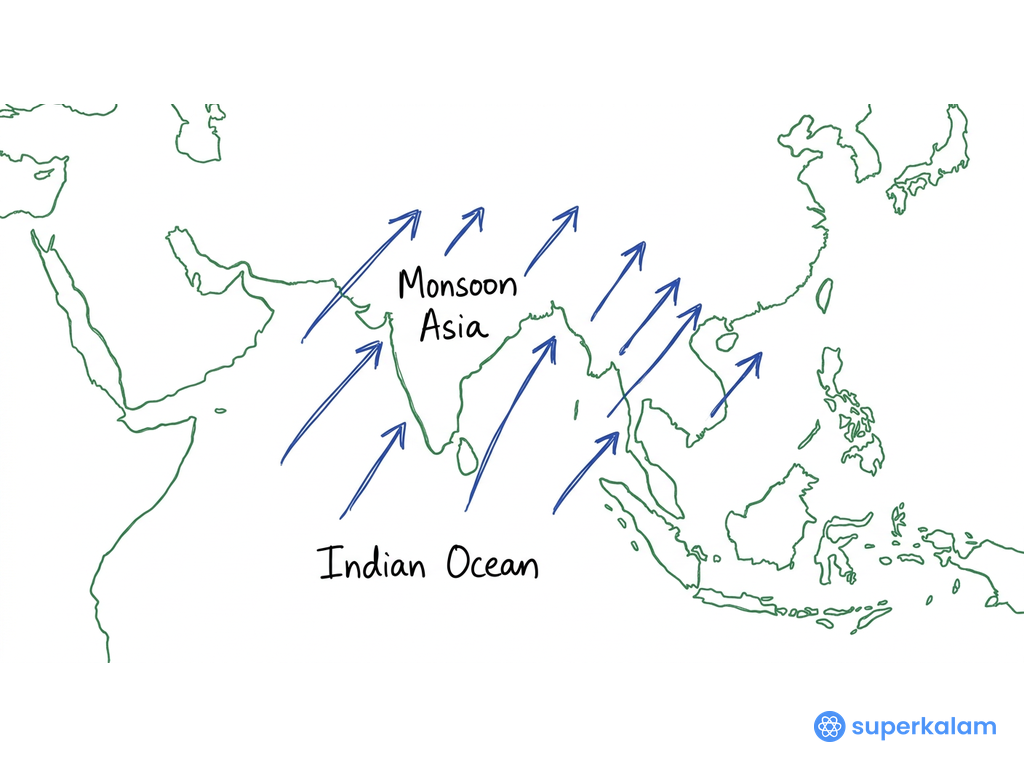
Arrows show influence from Indian Ocean
Seasonal Wind Reversal System
- Complete wind direction reversal between summer and winter due to differential heating of land and ocean masses
- Creates distinct wet (June-September) and dry (October-May) seasons enabling systematic agricultural planning
- Thermal contrast mechanism between Asian landmass and surrounding oceans drives this seasonal pattern
- Predictable timing allows farmers to plan cropping calendars and water management strategies
- Wind reversal brings moisture-laden air from oceans during summer, ensuring water availability for crops
Rainfall Characteristics and Distribution
- Heavy concentrated precipitation during monsoon months with 75-200cm average rainfall
- 80-90% of annual rainfall occurs in 3-4 months, creating water abundance during growing season
- Spatial variation creates diverse agro-climatic zones from Western Ghats (300cm) to rain-shadow areas (50cm)
- Pronounced dry period facilitates harvesting, threshing, and crop storage activities
- Orographic precipitation in mountain regions creates additional water resources through rivers and groundwater recharge
Agricultural Productivity Benefits
- Supports intensive rice cultivation covering over 50% of cultivated land in monsoon Asia
- Enables multiple cropping patterns: Kharif (monsoon), Rabi (winter), and Zaid (summer) crops
- Natural irrigation system reduces dependency on artificial water sources during peak growing season
- High temperatures (25-35°C) during monsoon period accelerate crop growth and photosynthesis
- Creates ideal conditions for staple crops: rice, wheat, sugarcane, cotton, and pulses
Water Resource Management
- Seasonal rainfall concentration facilitates water storage in reservoirs, tanks, and groundwater aquifers
- Traditional systems like check dams, baolis, and step wells maximize water harvesting during monsoon
- River systems like Ganga, Brahmaputra, and Mekong receive monsoon recharge supporting year-round irrigation
- Flood plains get annual nutrient deposition improving soil fertility naturally
- Integration of rainwater harvesting with modern irrigation creates resilient water security systems
The monsoon climate's predictable seasonality, abundant rainfall, and supporting ecosystem create optimal conditions for intensive agriculture, enabling sustainable food production for over half the world's population through efficient water-crop-climate integration.
Answer Length
Model answers may exceed the word limit for better clarity and depth. Use them as a guide, but always frame your final answer within the exam’s prescribed limit.
Evaluate this PYQ now
Write your answer & evaluate in just 60 seconds




500+ students evaluated
Model Answers from
- 2017Physical Geography15 MarksView Answer
Account for variations in oceanic salinity and discuss its multi-dimensional effects.
- 2017Physical Geography10 MarksView Answer
How does the cryosphere affect global climate?
- 2017Physical Geography10 MarksView Answer
How does the Juno Mission of NASA help to understand the origin and evolution of the Earth?
Model Answers by Subject


Crack UPSC with your
Personal AI Mentor
An AI-powered ecosystem to learn, practice, and evaluate with discipline