The aim of Information Technology Agreements (ITAs) is to lower all taxes and tariffs on Information technology products by signatories to zero. What impact would such agreements have on India’s interests?
The aim of Information Technology Agreements (ITAs) is to lower all taxes and tariffs on Information technology products by signatories to zero. What impact would such agreements have on India’s interests?
Recent discussions around India's participation in Information Technology Agreements highlight critical trade-offs between global integration and domestic industry protection in the digital economy era.
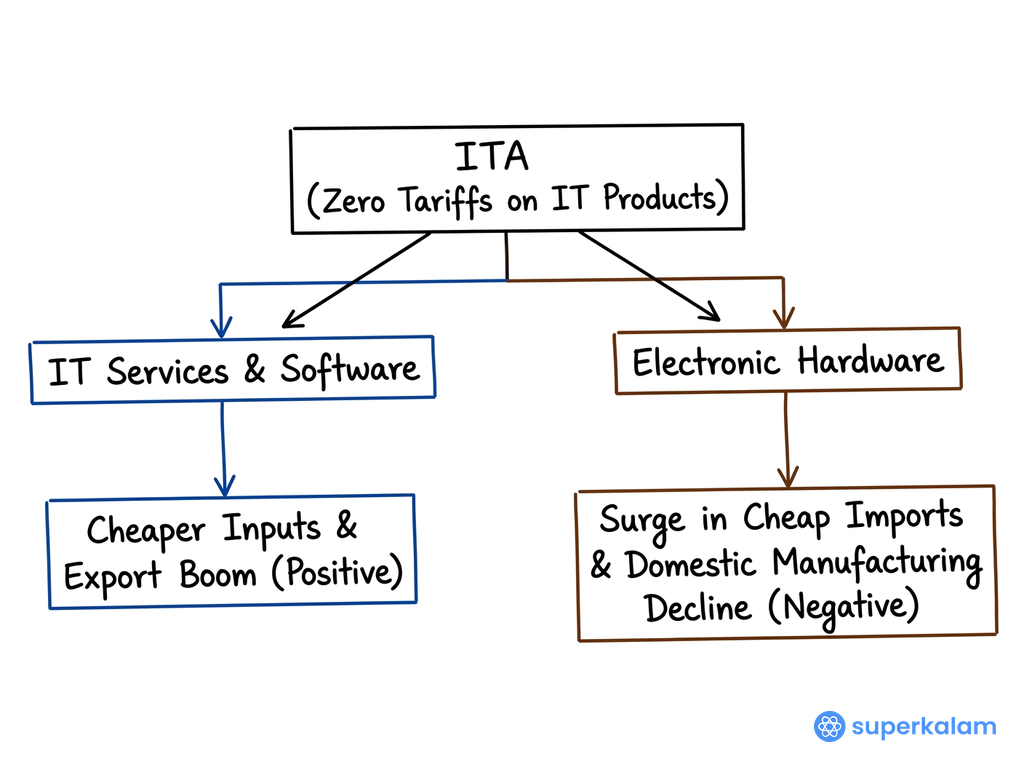
Information Technology Agreement's impact on India
Benefits for India's IT Interests
- Cost Reduction: Zero tariffs reduce input costs for IT hardware, lowering production expenses for Indian software companies
- Global Market Access: Improved access to international markets for India's $254 billion IT services sector (2024-25)
- Technology Upgradation: Access to cutting-edge hardware accelerates digital transformation across sectors
- Innovation Ecosystem: Cheaper IT products foster startup ecosystem and digital entrepreneurship
- Service Integration: Lower hardware costs support India's position in global IT services, currently holding 55% market share in global outsourcing
Challenges to India's Economic Interests
- Industry Displacement: Flood of cheap imports threatens India's emerging electronics manufacturing sector under PLI schemes
- Revenue Loss: Elimination of import duties reduces government revenue significantly, impacting fiscal resources
- Trade Deficit: Increased imports worsen trade balance - India's electronics import bill reached $75 billion in 2023-24
- Employment Impact: Potential job losses in domestic manufacturing units competing with zero-tariff imports
- Strategic Vulnerability: Over-dependence on foreign technology creates supply chain risks
Strategic Implications for India
| Aspect | Opportunities | Risks |
|---|---|---|
| Manufacturing | Lower input costs for assembly | Competition with established players |
| Services | Enhanced competitiveness | Technological dependency |
| Innovation | Access to advanced technology | Limited policy space |
| Economy | Export growth potential | Import surge challenges |
Policy Considerations
- Selective Participation: India could negotiate sector-specific exemptions protecting critical domestic industries
- Phased Implementation: Gradual tariff reduction allowing domestic industry adjustment time
- Complementary Measures: Strengthening Atmanirbhar Bharat initiatives alongside ITA participation
India must balance ITA participation with domestic industry protection through strategic negotiations and robust domestic capacity building under the Digital India framework.
Answer Length
Model answers may exceed the word limit for better clarity and depth. Use them as a guide, but always frame your final answer within the exam’s prescribed limit.
Evaluate this PYQ now
Write your answer & evaluate in just 60 seconds




500+ students evaluated
Model Answers from
- 2014International Relations12.5 MarksView Answer
WTO is an important international institution where decisions taken affect countries in a profound manner. What is the mandate of WTO and how binding are their decisions? Critically analyse India’s stand on the latest round of talks on Food security.
- 2014International Relations12.5 MarksView Answer
India has recently signed to become a founding member of New Development Bank (NDB) and also the Asian Infrastructure Investment Bank (AIIB). How will the role of the two Banks be different? Discuss the strategic significance of these two Banks for India.
- 2014International Relations12.5 MarksView Answer
Some of the International funding agencies have special terms for economic participation stipulating a substantial component of the aid used for sourcing equipment from the leading countries. Discuss the merits of such terms and there exists a strong case not to accept such conditions in the Indian context.
- 2014International Relations12.5 MarksView Answer
With respect to the South China sea, maritime territorial disputes and rising tension affirm the need for safeguarding maritime security to ensure freedom of navigation and ever flight throughout the region. In this context, discuss the bilateral issues between India and China.
Model Answers by Subject


Crack UPSC with your
Personal AI Mentor
An AI-powered ecosystem to learn, practice, and evaluate with discipline



