Explain the reasons for the growth of PILs in India. As a result of it, has the India supreme court emerged as the most powerful judiciary?
Explain the reasons for the growth of PILs in India. As a result of it, has the India supreme court emerged as the most powerful judiciary?
Subject: Indian Polity
Public Interest Litigation (PIL), relaxing traditional locus standi, secures justice for the marginalized. Reflecting its scale, the Supreme Court (SC) admitted a record 570 new PILs in 2025.
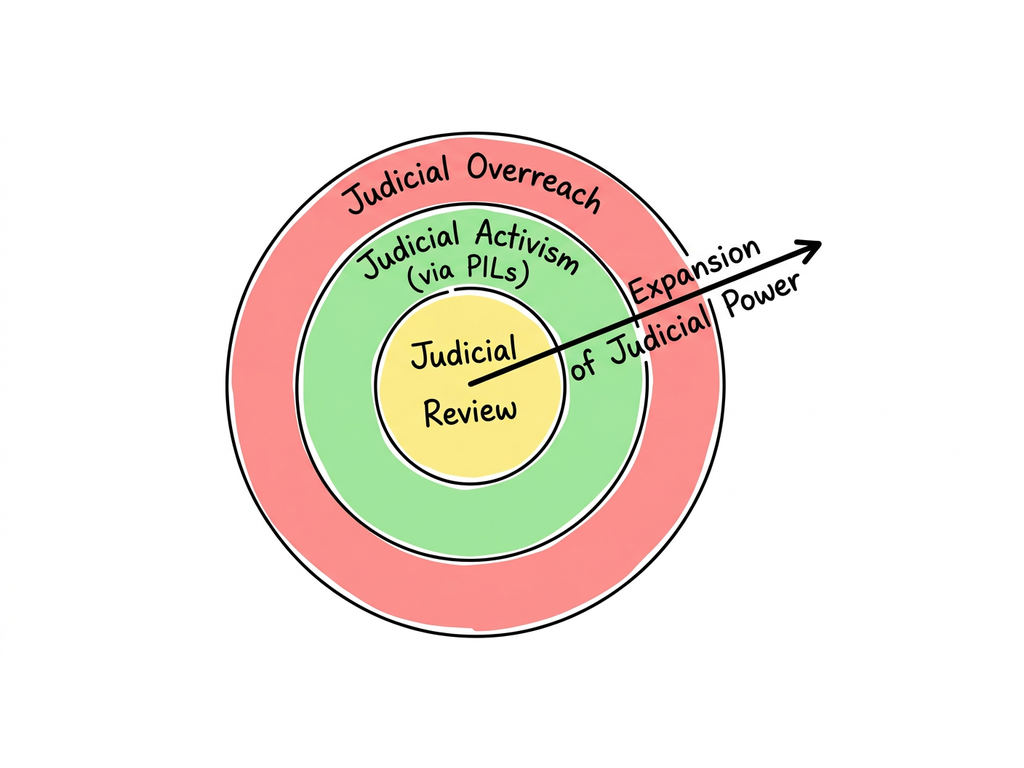
Expansion of Judicial Power and Review
Reasons for the Growth of PILs in India
- Procedural relaxation: Epistolary jurisdiction allows treating simple letters or newspaper reports as Article 32 writ petitions.
- Technological democratization: Integration of E-filing 4.0 and the SUVAS AI translation tool makes the apex court accessible to non-English speakers.
- Executive inertia: PILs cure governance deficits, seen in the October 2024 SC judgment striking down caste-based segregation in state prison manuals.
- Expansive Article 21: Broadening the "Right to Life" encompasses complex environmental, livelihood, and privacy claims.
- Civil society leverage: NGOs aggressively utilize PILs as their primary instrument for systemic socio-economic reform.
- Continuing mandamus: Courts keeping cases open for years incentivizes activists seeking long-term judicial oversight.
Emergence as the Most Powerful Judiciary (Enablers)
- Policy review: The SC actively invalidates major executive policies, like scrapping the Electoral Bonds scheme in February 2024.
- Governance micro-management: Suo motu PILs allow direct intervention in state administrative issues like the March 2025 Delhi-NCR air pollution proceedings.
- Quasi-legislative role: Formulating binding guidelines where parliamentary laws are absent expands judicial reach beyond interpretation.
- Institutional supremacy: Synergizing PILs with the Basic Structure doctrine ensures unmatched constitutional authority over the legislature.
Systemic Limits Restraining Absolute Power (Nuance)
- Capacity constraints: The massive backlog of 3,525 pending PILs as of March 2025 severely undermines swift justice delivery.
- Implementation deficits: India ranking 86th in the 2025 WJP Rule of Law Index proves expansive judicial orders often lack grassroots executive enforcement.
- Penalizing frivolity: The SC is actively curbing "publicity petitions," upholding a ₹5 lakh penalty in January 2026 to prevent judicial weaponization.
- Ending perpetual oversight: The court officially closed the 39-year-old M.C. Mehta environmental PIL in March 2025, acknowledging the futility of endless monitoring.
- Delegating to experts: Rather than micro-managing, courts increasingly transfer specialized oversight to expert statutory bodies and tribunals.
While PILs forged the SC into a formidable socio-economic equalizer, its power remains checked by implementation dependencies. By enforcing strict admissibility bounds, the SC ensures it remains a targeted court of last resort rather than a parallel legislature.
Answer Length
Model answers may exceed the word limit for better clarity and depth. Use them as a guide, but always frame your final answer within the exam’s prescribed limit.
Evaluate this PYQ now
Write your answer & evaluate in just 60 seconds




500+ students evaluated
Model Answers from
- 2024Indian Polity15 MarksView Answer
Discuss India as a secular state and compare it with the secular principles of the US constitution.
- 2024Indian Polity15 MarksView Answer
What changes has the union government recently introduced in the domain of center- state relations ? Suggest measures to be adopted to build the trust between the center and the states and for strengthening federalism.
- 2024Indian Polity15 MarksView Answer
Right to privacy is intrinsic to life and personal liberty and is inherently protected under Article 21 of the constitution. Explain. In this reference discuss the law relating to D.N.A. testing of a child in the womb to establish its paternity.
- 2024Indian Polity10 MarksView Answer
Analyze the role of local bodies in providing good governance at local level and bring out the pros and cons of merging the rural local bodies with the urban local bodies.
- 2024Indian Polity10 MarksView Answer
"The duty of the Comptroller and Auditor General is not merely to ensure the legality of expenditure but also its propriety." Comment.
- 2024Indian Polity10 MarksView Answer
"The growth of the cabinet system has practically resulted in the marginalization of parliamentary supremacy." Elucidate.
Model Answers by Subject


Crack UPSC with your
Personal AI Mentor
An AI-powered ecosystem to learn, practice, and evaluate with discipline