Examine the pattern and trend of public expenditure on social services in the post-reform period in India. To what extent has this been in consonance with achieving the objective of inclusive growth?
Examine the pattern and trend of public expenditure on social services in the post-reform period in India. To what extent has this been in consonance with achieving the objective of inclusive growth?
Subject: Economy
Since the 1991 reforms, India has gradually shifted its fiscal policy to balance economic growth with social equity by expanding public spending on core social sectors—education, health, and welfare—aiming to support human development and inclusive growth.
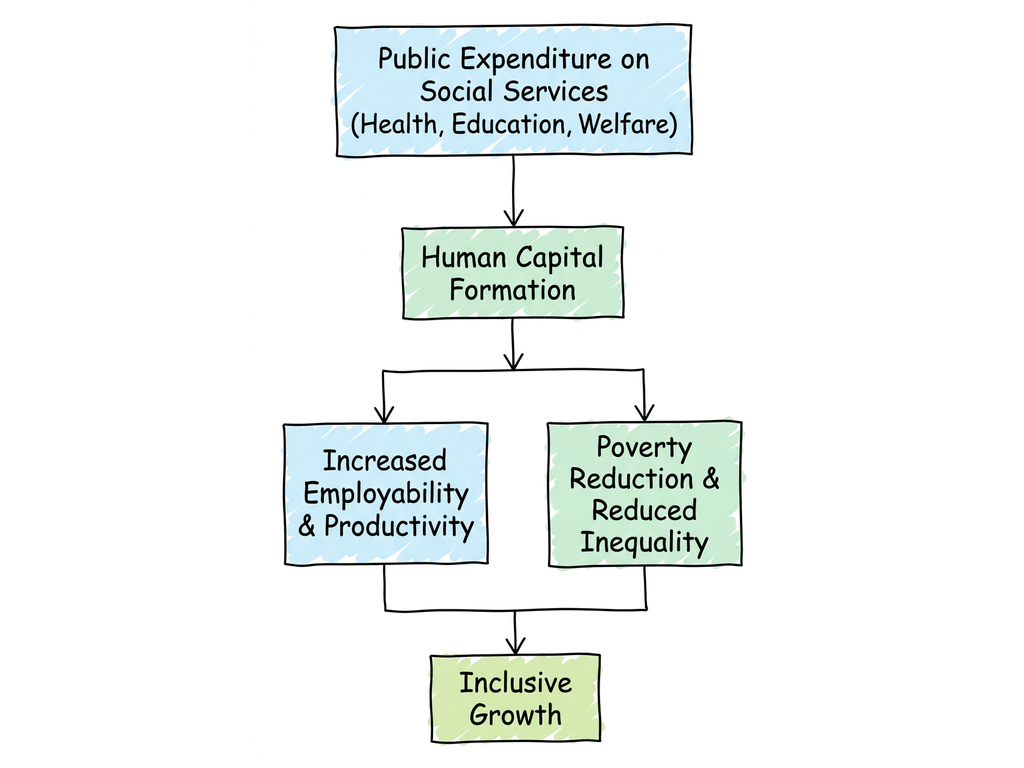
Public Spending on Social Services Diagram
Patterns & Trends in Expenditure
1. Rising Share of GDP
- Social services spending increased from ~6 % of GDP in 1990–91 to approximately 7.8 % in 2023–24 .
- Between 2017–18 and 2023–24, it grew at a CAGR of ~12.8 %, outpacing nominal GDP (~9.5 %).
2. Sectoral Composition
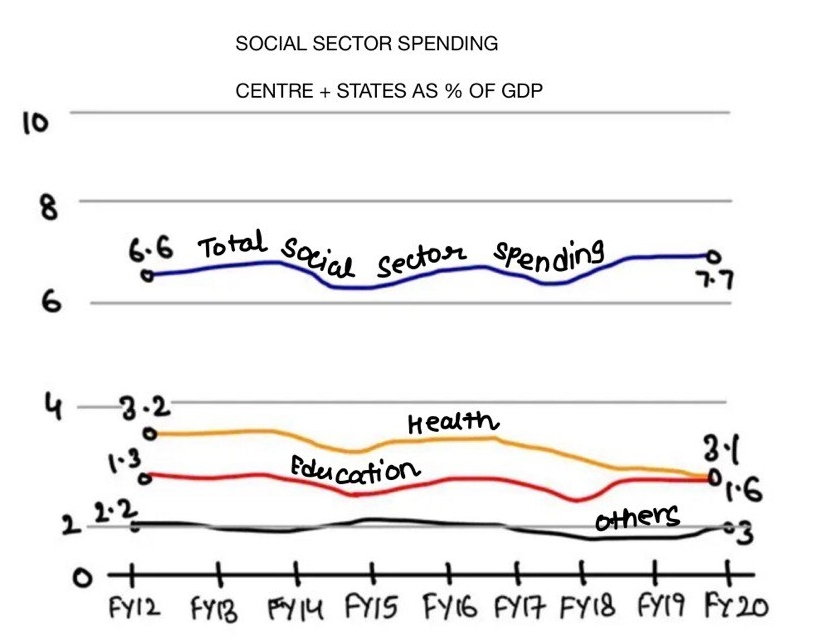
Trend of expenditure on social services
Consonance with Inclusive Growth
Strengths
-
Poverty & Human Development
- Poverty headcount fell dramatically (e.g., World Bank: ~36 % in 1993 → ~6 % in 2022) .
- India’s HDI rose from 0.433 to 0.675 (1990–2021), reflecting improved education, health, and services .
-
Health & Education Outcomes
- Government health insurance (e.g., AB-PMJAY) and infrastructure spending reduced out-of-pocket expenditure: OOPE dropped from ~62.6 % to ~39.4 % of total health spend between FY21–FY25 .
- Education enrolment and retention have improved; primary enrolment near-universal, dropout rates falling, though quality gaps persist.
-
Social Safety Nets
- MGNREGA, PMJDY, PMAY, Ujjwala, and sanitation schemes have expanded social security, finance inclusion, and basic amenities—crucial pillars of inclusive growth.
Challenges & Shortcomings
-
Insufficient Investment Targets
- Education spending around 2.7% of GDP falls short of NEP’s 6% target; health remains ~1.9%, well below global/regional norms.
-
Quality and Equity Gaps
- Foundational learning remains weak (e.g., ASER 2023: < 20 % of Grade III can read Grade II text); health infrastructure (beds, public hospitals) remains inadequate.
-
Regional Disparities & Inclusion
- Per-capita outlays and outcomes skewed toward richer states; marginalized groups (SC/ST, informal workers, women) remain underprotected despite schemes.
-
Fiscal Sustainability & Implementation
- Rising welfare expenditure pressures revenue deficits; implementation inefficiencies and leakages (e.g., PDS, healthcare access) reduce impact.
Public expenditure on social services in India has seen a clear upward trend in the post-reform era, reflecting a policy focus on inclusive growth. This has led to notable progress in poverty reduction, human development, and delivery of social welfare. However, key fiscal gaps remain, particularly in achieving adequate scale (e.g., 6% GDP for education, 2.5–5% for health) and ensuring equity in quality and access. To fully realize inclusive growth, India must:
- Scale up spending to meet NHPS/NEP targets.
- Invest in quality (teacher training, health infrastructure).
- Target disadvantaged regions/groups more effectively.
- Strengthen implementation and governance to minimize leakages.
This balanced approach would ensure that growth is not only sustained but also truly inclusive.
Answer Length
Model answers may exceed the word limit for better clarity and depth. Use them as a guide, but always frame your final answer within the exam’s prescribed limit.
Evaluate this PYQ now
Write your answer & evaluate in just 60 seconds




500+ students evaluated
Model Answers from
- 2024Economy15 MarksView Answer
Elucidate the importance of buffer stocks for stabilizing agricultural prices in India. What are the challenges associated with the storage of buffer stocks? Discuss.
- 2024Economy15 MarksView Answer
What are the major challenges faced by the Indian irrigation system in recent times? State the measures taken by the government for efficient irrigation management.
- 2024Economy15 MarksView Answer
What is the need for expanding the regional air connectivity in India? In this context, discuss the government’s UDAN Scheme and its achievements.
- 2024Economy15 MarksView Answer
Discuss the merits and demerits of the four ‘Labour Codes’ in the context of labour market reforms in India. What has been the progress so far in these regards?
- 2024Economy10 MarksView Answer
Explain the role of millets for ensuring health and nutritional security in India.
- 2024Economy10 MarksView Answer
What were the factors responsible for the successful implementation of land reforms in some parts of the country? Elaborate.
Model Answers by Subject


Crack UPSC with your
Personal AI Mentor
An AI-powered ecosystem to learn, practice, and evaluate with discipline



