Why is Public Private Partnership (PPP) required in infrastructural projects ? Examine the role of PPP model in the redevelopment of Railway Stations in India.
Why is Public Private Partnership (PPP) required in infrastructural projects ? Examine the role of PPP model in the redevelopment of Railway Stations in India.
Public infrastructure is the backbone of economic development, but financing and executing large projects often faces delays due to limited government resources, procedural bottlenecks, and inefficiencies. In this context, the Public Private Partnership (PPP) model becomes vital as it combines public sector oversight with private sector efficiency, innovation, and investment.
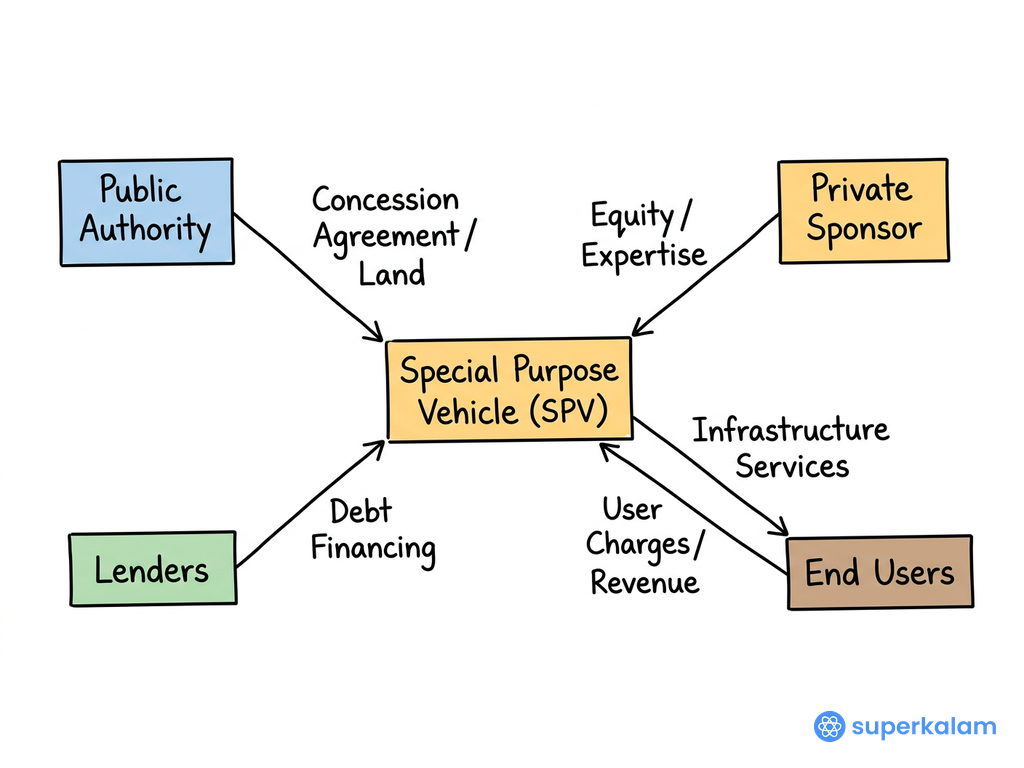
Typical PPP model structural framework diagram
Why is PPP required in infrastructural projects?
-
Resource Mobilization
-
Infrastructure investment needs are $1.4 trillion (2020–2040, NITI Aayog).
-
PPP helps bridge the fiscal deficit by leveraging private capital.
-
-
Efficiency and Innovation
- Private players bring modern technology, project management skills, and operational efficiency, reducing delays and cost overruns.
-
Risk Sharing
- PPP enables the distribution of project risks (construction, demand and revenue) between public and private sectors, reducing burden on the exchequer.
-
Improved Service Delivery
- Examples: Delhi Airport (GMR-led PPP) transformed into a world-class hub through PPP.
-
Reducing Public Debt Burden
- Large projects can be financed without adding to government debt, important in the context of India’s fiscal deficit (5.8% of GDP in 2023–24 BE).
-
Long-term Sustainability
- PPP ensures maintenance and lifecycle management (not just construction), enhancing infrastructure longevity.
PPP in Redevelopment of Railway Stations in India
The Indian Railways launched the Amrit Bharat Station Scheme (2023) targeting over 1300 stations for redevelopment, many through PPP.
-
Private Investment in Redevelopment
- Stations like Habibganj (Rani Kamlapati) in Bhopal and Gandhinagar (Gujarat) redeveloped under PPP with airports-like facilities (malls, hotels, and digital infrastructure).
-
Transit-Oriented Development (TOD)
- PPP enables development of commercial real estate around stations, cross-subsidising railway infrastructure.
-
Reduced Financial Burden on Railways
- Total estimated cost of station redevelopment: ₹24,470 crore (Ministry of Railways, 2023). PPP helps meet this huge investment need.
-
Better Passenger Experience
- Improved passenger amenities: waiting lounges, food courts, modern ticketing, clean platforms (Habibganj model).
-
Global Best Practices
- Inspired by London’s St. Pancras, Japan’s Shinjuku, PPP ensures world-class designs with commercial viability.
Challenges in PPP Model for Railway Station Redevelopment
-
Commercial Viability Concerns
-
Private developers prefer Tier-1, high-footfall stations (Delhi, Mumbai, Bangalore) while smaller stations remain neglected.
-
Example: PPP bids for smaller stations like Nagpur initially failed due to poor commercial prospects.
-
-
Land Acquisition and Encroachment Issues
-
Railway stations often have densely populated surroundings with informal settlements, delaying land clearance.
-
Example: Comptroller and Auditor General (CAG, 2019) noted land use disputes as a major bottleneck in station redevelopment projects.
-
-
Revenue Sharing and Risk Allocation Disputes
-
Disagreements on how to share commercial revenues from real estate, advertisements, and retail outlets.
-
Example: The Kelkar Committee (2015) highlighted vague contracts and “misplaced risk allocation” as key causes of stalled PPPs.
-
-
Regulatory and Policy Uncertainty
- Frequent changes in PPP frameworks, contract renegotiations, and lack of an independent regulator discourage private investment.
-
Financing and Delayed Returns
-
Redeveloped stations require heavy upfront investment (₹200–400 crore for medium stations), but returns are long-term and uncertain.
-
Banks/NBFCs remain reluctant due to past stressed assets in infrastructure sector.
-
-
Operational and Governance Challenges
-
Coordination required between Railways, State Governments, Urban Local Bodies, and Private Developers leads to delays.
-
Example: New Delhi Railway Station PPP project worth ₹6,500 crore saw delays due to multi-agency clearances.
-
PPP is not a substitute but a complement to public investment. In railway station redevelopment, PPP has demonstrated success by bringing modern facilities and reducing fiscal strain on the government. However, transparent contracts, fair risk-sharing, and independent regulatory oversight are essential for scaling PPP across India’s 7,000+ railway stations.
Answer Length
Model answers may exceed the word limit for better clarity and depth. Use them as a guide, but always frame your final answer within the exam’s prescribed limit.
Evaluate this PYQ now
Write your answer & evaluate in just 60 seconds




500+ students evaluated
Model Answers from
- 2022Economy15 MarksView Answer
Economic growth in the recent past has been led by increase in labour activity.” Explain this statement. Suggest the growth pattern that will lead to creation of more jobs without compromising labour productivity.
- 2022Economy10 MarksView Answer
The increase in life expectancy in the country has led to newer health challenges in the community. What are those challenges and what steps need to be taken to meet them ?
- 2022Economy10 MarksView Answer
Elaborate the scope and significance of the food processing industry in India
- 2022Economy10 MarksView Answer
What are the major challenges of Public Distribution System (PDS) in India ? How can it be made effective and transparent ?
- 2022Economy10 MarksView Answer
Is inclusive growth possible under market economy ? State the significance of financial inclusion in achieving economic growth in India.
Model Answers by Subject


Crack UPSC with your
Personal AI Mentor
An AI-powered ecosystem to learn, practice, and evaluate with discipline



