What is an Integrated Farming System ? How is it helpful to small and marginal farmers in India ?
What is an Integrated Farming System ? How is it helpful to small and marginal farmers in India ?
IFS is a farm management approach that integrates multiple agricultural enterprises such as crops, livestock, horticulture, agroforestry, and mushroom cultivation in a synergistic and complementary manner. The idea is to ensure optimal utilisation of resources, waste recycling, and sustainable livelihood security, especially for small and marginal farmers.
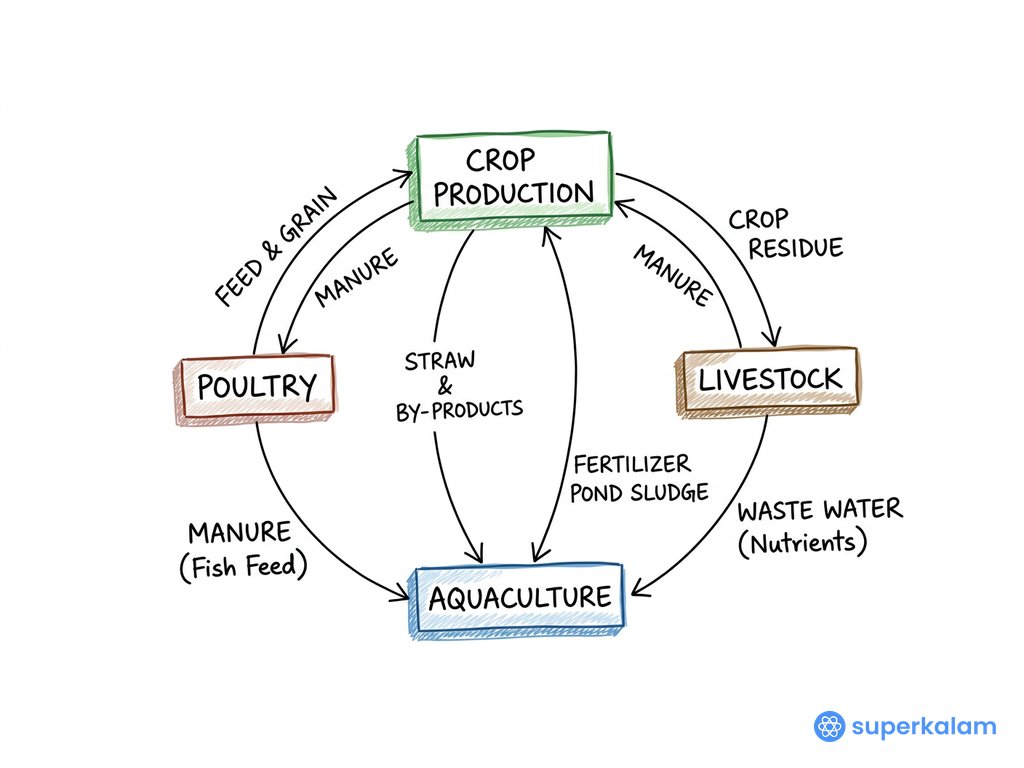
Integrated Farming System Circular Network Diagram
Core Features of IFS
-
Diversification of Enterprises – Combines crops with livestock, fisheries, poultry, horticulture, agroforestry, etc.
-
Resource Recycling – By-products/wastes of one component serve as inputs for another (e.g., dung → biogas/fertiliser, crop residues → fodder).
-
Complementarity & Synergy – Different components support each other, ensuring overall system productivity.
-
Nutritional Basket – Produces food, milk, eggs, vegetables, honey, etc., from a single farm.
-
Sustainability – Reduces dependence on external inputs and improves soil, water, and ecological health.
-
Adaptability – Model can be modified as per agro-climatic zones (e.g., rice–fish–duck in East India, crop–goat–horticulture in drylands).
-
Economic Viability – Multiple income streams reduce risk and stabilise farm economy.
How IFS Helps Small & Marginal Farmers in India
-
Income Enhancement & Stability
-
Multiple enterprises ensure steady cash flow throughout the year.
-
NITI Aayog (2020): IFS can double/triple farm income compared to monocropping.
-
-
Risk Diversification
-
Protects against crop failure, price crashes, or pest attacks.
-
Example: If paddy fails, fish or poultry still generate income.
-
-
Efficient Resource Utilisation & Cost Reduction
-
Livestock manure → organic fertiliser; crop residues → fodder/fuel.
-
Reduces dependence on costly chemical fertilisers, pesticides, and feed.
-
-
Employment Generation & Inclusivity
-
Year-round farm work absorbs family labour, reducing rural distress migration.
-
Provides women & youth employment in poultry, dairy, mushroom, beekeeping.
-
-
Nutritional Security
-
Provides a balanced food basket (carbohydrates, proteins, vitamins, minerals).
-
Addresses hidden hunger in rural households (aligned with POSHAN Abhiyaan).
-
-
Sustainability & Climate Resilience
-
Soil fertility restored through organic recycling.
-
Reduces vulnerability to climate shocks (droughts, floods).
-
ICAR (2021): IFS improves water-use efficiency by 25–30%.
-
-
Market & Value-Addition Opportunities
-
Surplus produce (milk, honey, vegetables, eggs, fish) can be marketed through FPOs and cooperatives.
-
Encourages rural entrepreneurship & local food processing.
-
-
Environmental Benefits
-
Reduces stubble burning (straw used as fodder/mushroom substrate).
-
Cuts down GHG emissions through organic manures and biogas use.
-
For small and marginal farmers (86% of total farmers), IFS is not just a farming model, but a livelihood security strategy. It promotes higher income, food & nutritional security, sustainable natural resource use, and climate resilience. Scaling it through schemes like RKVY, PKVY, and FPO support will be crucial in achieving the goal of Doubling Farmers’ Income and building a self-reliant rural economy.
Answer Length
Model answers may exceed the word limit for better clarity and depth. Use them as a guide, but always frame your final answer within the exam’s prescribed limit.
Evaluate this PYQ now
Write your answer & evaluate in just 60 seconds




500+ students evaluated
Model Answers from
- 2022Environment & Ecology15 MarksView Answer
Discuss global warming and mention its effects on the global climate. Explain the control measures to bring down the level of greenhouse gases which cause global warming, in the light of the Kyoto Protocol, 1997.
- 2022Environment & Ecology15 MarksView Answer
What are the main bottlenecks in the upstream and downstream process of marketing of agricultural products in India ?
- 2022Environment & Ecology15 MarksView Answer
Do you think India will meet 50 percent of its energy needs from renewable energy by 2030 ? Justify your answer. How will the shift of subsidies from fossil fuels to renewables help achieve the above objective ? Explain.
- 2022Environment & Ecology10 MarksView Answer
Discuss in detail the photochemical smog emphasizing its formation, effects and mitigation. Explain the 1999 Gothenburg Protocol.
Model Answers by Subject


Crack UPSC with your
Personal AI Mentor
An AI-powered ecosystem to learn, practice, and evaluate with discipline



