Clean energy is the order of the day.’ Describe briefly India’s changing policy towards climate change in various international fora in the context of geopolitics.
Clean energy is the order of the day.’ Describe briefly India’s changing policy towards climate change in various international fora in the context of geopolitics.
Clean energy has emerged as both a developmental imperative and geopolitical tool. India, once seen as a reluctant actor in climate negotiations, has gradually repositioned itself as a proactive leader of Global South voices while balancing developmental needs with climate responsibility.
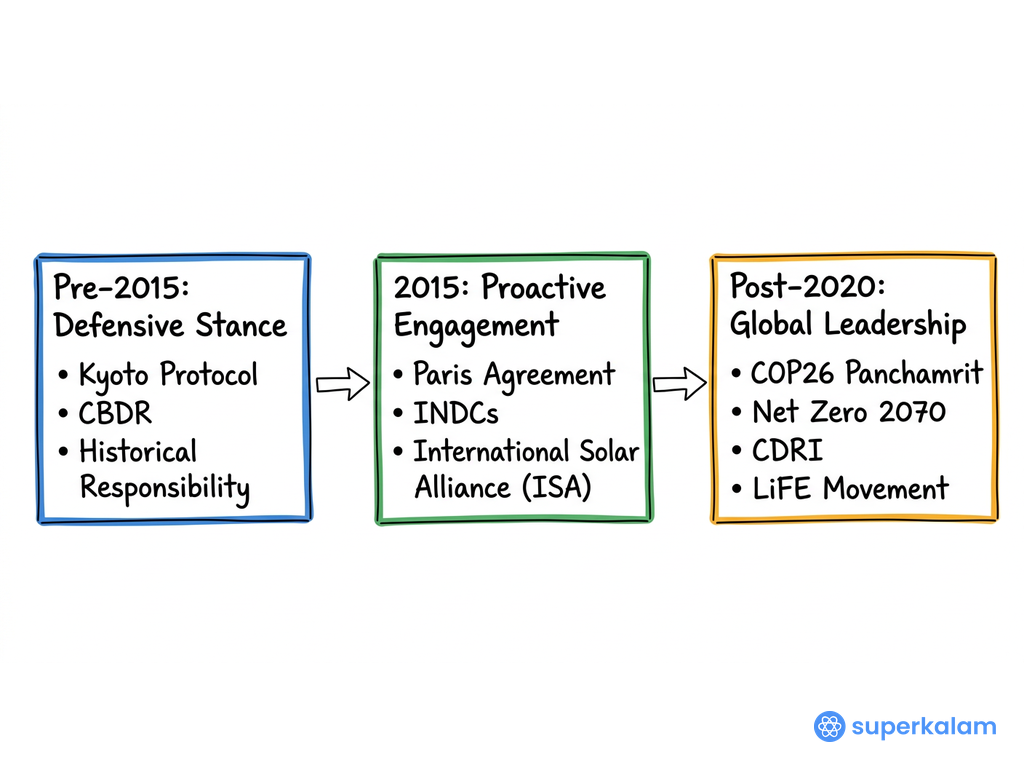
Timeline flowchart with sequential connected blocks
India’s Changing Climate Policy in International Fora
-
Early Phase (1990s–2000s)
-
In the UNFCCC & Kyoto Protocol (1997), India strongly emphasized the principle of Common but Differentiated Responsibilities (CBDR).
-
It resisted binding emission reduction targets, arguing its per capita emissions were far below developed nations.
-
Climate policy was largely framed around protecting developmental space.
-
-
Assertive Engagement (2009–2015)
-
At Copenhagen (2009), India resisted external pressure for binding commitments but voluntarily pledged emission intensity reduction by 20–25% by 2020 (from 2005 levels).
-
At the Paris Agreement (2015), India shifted to a more constructive role:
- Committed to 33–35% reduction in emission intensity by 2030.
- Pledged 40% of power capacity from non-fossil fuels.
- Launched the International Solar Alliance (ISA) with France — signaling leadership in clean energy geopolitics.
-
-
Leadership & Climate Diplomacy (2015–Present)
-
Glasgow COP26 (2021): PM Modi announced Panchamrit goals, including:
- Net-zero by 2070,
- 50% energy from renewables by 2030,
- 1 bn tonnes reduction in carbon emissions.
-
G20 Presidency (2023): Pushed for tripling global renewable capacity and phasing down unabated coal.
-
ISA expansion: 110+ countries joined, making India a clean energy “norm entrepreneur.”
-
Leadership in Global Biofuel Alliance (2023, with US & Brazil): Positions India as a bridge between developed & developing economies in green energy transition.
-
Geopolitical Dimensions of India’s Climate Policy
-
Climate Justice and Equity in Global Forums: India consistently advocates for equity and CBDR (Common but Differentiated Responsibilities), arguing that developed nations must take the lead.
- Example: At COP26 (Glasgow, 2021), India pledged Net Zero by 2070, balancing development needs with climate action.
-
Strategic Partnerships with Major Powers: India uses climate cooperation to deepen ties with key powers:
-
US–India Climate and Clean Energy Agenda 2030 Partnership focuses on hydrogen and renewables.
-
Quad Climate Working Group emphasizes clean hydrogen and offshore wind in the Indo-Pacific.
-
This ensures technology transfer and access to green finance.
-
-
Energy Security & Diversification: Clean energy is tied to reducing import dependence (80% of crude oil imported).
-
Example: National Green Hydrogen Mission (2023) aims for 5 MMT annual production by 2030 to cut oil dependence.
-
Solar capacity – 73 GW (2023), making India the 5th largest globally.
-
-
South–South Leadership: India projects itself as the voice of developing countries.
-
Initiatives:
- International Solar Alliance (ISA) – 100+ countries joined.
- Coalition for Disaster Resilient Infrastructure (CDRI) supported by 30+ countries.
-
Example: At COP27 (Egypt, 2022), India pushed for the Loss and Damage Fund, highlighting historical responsibility of developed nations.
-
-
Technology and Finance Diplomacy:
-
India demands delivery of the $100 billion annual climate finance promised by developed nations.
-
Pushes for affordable technology transfer (solar panels, storage, hydrogen tech).
-
Example: Under G20 Presidency (2023), India pushed global leaders to agree on tripling renewable energy capacity by 2030.
-
-
Countering Green Protectionism
-
India views Western climate measures as disguised trade barriers.
-
Example: EU’s Carbon Border Adjustment Mechanism (CBAM) will impact Indian exports like steel and cement.
-
To counter, India launched the Global Biofuel Alliance (2023) with the US and Brazil, shaping trade-friendly green alternatives.
-
India’s climate policy has evolved from defensive equity-seeking to proactive leadership in global clean energy governance. While balancing its developmental needs, India has turned clean energy into a geopolitical instrument, enhancing strategic partnerships, asserting leadership of the Global South, and positioning itself as a central player in the emerging green order.
Answer Length
Model answers may exceed the word limit for better clarity and depth. Use them as a guide, but always frame your final answer within the exam’s prescribed limit.
Evaluate this PYQ now
Write your answer & evaluate in just 60 seconds




500+ students evaluated
Model Answers from
- 2022International Relations15 MarksView Answer
How will 12U2 (India, Israel, UAE and USA) grouping transform India’s position in global politics?
- 2022International Relations15 MarksView Answer
Critically examine the procedures through which the Presidents of India and France are elected.
- 2022International Relations10 MarksView Answer
Do you think that BIMSTEC is a parallel organisation like the SAARC ? What are the similarities and dissimilarities between the two ? How are Indian foreign policy objectives realized by forming this new organisation ?
- 2022International Relations10 MarksView Answer
India is an age-old friend of Sri Lanka.’ Discuss India’s role in the recent crisis in Sri Lanka in the light of the preceding statement.
Model Answers by Subject


Crack UPSC with your
Personal AI Mentor
An AI-powered ecosystem to learn, practice, and evaluate with discipline