Explain the mechanism and occurrence of cloudburst in the context of the Indian subcontinent. Discuss two recent examples.
Explain the mechanism and occurrence of cloudburst in the context of the Indian subcontinent. Discuss two recent examples.
A cloudburst is an extreme rainfall event characterized by precipitation exceeding 100 mm per hour over a limited area (<20–30 sq. km). It often results in flash floods, landslides, and heavy damage in mountainous and hilly regions.
Mechanism of Cloudburst
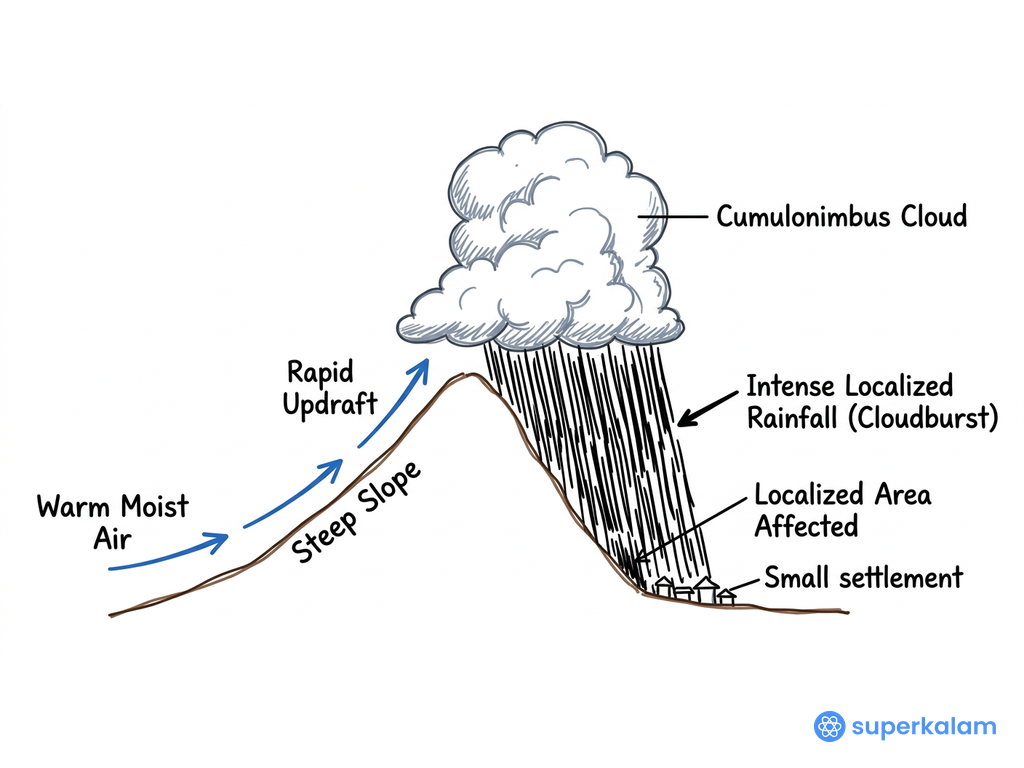
Cloudburst Mechanism Reference
-
Orographic Effect: Moist monsoon winds, when forced to ascend steep mountain slopes (Himalayas, Western Ghats), cool rapidly, leading to sudden condensation and torrential rainfall.
-
Convective Instability: Strong solar heating of the ground creates rising air currents which interact with moisture-laden winds, triggering rapid vertical cloud growth (cumulonimbus clouds).
-
Temperature Gradient: Presence of Western Disturbances or mid-tropospheric troughs enhances instability, increasing intensity of precipitation.
-
Localized Nature: Since moisture gets trapped in a small air column due to surrounding topography, rainfall becomes extremely concentrated in a short duration.
-
Cloud Microphysics: Collision-coalescence process in warm clouds and ice-crystal mechanism in cold clouds accelerate precipitation release.
Occurrence in Indian Subcontinent
-
Himalayan Region: Uttarakhand, Himachal Pradesh, J&K, Ladakh – due to orographic lifting and interaction of monsoon with western disturbances.
-
North-Eastern India: Heavy convective rainfall events due to moisture from Bay of Bengal.
-
Western Ghats: Cloudbursts during southwest monsoon because of orographic lifting of Arabian Sea moisture.
Recent Examples
-
Amarnath Cloudburst (July 2022, J&K):
-
Around 16 people died and many injured when a sudden cloudburst near the Amarnath cave shrine triggered flash floods.
-
Caused by localized convection enhanced by western disturbance interaction.
-
-
Kinnaur Cloudburst (August 2021, Himachal Pradesh):
-
Cloudburst led to landslides and flash floods killing 9 tourists and damaging infrastructure.
-
Highlighted vulnerability of fragile Himalayan ecology to extreme weather.
-
Cloudbursts in India are becoming more frequent and intense due to climate change and increased atmospheric moisture (Clausius-Clapeyron relation). Addressing them requires Improved Doppler radar-based forecasting, Land-use planning in fragile ecosystems, and Strengthening disaster preparedness and early warning systems.
Answer Length
Model answers may exceed the word limit for better clarity and depth. Use them as a guide, but always frame your final answer within the exam’s prescribed limit.
Evaluate this PYQ now
Write your answer & evaluate in just 60 seconds




500+ students evaluated
Model Answers by Subject


Crack UPSC with your
Personal AI Mentor
An AI-powered ecosystem to learn, practice, and evaluate with discipline



