Critically examine the role of WHO in providing global health security during the COVID-19 Pandemic.
Critically examine the role of WHO in providing global health security during the COVID-19 Pandemic.
WHO faced unprecedented challenges during COVID-19, serving as the primary global health coordinator while navigating complex geopolitical tensions and resource constraints.
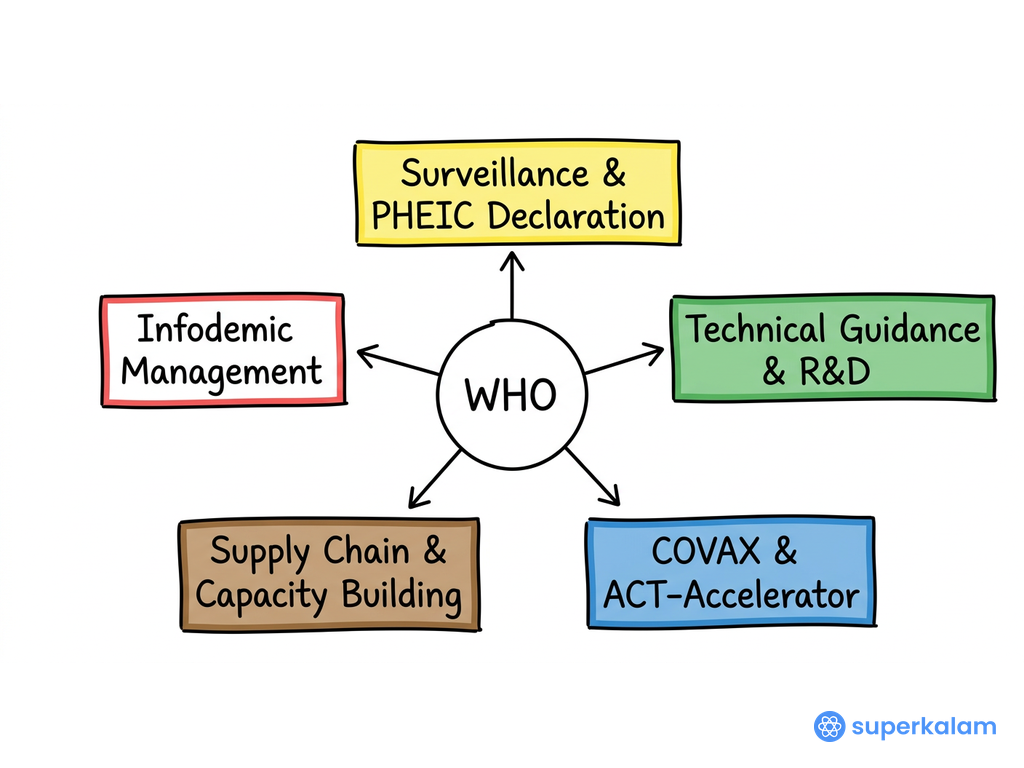
WHO hub and spoke diagram illustration
WHO's Leadership and Coordination Role
- Emergency Declaration: Declared Public Health Emergency of International Concern on January 30, 2020, providing early global alert system
- Technical Guidance: Issued over 200 technical guidance documents on treatment protocols, testing strategies, and prevention measures
- Global Surveillance: Established comprehensive tracking systems for virus mutations and variants through GISAID platform
- Research Coordination: Facilitated international collaboration through R&D Blueprint and Solidarity Trial for treatment evaluation
- Information Hub: Served as central repository for pandemic data, countering misinformation through regular briefings
Resource Mobilization and Distribution
- COVAX Initiative: Co-led global vaccine equity program, delivering 1.9 billion doses to 146 countries by 2023
- Funding Mechanisms: Mobilized $2.4 billion through COVID-19 Solidarity Response Fund for emergency response
- Supply Chain Support: Coordinated distribution of 500 million diagnostic tests and 240 million PPE items globally
- Technical Assistance: Deployed over 2,000 experts to support 150+ countries in pandemic response
- Health System Strengthening: Provided emergency support to maintain essential health services during lockdowns
(SK Flowchart: WHO's pandemic response coordination showing emergency declaration → resource mobilization → global coordination → technical support)
Criticisms and Limitations
- Delayed Response: Faced criticism for delayed pandemic declaration despite early warning signs from multiple countries
- China Relations: Scrutinized for initial reliance on Chinese data and delayed independent investigation approval
- Enforcement Powers: Limited authority to compel member states' compliance with health recommendations
- Funding Constraints: Chronic underfunding affected rapid response capabilities, with 80% budget dependent on voluntary contributions
- Vaccine Inequity: Despite COVAX efforts, significant disparities persisted between developed and developing nations
WHO's pandemic response highlighted both the critical importance of global health governance and urgent need for reforms. The proposed Pandemic Treaty and strengthened International Health Regulations (2005) represent essential steps toward enhanced global health security architecture.
Answer Length
Model answers may exceed the word limit for better clarity and depth. Use them as a guide, but always frame your final answer within the exam’s prescribed limit.
Evaluate this PYQ now
Write your answer & evaluate in just 60 seconds




500+ students evaluated
Model Answers from
- 2020International Relations15 MarksView Answer
What is the significance of Indo-US deals over Indo-Russian defense deals? Discuss with reference to stability in the Indo-Pacific region.
- 2020International Relations15 MarksView Answer
Quadrilateral Security Dialogue is transforming itself into a trade block from the military alliance, in present times. Discuss
- 2020International Relations10 MarksView Answer
The Indian diaspora has a decisive role to play in the politics and economy of America and European Countries”. Comment with examples.
Model Answers by Subject


Crack UPSC with your
Personal AI Mentor
An AI-powered ecosystem to learn, practice, and evaluate with discipline



