For effective border area management, discuss the steps required to be taken to deny local support to militants and also suggest ways to manage favourable perception among locals.
For effective border area management, discuss the steps required to be taken to deny local support to militants and also suggest ways to manage favourable perception among locals.
Effective border area management requires a comprehensive strategy that simultaneously denies local support to militants while building trust and favorable perception among border communities through development and engagement initiatives.
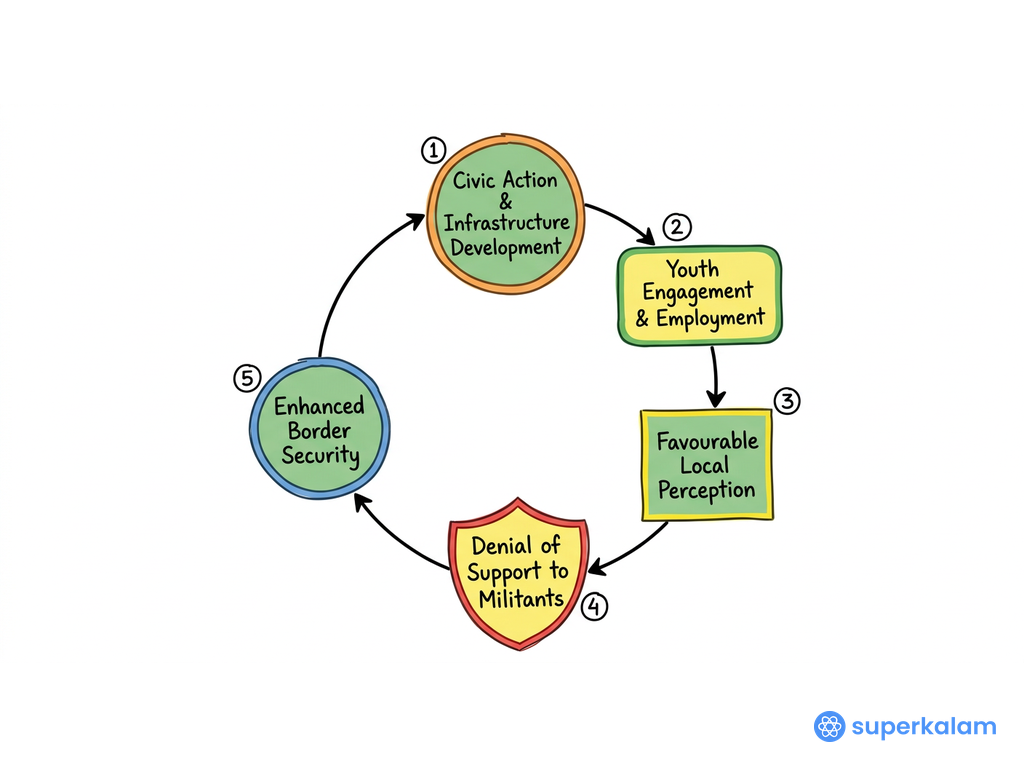
Virtuous Cycle of Border Area Management
Steps to Deny Local Support to Militants
Intelligence and Surveillance Framework
- Establishment of multi-layered intelligence networks combining HUMINT, TECHINT, and community informants
- Deployment of Comprehensive Integrated Border Management System (CIBMS) with sensors, cameras, and drones
- Creation of Village Defense Committees involving local youth and ex-servicemen
- Implementation of Border Grid system for real-time monitoring and quick response
- Coordination between BSF, Army, and local police through joint command centers
Security Operations and Legal Framework
- Area domination exercises and regular patrolling to establish security force presence
- Implementation of Disturbed Area provisions under AFSPA where necessary
- Search and cordon operations based on intelligence inputs
- Strict enforcement of border crossing regulations through biometric systems
- Asset freezing and financial monitoring to cut militant funding sources
Managing Favorable Perception Among Locals
Socio-Economic Development Initiatives
- Border Area Development Programme (BADP) focusing on infrastructure, education, and healthcare
- Vibrant Villages Programme covering 2,967 villages along China border with ₹4,800 crore allocation
- Establishment of Border Haats for cross-border trade (currently 5 operational along Bangladesh border)
- Skill development programs targeting youth unemployment and preventing radicalization
- Model villages development with modern amenities and connectivity
Community Engagement and Trust Building
- Operation Sadbhavana conducting medical camps, educational programs, and infrastructure development
- Regular civil-military liaison meetings for grievance redressal
- Cultural festivals and sports events organized by security forces
- Recruitment of local youth in security forces as Special Police Officers (SPOs)
- Civic action programs during natural disasters and emergencies
Successful border management requires balancing security imperatives with developmental aspirations. The Integrated Check Posts (ICPs) model and community-centric approach have shown positive results in states like Punjab and Rajasthan, demonstrating that sustainable border security is achieved through winning hearts and minds.
Answer Length
Model answers may exceed the word limit for better clarity and depth. Use them as a guide, but always frame your final answer within the exam’s prescribed limit.
Evaluate this PYQ now
Write your answer & evaluate in just 60 seconds




500+ students evaluated
Model Answers from
- 2020Internal Security15 MarksView Answer
Analyse internal security threats and transborder crimes along Myanmar, Bangladesh and Pakistan borders including Line of Control (LoC). Also discuss the role played by various security forces in this regard.
- 2020Internal Security15 MarksView Answer
What are the determinants of left-wing extremism in the Eastern part of India? What strategy should the Government of India, civil administration and security forces adopt to counter the threat in the affected areas?
- 2020Internal Security10 MarksView Answer
Discuss different types of cybercrimes and measures required to be taken to fight the menace.
Model Answers by Subject


Crack UPSC with your
Personal AI Mentor
An AI-powered ecosystem to learn, practice, and evaluate with discipline



