Whether the Supreme Court Judgement (July 2018) can settle the political tussle between the Lt. Governor and elected government of Delhi? Examine.
Whether the Supreme Court Judgement (July 2018) can settle the political tussle between the Lt. Governor and elected government of Delhi? Examine.
The July 2018 Supreme Court judgment in Government of NCT of Delhi vs Union of India attempted to resolve the constitutional deadlock but has shown limited success in completely settling the political tussle between Delhi's Lieutenant Governor and elected government.
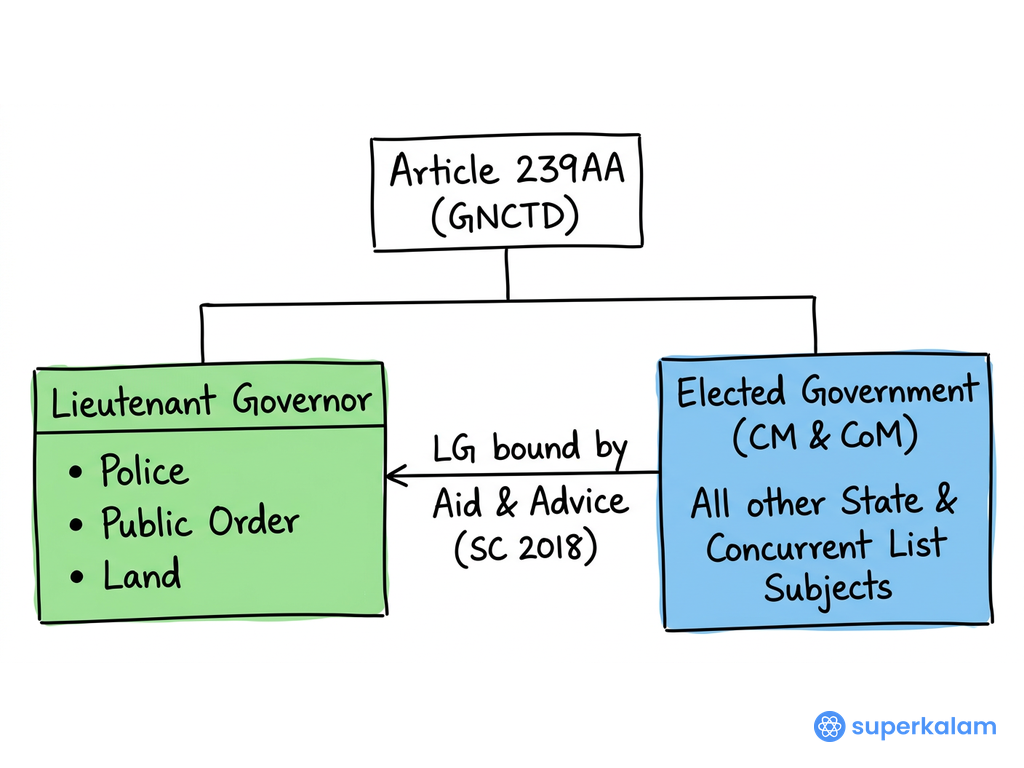
Division of Powers under Article 239AA
Supreme Court Judgment Provisions
- Aid and Advice Principle: LG must act on Council of Ministers' aid and advice except in matters of land, police, and public order
- Cooperative Federalism: Emphasized harmonious working relationship between constitutional functionaries under Article 239AA
- Anti-Obstructionist Mandate: LG cannot act as an obstructionist; decisions must be made expeditiously
- Difference Resolution: Established mechanism for resolving disagreements through Union Government consultation
- Democratic Governance: Reinforced that elected government represents people's will in Delhi's unique federal structure
Limitations in Resolving Political Tussle
| Aspect | Pre-2018 | Post-2018 |
|---|---|---|
| Administrative Control | Disputed | Still contested despite judgment |
| Services Control | LG dominated | Clarified only in May 2023 SC verdict |
| Policy Implementation | Frequent conflicts | Ongoing disagreements persist |
| Legislative Powers | Unclear boundaries | GNCTD Amendment Act 2021 created fresh disputes |
Continuing Challenges
- GNCTD Amendment Act 2021: Expanded LG's powers, undermining 2018 judgment's spirit
- Services Matter: Required separate Supreme Court intervention in 2023 for complete clarity
- Interpretation Conflicts: Both sides continue to interpret constitutional provisions differently
- Administrative Paralysis: File movement and policy decisions still face regular delays
- Political Confrontation: Electoral politics continue to influence administrative decisions
Recent Developments and Assessment
- May 2023 Services Verdict: Supreme Court finally settled administrative services control with elected government
- Ongoing Legal Battles: Multiple cases pending regarding various administrative matters
- Constitutional Morality: Both functionaries struggle to implement cooperative federalism principles
- Public Welfare Impact: Administrative conflicts continue affecting governance delivery
The 2018 judgment provided important constitutional clarity but cannot eliminate the inherent structural contradictions in Delhi's governance model. Complete resolution requires constitutional amendments, clearer institutional frameworks, and most importantly, political maturity from both constitutional functionaries to prioritize public interest over political positioning.
Answer Length
Model answers may exceed the word limit for better clarity and depth. Use them as a guide, but always frame your final answer within the exam’s prescribed limit.
Evaluate this PYQ now
Write your answer & evaluate in just 60 seconds




500+ students evaluated
Model Answers from
- 2018Indian Polity15 MarksView Answer
Multiplicity of various commissions for the vulnerable sections of the society leads to problems of overlapping jurisdiction and duplication of functions. Is it better to merge all commissions into an umbrella Human Rights Commission? Argue your case.
- 2018Indian Polity15 MarksView Answer
Assess the importance of the Panchayat system in India as a part of local government. Apart from government grants, what sources can the Panchayats look out for financing developmental projects?
- 2018Indian Polity15 MarksView Answer
How is the Finance Commission of India constituted? What do you know about the terms of reference of the recently constituted Finance Commission? Discuss.
- 2018Indian Polity15 MarksView Answer
India and the USA are two large democracies. Examine the basic tenets on which the two political systems are based.
- 2018Indian Polity15 MarksView Answer
How far do you agree with the view that tribunals curtail the jurisdiction of ordinary courts? In view of the above, discuss the constitutional validity and competency of the tribunals in India.
- 2018Indian Polity10 MarksView Answer
“The Comptroller and Auditor General (CAG) has a very vital role to play.” Explain how this is reflected in the method and terms of his appointment as well as the range of powers he can exercise.
Model Answers by Subject


Crack UPSC with your
Personal AI Mentor
An AI-powered ecosystem to learn, practice, and evaluate with discipline