Assess the importance of the Panchayat system in India as a part of local government. Apart from government grants, what sources can the Panchayats look out for financing developmental projects?
Assess the importance of the Panchayat system in India as a part of local government. Apart from government grants, what sources can the Panchayats look out for financing developmental projects?
India's Panchayati Raj system, institutionalized through the 73rd Constitutional Amendment Act, 1992, represents the cornerstone of grassroots democracy, embodying Gandhi's vision of village self-rule.
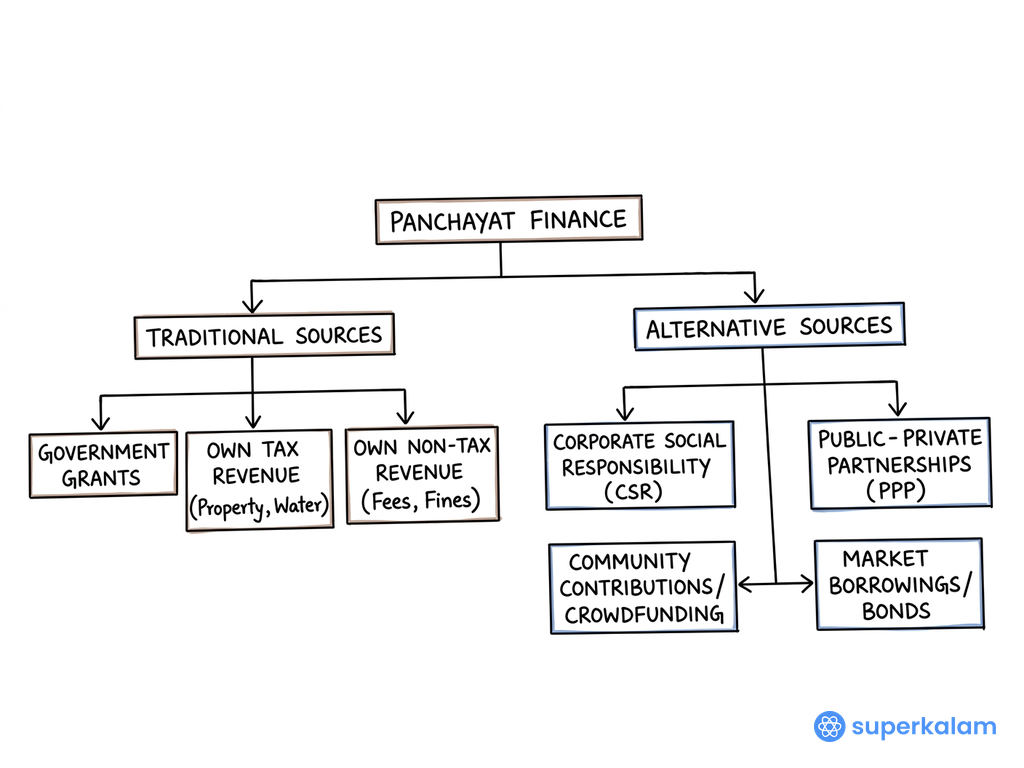
Panchayat Finance Sources Tree Diagram
Importance of Panchayat System in Local Governance
Democratic Participation and Representation
- Ensures direct citizen participation through regular elections and mandatory Gram Sabha meetings
- Provides 33% reservation for women (states like Odisha increased it to 50% in 2023)
- Empowers marginalized communities through reserved seats for SC/ST populations
- Facilitates social audit of government schemes, ensuring transparency
- Creates local leadership, especially among rural women and marginalized groups
Administrative Efficiency and Service Delivery
- Implements flagship schemes like MGNREGA, Swachh Bharat Mission, and PM-KISAN
- Ensures better monitoring of development programs through local oversight
- Facilitates bottom-up planning via Village Development Plans and District Planning Committees
- Provides essential services like sanitation, water supply, and primary healthcare
- Reduces bureaucratic delays through decentralized decision-making
Development and Welfare Functions
- Manages rural infrastructure development including roads, schools, and health centers
- Implements poverty alleviation and livelihood programs
- Promotes local economic development through skill training and micro-enterprises
- Ensures food security through Public Distribution System management
- Coordinates disaster management and emergency response at village level
Alternative Financing Sources for Panchayats
Local Revenue Generation
- Property tax collection (e.g., Tirupati Rural achieved ₹29.70 crore in 2023-24)
- User charges for water supply, waste management, and market facilities
- Professional tax from local businesses and trade licenses
- Revenue from community assets like ponds, markets, and common lands
- Toll collection from local infrastructure like community halls
Public-Private Partnerships and External Support
- Corporate Social Responsibility (CSR) funds (e.g., Rajasthan Panchayats securing ₹45 crore for rural infrastructure in 2024)
- Partnerships with private companies for renewable energy projects
- Crowdfunding platforms for specific development initiatives
- International donor agencies and NGO collaborations
- Bank linkages for infrastructure financing and microfinance programs
The Panchayati Raj system, strengthened by the 15th Finance Commission's ₹2.36 lakh crore allocation, continues evolving as India's democratic foundation, ensuring inclusive development through participatory governance and innovative financing mechanisms.
Answer Length
Model answers may exceed the word limit for better clarity and depth. Use them as a guide, but always frame your final answer within the exam’s prescribed limit.
Evaluate this PYQ now
Write your answer & evaluate in just 60 seconds




500+ students evaluated
Model Answers from
- 2018Indian Polity15 MarksView Answer
Multiplicity of various commissions for the vulnerable sections of the society leads to problems of overlapping jurisdiction and duplication of functions. Is it better to merge all commissions into an umbrella Human Rights Commission? Argue your case.
- 2018Indian Polity15 MarksView Answer
How is the Finance Commission of India constituted? What do you know about the terms of reference of the recently constituted Finance Commission? Discuss.
- 2018Indian Polity15 MarksView Answer
India and the USA are two large democracies. Examine the basic tenets on which the two political systems are based.
- 2018Indian Polity15 MarksView Answer
How far do you agree with the view that tribunals curtail the jurisdiction of ordinary courts? In view of the above, discuss the constitutional validity and competency of the tribunals in India.
- 2018Indian Polity15 MarksView Answer
Whether the Supreme Court Judgement (July 2018) can settle the political tussle between the Lt. Governor and elected government of Delhi? Examine.
- 2018Indian Polity10 MarksView Answer
“The Comptroller and Auditor General (CAG) has a very vital role to play.” Explain how this is reflected in the method and terms of his appointment as well as the range of powers he can exercise.
Model Answers by Subject


Crack UPSC with your
Personal AI Mentor
An AI-powered ecosystem to learn, practice, and evaluate with discipline



